

Reading time: ~4 min read
Stephen Jay Gould has described this as “everyone’s favourite invertebrate fossil,”.101because the trilobites were uniquely attractive creatures, the best preserved member of the marine arthropods, with a sculpted appearance and dazzling complexity. With their eyes consisting of many lenses and a perfect structure allowing them to see and hunt, and their ability to swim and feed in the silent seas of 530 million years ago, they were prolific and are commonly found in fossil beds. They also present one of the greatest disappointments facing Darwin and his supporters in later years, and one of the greatest problems they need to overcome.
As we mentioned before, with few exceptions, soft tissues are seldom preserved because they represent food for predators. Also bacteria are microscopic predators, ready to decay tissues as soon as organisms die, wherever they may be. They feed on such organic substances throughout their lives.102
That is why we cannot obtain complete knowledge of how an extinct life form lived, which organs it used for what purpose, or the structure of those internal organs. Only the fossil remains they have left behind can give us any information to learn about them and understand the general systems they possessed.
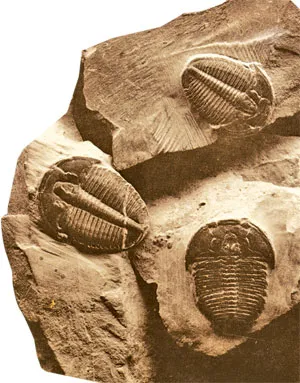
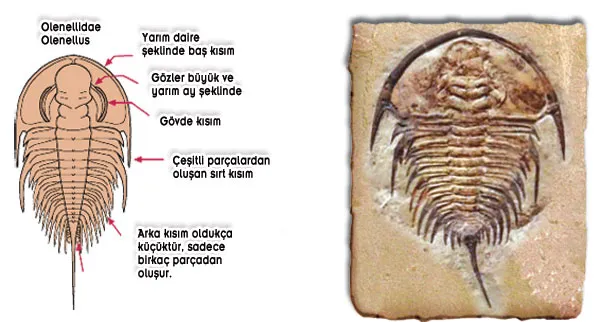
Trilobites represent a subphylum of the phylum Arthropoda. Their hindparts were divided longitudinally into three lobes (which is where the name trilobite comes from). A shell made of keratin covered their head and body. Like present-day arthropods, these creatures grew by molting, or shedding their shells. In sheer numbers, trilobites represent more than half of all Cambrian fossils, and their shells have been exceptionally well preserved. With their detailed body structure and their perfectly developed form, sensitive nervous system and compound eyes, they emerged together with many other similarly complex phyla at the beginning of the Cambrian explosion.
The longest section of a trilobite was its thorax. This region consisted of various segmented sections, all joined together. Each was connected to the adjoining ones with a hinge, forming a linked system like railway carriages. They were interconnected by a coupling, which allowed flexibility. Thanks to their segmented body, these creatures could easily move over obstacles, flex and turn.103
Looked at in close up, the trilobite’s tail also consisted of a few segments, but these were not free but were fused together. In some trilobites, the tail section is longer than the head, consisting of a large number of segments.104
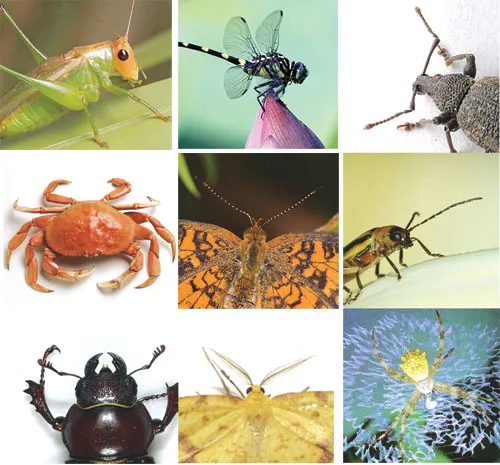
Present-day species consisting of various segments are very similar to the trilobite. Beetles, shelled animals, centipedes and spiders all consist of a number of consecutive segments and also share another feature with trilobites: jointed legs. At first sight, it may be difficult to see much resemblance between the legs of a fly and those of a lobster, but both are actually jointed in the same way. Every joint can bend and turn around its own axis.
Animals with jointed legs are known as arthropods, for which reason trilobites are also classed as a form of arthropod.
From each section comprising the trilobite emerged a pair of appendages. Generally, that section containing the internal organs lay in the middle of the organism. Outside the legs were three other branches. The two outer ones were the branchial appendages—gills that the trilobite used to breathe and absorbe oxygen in the sea water, just as all arthropods must do.105
Examined under magnification, the antennae projecting from the trilobite’s head were noticed. Again, they consisted of segments, and were the advance guard of the arthropod body. These antennae performed the tasks carried out by the fingers and nose, and permitted the creature to acquire detailed knowledge of its surroundings. In the trilobite, these structures were incomparably more complex than in any pre-Cambrian life form.
One organ in particular had a structure that optic physicians dream of: The trilobite eye, which exhibits a flawless creation.