Reading time: ~4 min read
The creation in the trilobite lens reveals an extraordinary sensitivity in terms of the calcite and chitin refractive indexes. (Refractive index is a measure for how much the speed of light is reduced when passing from one medium into another. For instance, the refractive index of air is 1, of glass 1.5, of water 1.33, and of diamond 2.42.) The refractive index of calcite is 1.6, and that of the chitin beneath it is 1.53.
Huygens and Descartes’ lens designs provide an ideal eye structure, and the trilobite’s eye is highly compatible with those designs. However, Huygens and Descartes’ designs were based on the existence of just one unit. But one unit is not enough for the trilobite eye, because the refractive index of the water in which trilobites lived is different from that of the air.
This is where the usefulness of the bottom lens unit comes in. The deviation that occurs in a water environment is overcome by this second unit—which only goes to demonstrate the complexity in the structure in question.
Levi-Setti stated the following about this property of the trilobite lens:
There is in fact only one choice of indices for which the lens brings an incident parallel beam to a focus. This involves the upper lens being made of calcite (n=1.66) and the intralensar bowl being made of chitin (n=1.53)
In addition, the mathematical solution in the trilobite lens is based upon several laws and principles. Levi-Setti says:
Trilobites had solved a very elegant physical problem and apparently knew about Fermat’s principle, Abbé’s sine law, Snell’s laws of refraction and the optics of birefringent crystals.118
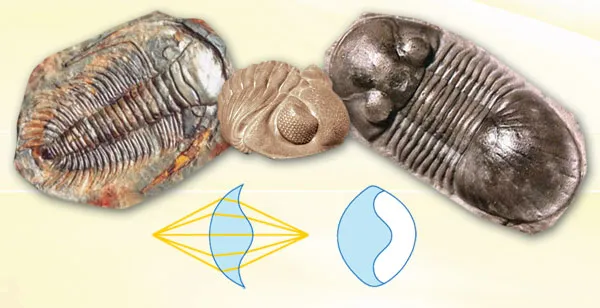
It would, of course, be irrational to claim that a prehistoric animal could possess any knowledge of the laws of optics as set out by Levi-Setti. It is impossible for a trilobite to have known anything on this subject nor, moreover, to produce a flawless structure in its own body in the light of that knowledge. It is Allah, the Creator of all living things, Who gave the trilobite these properties.
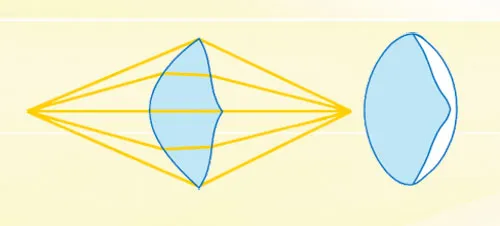
As you have seen, the trilobite’s lens structure, the material of which its lens units were made and the connecting interfaces were just as they needed to be. Moreover, these features were made possible by their being in complete agreement with the laws of physics and optics, and being applied in a perfect fashion. In his article Conflicts between Darwin and Paleontology, the paleontologist David M. Raup writes:
But if we look at the individual elements of the trilobite eye, we find that the lens systems were very different from what we now have. Riccardo Levi-Setti has recently done some spectacular work on the optics of these lens systems . . . The shape is nearly identical to designs published independently by Descartes and Huygens in the seventeenth century. The Descartes and Huygens designs had the purpose of avoiding spherical aberration and were what is known as splenetic lenses. The only significant difference between them and the trilobite lens is that the Descartes and Huygens lenses were not doublets—that is, they did not have the lower lens. But, as Levi-Setti has shown, for these designs to work underwater where the trilobite lived, the lower lens was necessary.119