

Reading time: ~4 min read
For as long as they have been investigated, Cambrian rocks have continued to reveal the characteristics of brand new organisms, revealing important specimens that enriched the variety of life hitherto known to us and that totally eliminated the groundless idea of any “common ancestor.” For evolutionists seeking an answer to the question of how Cambrian life forms first emerged, the existence of these organisms with previously unknown structures and living habits constituted an enormous difficulty.
The evolutionist John Maynard Smith has described this variety:
But in the Burgess Shale, information about soft parts is beautifully preserved. These fossils have been known for over fifty years, but recently they have been re-examined. It is now clear that there existed in the Cambrian a very wide array of forms, some of which may differ in their basic body plan from anything alive today. It also seems likely that, with a few minor exceptions, all the body plans that exist today were already present in the Cambrian.87
The evolutionist Niles Eldredge, an American Museum of Natural History paleontologist, described this perfect variety and was forced to confess the extraordinary nature of the phenomenon:
[After the Ediacaran] Then there was something of an explosion. Beginning about six hundred million years ago, and continuing for about ten to fifteen million years, the earliest known representatives of the major kinds of animals still populating today’s seas made a rather abrupt appearance. This rather protracted “event” shows up graphically in the rock record: all over the world, at roughly the same time, thick sequences of rocks, barren of any easily detected fossils, are overlain by sediments containing a gorgeous array of shelly invertebrates: trilobites..., brachiopods, mollusks. All of the typical forma of hard-shelled animals we see in the modern oceans appeared ... in the seas of six hundred million years ago.
After stating that rather than representing evidence for evolution, this is actually a finding in favor of creation, Eldredge went on:
Indeed, the sudden appearance of a varied, well-preserved array of fossils, which geologists have used to mark the beginnings of the Cambrian Period does pose a fascinating intellectual challenge.88
Bob Holmes described the fact of the Cambrian in the 18 October, 1997, edition of New Scientist magazine:
Glass skyscrapers, Gothic cathedrals, yurts, Georgian terraces, Shinto shrines, wattle and daub, Victorian railway stations, Bauhaus, igloos, mock-Tudor. Imagine that all the architectural styles that human ingenuity could ever devise appeared during one 35-year period, sometime in the middle of the 15th century. Imagine how today’s historians would be trampling over each other in their eagerness to learn what made that window of profound creativity possible. That’s roughly how palaeontologists feel about the Cambrian explosion.
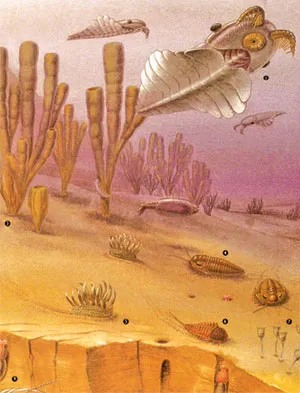
“Anything the planet has seen before or since” is certainly a very accurate description for the Cambrian explosion because the most complex of the various ecosystems on Earth emerged suddenly, as a work of art revealing countless examples of intricate complexity. The Cambrian is a time when sophisticated creatures appeared suddenly at a time when there had been no life forms at all, apart from a few bacteria and other single-celled organisms. And the forms that emerged are indeed far more extraordinary than historic buildings or giant skyscrapers.
Of course, this amazing variety is not the product of trial-and-error genetic coincidences, as Darwinists maintain. Each one is an example of the flawless creation of Allah, our Creator:
Allah, there is no deity but Him, the Living, the Self-Sustaining. He is not subject to drowsiness or sleep. Everything in the heavens and the Earth belongs to Him. Who can intercede with Him except by His permission? He knows what is before them and what is behind them, but they cannot grasp any of His knowledge save what He wills. His Footstool encompasses the heavens and the Earth and their preservation does not tire Him. He is the Most High, the Magnificent. (Surat al-Baqara, 255)