

Reading time: ~8 min read
The way cells produce a variety of different proteins and develop different organs in a programmed manner, is referred to in medical language as differentiation or morphogenesis. Cells become differentiated as they divide, assuming different tasks and going to those regions in the body where they are needed. It is not a mere collection of tissue that grows from identical cells. Some cells go where they must in order to become eye cells, some enter the chest cavity and make up the heart, and others cover the entire body in the form of skin. All cells multiply to an extent required by the particular tissue they are to comprise, and begin forming organs by combining with one another to construct the requisite structures.
During all these events, the cells function just like construction teams working closely together in a process calling for the greatest care and attention. Each "member" cell has a complete knowledge of the blueprint, letting them all work with communication and intense cooperation. How does such advanced order come about? How do cells know where to go, which organ they will develop and what to do at their destinations? At the same time, how do they manage to work in such harmony with other cells? The Israeli biophysicist Dr. Lee Spetner asks about the miraculous creation involved here:
How does the development program work, and how is it so perfect? As we have seen, development starts with one cell, which divides into two. The two divide into four, and so on. At some point, the cells differentiate, which means they change their character. Eventually, some of the cells become one kind of tissue or organ, while other cells become other kinds. And it happens the same way nearly every time. How does it happen? 110
The answer to these questions is evident: Living things have been created in a flawless manner, and the artistry and knowledge in that creation is that of Almighty Allah, the Lord of All. In one verse, we are told that:
He created the heavens and the Earth with truth and formed you, giving you the best of forms. And He is your final destination. (Surat at-Taghabun, 3)
On the other hand, different varieties of proteins are also produced for various cells. As an embryo develops inside the mother's body, the DNA in the cells that will constitute its eyes produces only proteins concerned with vision. In the same way, the DNA in the cells forming the embryo's brain produce only proteins concerned with the neurological functions.
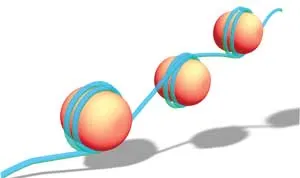
The important point is that information to make up all of a human being's organs are contained in the DNA of cells in every part of the body, whether they be liver or kidney cells, or any other kind of cell. However, only the proteins to be produced for the organ in question actually emerge from all that genetic information. In other words, every cell contains information about the proteins of every organ in the human body, but does not manufacture them all. Only proteins concerning the organ to be formed are produced. In order for this to happen, the surface of the DNA is coated with a special protein known as histone that prevents the production of proteins that have nothing to do with that particular organ. One of the greatest secrets that baffle scientists is how the histones in the cells know which genes to suppress and which to leave activated, because proteins are simply molecules made up of inanimate atoms. Obviously, atoms devoid of consciousness and intelligence cannot give rise to such a magnificent marvel of creation.
The coordination in the cells during differentiation and construction is ensured by the DNA molecule. Yet DNA is not a chemist equipped with the latest technology, nor a super-computer capable of performing trillions of processes a second. DNA is a molecule consisting of atoms like carbon, phosphorus, nitrogen, hydrogen and oxygen.
The trillions of cells in the human body emerge from one another by way of division, yet different genes in every cell go into action at different times, and so cell differentiation becomes possible. Every cell resulting from the division and multiplication of the original cell contains all the genetic information with which to produce heart muscle, skin, blood cells and every other bodily tissue. Yet although every cell's DNA possesses a full description of the body, only certain genes are active at different phases of development and in different organs. For example, the codes for the kidneys' formation and function are present inside every cell; but only relevant genes become active in this organ, at specific times, during development. Similarly, specific enzymes such as glucose 6-phosphate are basically present in the liver, yet although all the cells of other organs possess the description of that same protein, they never actually manufacture it. A cell in the eye, for instance, does not produce this enzyme; it manufactures only those that are necessary for vision. Nerve cells specialize in carrying messages and instructions between the brain and the organs. Liver cells specialize in neutralizing toxins, while fat cells specialize in storing food for times of scarcity. They never commit any errors such as producing digestive enzymes concerned with the stomach. So who establishes this flawless division of labor? Who gives the order for cells to divide and subsequently specialize in such different tasks? Furthermore, how can all the body's cells possess an awareness, an obedience, and work in such a perfectly disciplined and organized way? Obviously, none of these actions came about by chance or are purely haphazard systems. They all take place by the leave of Almighty Allah, Who "directs the whole affair from heaven to Earth"(Surat as-Sajda, 5)
This perfection is not restricted to cells being in the right place at the right times and activating the proper genes. Cells must also be present at the right stage of life and in the correct quantities. In just about all cells, some maintenance genes work all the time. Other genes function in some cells for just a few hours, after which they are placed on standby, ready to function again in the future. Milk production, for example, is accelerated by genes during suckling. The existing genetic information is acted upon at the appropriate time and place, at the appropriate level. Such consciously planned, deliberately calculated and rational use of the billions of pieces of information contained within DNA can definitely not be explained by way of any evolutionist claims of chance. To stubbornly regard chance as the cause of such extraordinarily planned and organized events, taking place in such a microscopically small space, is a completely contrary to logic. Even evolutionists admit that they are far from being able to account for this differentiation and immaculate division of labor in cells. The Turkish evolutionist and microbiologist Prof. Ali Demirsoy makes this admission:
In essence, the way that several cell groups with very different structures and functions comes into being from a fertilized egg has still not been satisfactorily explained. 111
A National Geographic Society book, The Incredible Machine, refers to scientists' inability to account for human creation:
Its 100 nonspecialized cells must somehow multiply into trillions of cells that make up the most complex vertebrate on Earth--the human being. The phenomenon of differentiation--how cells assume their different forms--remains one of the most baffling questions of science. How are DNA's orders issued to the cells? Is the story of life written once, in the fertilized egg? Are its orders parceled out to offspring cells as it divides?. . . Now there are new mysteries. Today we know that all cells are derived from generalized cells, and each one contains the genetic code for the whole body. But how does a cell, supplied with the voluminous script for all of life, come to play its exact role in the development of a human? How does a cell that could turn into anything turn into something? How is a rod cell in the retina, for example, designated to obey only orders to manufacture a light-absorbing protein? How does a pancreas cell know to produce insulin?112
Dr. Lee Spetner refers to the emergence of a thinking human being from a single cell:
The perfection of the eyes, the limbs, even the finger nails and the eyelashes. How did this perfect and complex organism develop from a single cell? What kind of program orchestrates this development? Eyes that see, ears that hear, a brain that can think and command the movement of complex organs, have all developed from a single cell? That each of us started as a single cell and developed into a functioning, thinking, human being is mind-boggling.113
Clearly, none of these extraordinary phenomena could be the work of chance or of the cells themselves. That being so, to whom does this intelligence belong, this power that directs all these events in the cell, creates them in line with a specific purpose, and compresses billions of pieces of information into a space too small to be seen with the naked eye? The only answer to that question is that our Almighty Lord has created, with His infinite mercy, human beings with their present orderly forms, and has bestowed their bodies' organization and the order of the surroundings as a blessing. It is revealed in one verse that:
He has given you everything you have asked Him for. If you tried to number Allah's blessings, you could never count them. Man is indeed wrongdoing, ungrateful. (Surah Ibrahim, 34)