

Reading time: ~6 min read
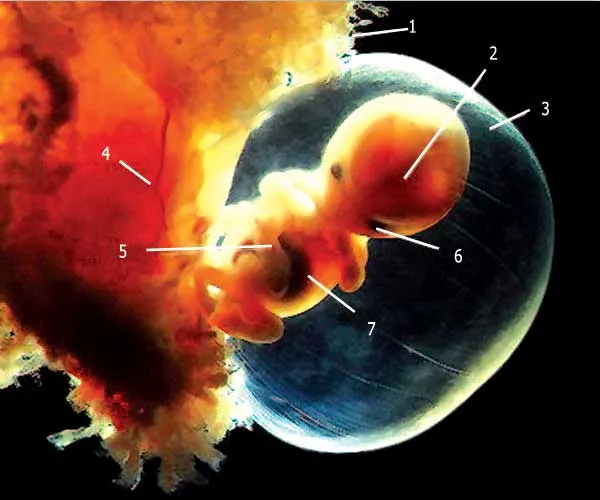
During cell division, every cell possesses all the complex contents described earlier, including mRNA, tRNA, ribosomes, proteins, and enzymes. Some 5,000 of these are produced in one second.105 In the words of Prof. Gerald Schroeder, "The miraculous nature of life is found in its details."106 106By the eighth week, all the embryo's major body parts have been formed, and it turns into a fetus.107
And when the cell needs to divide, the entire tape [DNA] must be split apart, duplicated and repackaged for each daughter cell. No one knows exactly how cells solve this topological nightmare.108
Predetermined solutions exist for all kinds of problems inside the cell, and these have been recorded inside the genetic information contained in the very first cell. Each of these features is evident proof of how human beings are created in a perfect manner. There are even more miracles of creation that could not possibly be covered in this book.
Another of the astonishing features in the cell is that not all the genetic program is constantly active. You might expect all the genetic information to be ready for use. But in that event, every cell would produce only copies of itself, resulting in masses of only one type of cell. The reason why there is such a variety of cells produced, all with different functions, is the genes' property of being switched on and off.
Genes are like sentences written in a chemical language. Each cell opens up only part of the genes in a chromosome and "reads" only that open section. The rest of the genes remain inert.
This turning on and off of genes is known as gene regulation, which occupies a very important place in human development. Different regions of the genes are switched on and off during the course of embryonic growth; thus a brain cell looks different from a liver or muscle cell and performs entirely different functions. As you now know, the type of cell is determined according to the varieties and quantity of proteins it produces. Cells become liver cells, stomach cells, skin or muscle cells because of the proteins they manufacture. And the genes tell the cells which proteins to produce. This production takes place as a result of some genes being switched on and others off. Liver cells, for example, produce different proteins with different properties by switching on different sets of genes than do skin cells.

Since the genes tell the cells which proteins to produce, any cell lacking genes could survive for only a short time, because it needs to be given instructions on what proteins to manufacture. Otherwise, the supply of fresh proteins would shortly come to an end, and the cell would be unable to perform vital functions. At certain times, for example, the genes instruct the cells to manufacture the special proteins that permit blood to clot. Flawed genes, however, cannot manage this, resulting in hemophilia, a disorder of the blood-clotting mechanism.
İThe human body needs to manufacture some proteins throughout its entire life, and others solely at times of need. For that reason, genes regulate every cell so that it produces the correct amount of protein at the exact times required. In the developing embryo, for example, several proteins are necessary in a very short space of time. The proteins produced by any specific cell depend on where in the embryo it lies, are, the developmental age of the embryo, and the instructions it receives from its own genes and from other cells. But scientists cannot say how the cell knows when to ignore which part of the enormous blueprint it possesses, and when. How are the genetic "files" for every feature and organ opened or closed at exactly the right time? Who issues the instructions to suppressor genes and to other genes that halt that suppression? These are questions that scientists have yet to answer.
The scientific literature refers to this ability as regulation. To claim that this process originated in a chance manner is incompatible with scientific logic. Here we are confronted by the same glorious and rational plan, which belongs to the One and Only Allah, the Lord of the Worlds, to Whom the entire blueprint and this extraordinary system belong.
A miniature human being starts to form as a result of cells establishing communications with one another, grouping together and working as a team. It takes three weeks more for the embryo to develop its complete anatomy. On day 24, the embryo's arms still cannot be detected, although by day 26 they are visible as small buds on either side of the body. The upper and lower sections of the arms then develop in just 48 hours. A few days later, the legs begin to appear. The legs elongate over the following months, and eventually the fingers and toes emerge from them.109
All these stages, which we can only sit back and observe, are all parts of the construction plan in DNA. Everything takes place in a highly controlled manner, with not the slightest confusion arising. It is of course irrational to speak of "coincidences" in reference to such flawless order. Moreover, even Darwinist scientists who suggest that living things are shaped as the result of chance factors refer to a surprising order in the series of precautions that have been taken by the cells: intelligent behavior, economical and efficient systems, and co-operation and harmony in the formation of a human embryo. The contradiction here is clear; there can be only chaos, irregularity and discord anywhere chance prevails.