
Reading time: ~6 min read

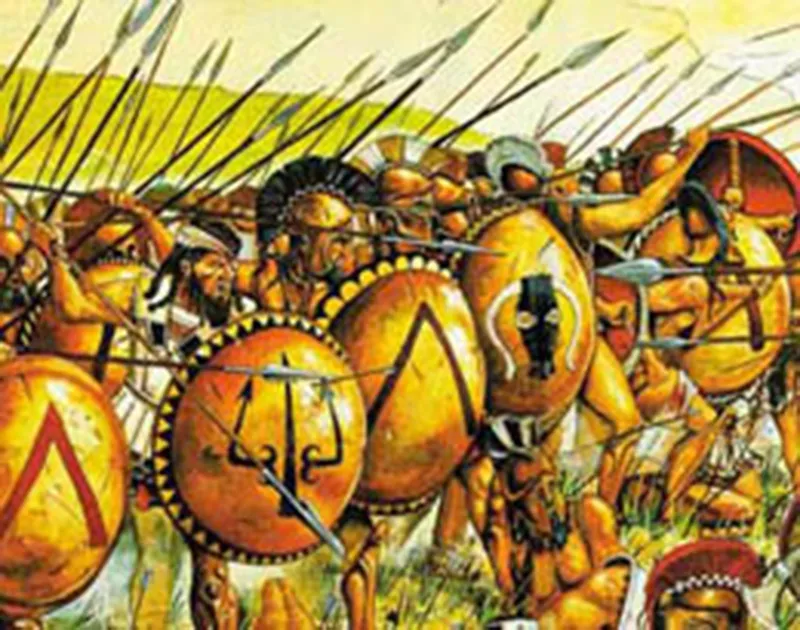
Sparta was a military state, dedicated to war and violence, and alleged to have been founded by Lycurgus in the 8th century BC. The Spartans implemented highly regimented system of education. Under the Spartan system, the state was very much more important than the individual. Peoples' lives were measured according to whether or not they would be of use to the state. Strong, healthy male children were dedicated to the state, while unhealthy babies were abandoned to the mountains to die. (This Spartan practice was taken as an example by the Nazis of Germany, and it was claimed, under the further influence of Darwinism, that the sickly needed to be eliminated to maintain a "healthy and superior race.") In Sparta, parents were responsible for raising their sons until the age of seven. From then, until the age of 12, children were placed in teams of 15, and those who stood out for their abilities were selected to be leaders. Children spent their time strengthening their bodies and preparing for war by practicing sports.
Literacy was not considered important, and there was little interest in music or literature. The only songs children were allowed to sing and learn were those of war and violence. (The education of children from the age of four under the fascism of Mussolini and Hitler was very similar). The Spartan custom was to indoctrinate people in the spirit of war, at the expense of art, literature, and education.
One of the most important thinkers to have offered detailed statements about Sparta was the famous Greek philosopher Plato. Although he lived in Athens, which was governed democratically, he was impressed with the fascist system in Sparta, and in his books portrayed Sparta as a model state. Because of Plato's fascist tendencies, Karl Popper, one of the foremost thinkers of the 20th century, in his famous book, The Open Society and Its Enemies, describes him as the first source of inspiration for oppressive regimes, and an enemy of open society. In support of his contention, Popper refers to how Plato calmly defended the killing of infants in Sparta, and describes him as the first theoretical proponent of "eugenics":
...[I]t is important that the master class should feel as one superior master race. 'The race of the guardians must be kept pure', says Plato (in defence of infanticide), when developing the racialist argument that we breed animals with great care while neglecting our own race, an argument which has been repeated ever since. (Infanticide was not an Athenian institution; Plato, seeing that it was practised at Sparta for eugenic reasons, concluded that it must be ancient and therefore good.) He demands that the same principles be applied to the breeding of the master race as are applied, by an experienced breeder, to dogs, horses or birds. 'If you did not breed them in this way, don't you think that the race of your birds or dogs would quickly degenerate?' Plato argues; and he draws the conclusion that 'the same principles apply to the race of men'. The racial qualities demanded from a guardian or from an auxiliary are, more specifically, those of a sheep-dog. 'Our warrior-athletes .. must be vigilant like watch-dogs', demands Plato, and he asks: 'Surely, there is no difference, so far as their natural fitness for keeping guard is concerned, between a gallant youth and a well-bred dog?'3
These views of Plato, who regarded human beings as a species of animal, and proposed that they should be "evolved" through "forced mating," came to the fore once again with the advent of Darwinism in the 19th century, and were implemented by the Nazis in the 20th. We shall be examining this in the pages that follow.
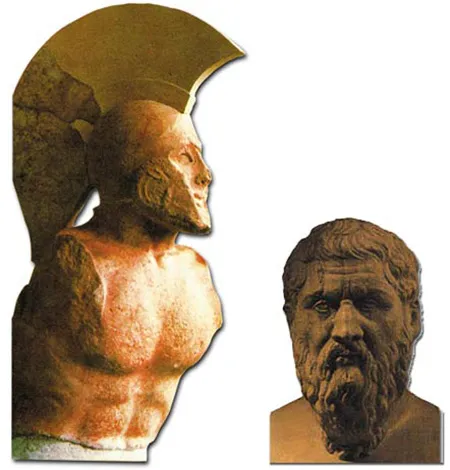
While defending the Spartan model, Plato also advanced another aspect of fascism, the state use of repression to administer society. In Plato's view, this pressure should be so comprehensive that people should be unable to think of anything apart from the orders of the state, and behave in complete adherence to state policy, forsaking the use of their intelligence and free will. The following words of Plato, quoted by Popper as a complete statement of the fascist mentality, describe the structure of fascist order:
The greatest principle of all is that nobody, whether male or female, should be without a leader. Nor should the mind of anybody be habituated to letting him do anything at all on his own initiative; neither out of zeal, nor even playfully. But in war and in the midst of peace—to his leader he shall direct his eye and follow him faithfully. And even in the smallest matter he should stand under leadership. For example, he should get up, or move, or wash, or take his meals .. only if he has been told to do so. In a word, he should teach his soul, by long habit, never to dream of acting independently, and to become utterly incapable of it.4
These ideas and practices, promoted by the Spartans, as they were by Plato, exemplify the fundamental characteristics of fascism—the perception of human beings as mere animals, fanatical racism, the promotion of war and conflict, state-sponsored repression, and "formal indoctrination."
Similar fascistic practices are also discoverable in other pagan societies. The system set up by the pharaohs, the rulers of ancient Egypt, is in certain aspects comparable to Spartan fascism. The Egyptian pharaohs built up state systems founded on ideals of military discipline, and used them to oppress even their own people. Rameses II, the tyrannical Egyptian ruler, who is believed to have lived in the time of the Prophet Moses, ordered that all male Jewish children be killed, a cruelty reminiscent of the infanticide in Sparta, and the psychological forms of oppression he inflicted on his own subjects also recalls the fascistic system described by Plato. As God revealed in the Koran, Pharaoh offered his subjects the following tyrannical ultimatum: "...I only show you what I see myself and I only guide you to the path of rectitude." (Koran, 40:29) And he threatened those magicians who rejected his pagan beliefs and led to the true religion by following Moses, "...Have you believed in him before I authorized you to do so?...I will cut off your alternate hands and feet and then I will crucify every one of you." (Koran, 7:123-124)