
Reading time: ~6 min read

There was another 19th century thinker influenced by the neo-paganism attendant to Darwinism, and who expanded on it, thus helping to establish the foundation for fascism: The German philosopher Friedrich Nietzsche.
Nietzsche was born in a village near Leipzig in 1844, and was fascinated by Greek culture, learning Greek at an early age. In 1868, he began studying philosophy in the Swiss city of Basel. Nietzsche hated divine religions, such as Christianity, Islam and Judaism, but was fascinated by the pagan culture of ancient Greece. He formed a close friendship in Basel with Wagner, the best-known composer of the age. Wagner, who had come to fame with his Die Götterdämmerung (The Twilight of the Gods), was a German racist who was also fascinated by pagan culture and hated divine religions. (Wagner would be regarded as Germany's greatest cultural genius throughout the Hitler period)
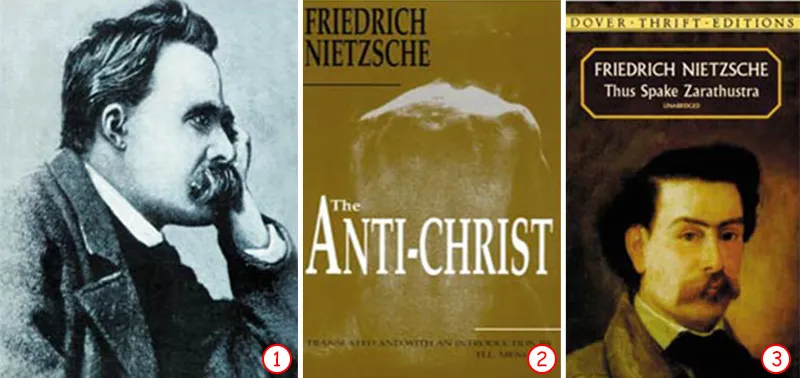
Nietzsche's publisher, Peter Gast, called Nietzsche "one of the fiercest anti-Christians and atheists."12 Another testament to Nietzsche's hatred of religion is the title of his book Anti-Christ. In his book Thus Spake Zarathustra, he tried to set up an ethical system beyond divine religion. According to H. F. Peters, Nietzsche's biographer, his philosophy rested on Roman and Greek paganism, and in his writings he called for "a new Caesar" to transform the world.13
Nietzsche had a particular hatred of the ethical views of Christianity, Islam and Judaism. In his opinion, concepts such as love, compassion and humility, must be abandoned and replaced with a so-called "master morality" which accepted the warlike and ruthless state of nature. In Thus Spake Zarathustra, he wrote, "Of all that is written I love only what a man has written with his blood. Write with blood, and you will experience that blood is spirit."14
Nietzsche was also a racist. He maintained that one part of mankind was composed of übermensch (superman), and that the others had to serve and obey them. Furthermore, he claimed that these so-called "supermen" would found an aristocratic world order, a theory which was put into practice by Hitler's armies at the start of the Second World War in 1939.
These two aspects of Nietzsche's philosophy, his racism and reverence for violence, are allied closely to Darwinism. Nietzsche's thought was in fact strongly influenced by Darwin. Darwin's discrimination between the different races conformed closely to Nietzsche's perception of "superior and inferior peoples." Nietzsche also adapted his hatred of religion with the atheism of Darwin.
In his book Darwin's Dangerous Idea, the Darwinist writer Daniel C. Dennett describes Darwin's influence on Nietzsche in the following way: "Friedrich Nietzsche saw …an even more cosmic message in Darwin:...If Nietzsche is the father of existentialism, then perhaps Darwin deserves the title of grandfather."15 Dennett explains in great detail how Darwin and Nietzsche's ideas run parallel, and although Nietzsche seems to criticize Darwin in some of his writings, he gives many examples where Nietzsche clearly approves of Darwinist thought.
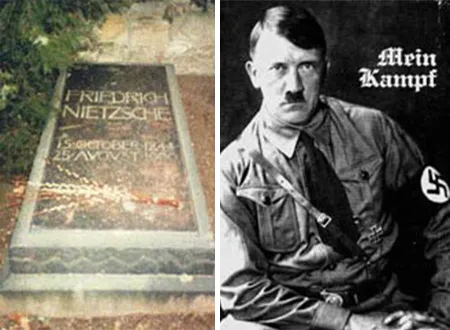
After Nietzsche's death, the most important exponent of his philosophy was his sister, Elisabeth Nietzsche. She stood out as an avowed supporter of Nazi ideology in Hitler's Germany, and announced that her brother's model of the "Superman" had been brought to life by Hitler.16
Nietzsche's influence on Nazi ideology is a reality that has been stressed by a great many historians. W. Cleon Skousen writes that, when "Hitler wrote Mein Kampf, it was as though Nietzsche was speaking from the dead."17 Another historian, George Lichtheim, writes, "It is not too much to say that but for Nietzsche the SS—Hitler's shock troops and the core of the whole movement—would have lacked the inspiration to carry our their programs of mass murder in Eastern Europe."18
As the historian H. F. Peters puts it, many have cursed Nietzsche as "the father of fascism."19 In his book, The Myth of the 20th Century, the Nazi ideologue Alfred Rosenberg openly praised Nietzsche. Hitlerjugend (Hitler Youth), the youth wing of the Nazi movement, took Nietzsche's Thus Spake Zarathustra as a sacred text. Adolf Hitler had a special monument erected in Nietzsche's memory, and incepted the foundations of an educational center and library "where German youth could be taught Nietzsche's doctrine of a master race."20 Finally, the Friedrich Nietzsche Memorial Building was opened by Hitler in August 1938.
The likeness of those who disbelieve is that of someone who yells out to something which cannot hearÑit is nothing but a cry and a call. Deaf-dumb-blind. They do not use their intellect.(Koran, 2:171)
Nietzsche's influence was not limited to Germany, it was also important in Italy, the birthplace of fascism. The poet Gabriele D'Annunzio, who may be regarded as the inspiration behind Mussolini, was greatly influenced by Nietzsche's philosophy.21 Historians note that D'Annunzio's successor, Benito Mussolini acknowledged a debt of gratitude to Nietzsche as well.22
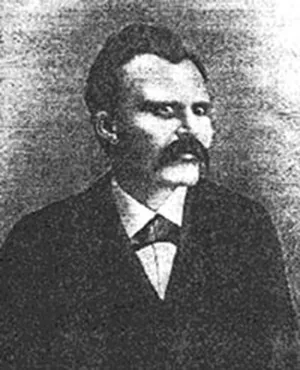
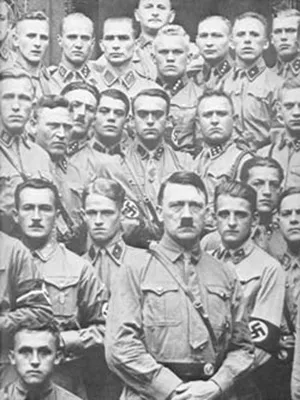
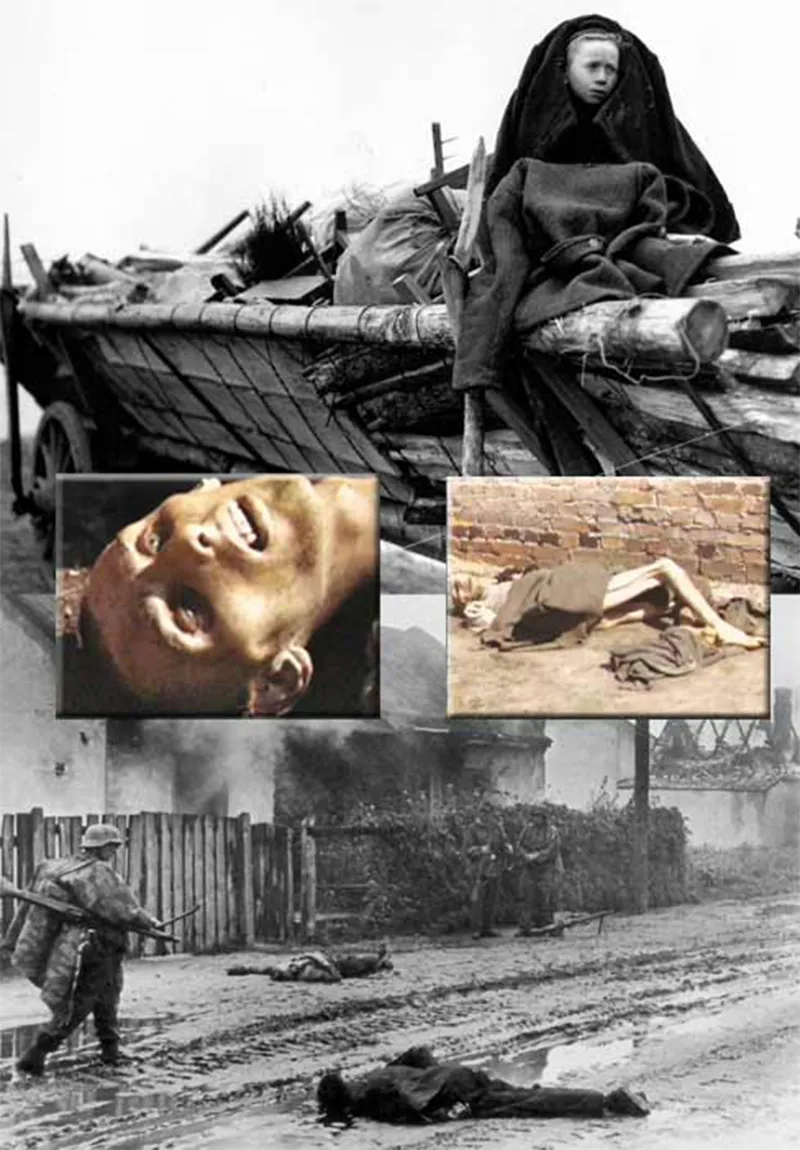
The disasters inflicted upon mankind by fascism, which Nietzsche had inspired, provide historical evidence of just how harmful were the German philosopher's Darwinist ideas. Nietzsche, who opposed the divine morality that God revealed to mankind to show it the true path, and who proposed taking mankind to the modern age by replacing that morality with a brutal and oppressive society, had put forward Darwin's idea that man is a species of animal, and divided man into superior and inferior races, is the best example of the dark reality into which a lack of religion draws individuals and societies. Moreover, Nietzsche's life itself serves a warning. At 44 he was taken to a mental hospital, where his illness grew steadily worse, until he died raving mad. In 1902, a doctor called P. J. Mobius warned people "that they should beware of Nietzsche, for his works were the products of a diseased brain."23 But the Germans had great respect for the diseased philosophy of this disturbed mind, and so Nazi Germany was born.
Nietzsche died of syphilis in a state of mental decay in a lunatic asylum. His private life was no less troubled or diseased than his philosophy.
Like all those who have ever denied the existence of God, he met a very unpleasant end.
Do not let those who rush headlong into disbelief sadden you. They do not harm God in any way. God desires to assign no portion to them in the hereafter. They will have a terrible punishment. Those who sell belief for disbelief do not harm God in any way. They will have a painful punishment. Those who disbelieve should not imagine that the extra time We grant to them is good for them. We only allow them more time so they will increase in evildoing. They will have a humiliating punishment. (Koran, 3:176-178)