
Reading time: ~2 min read
Mussolini's devotion to communism was rooted in both his tendency to violence and personal psychological problems. Denis Mack Smith describes Mussolini's personality in these words:
Despite his continuing allegiance to Marx, there was little precise doctrine in his eclectic brand of socialism. He sometimes called himself a syndicalist, but in private spoke unkindly about most other socialists and to some acquaintances seemed above all an anarchist.121
Another historian who has studied Mussolini's life, Angelica Balabanoff, thought his views were "more the reflection of his early environment and his own rebellious egoism than the product of understanding and conviction; his hatred of oppression was not that impersonal hatred of a system shared by all revolutionaries; it sprang rather from his own sense of indignity and frustration, from a passion to assert his own ego and from a determination for personal revenge.''122
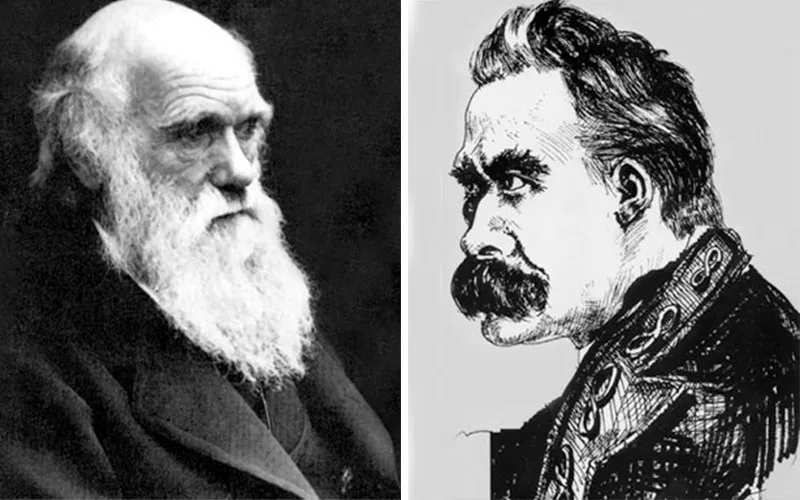
Actually, Mussolini's only definite beliefs were the principles of "conflict" and "war." These he had learned from the ideological founder of fascism, in other words, from Friedrich Nietzsche, and his mentor, Charles Darwin.
There is considerable evidence for the admiration Mussolini felt for them both. He admitted to his admiration for Nietzsche, whom he said filled him with a "spiritual eroticism."123 Denis Mack Smith writes:
In Nietzsche he found justification for his crusade against the Christian virtues of humility, resignation, charity, and goodness and it was also in Nietzsche that he found some of his favourite phrases including 'live dangerously', and 'the will to power'. Here, too, was the splendid concept of the superman, the supreme egoist who defied both God and the masses, who despised egalitarianism and democracy, who believed in the weakest going to the wall and pushing them if they did not go fast enough.124
Mussolini clearly referred to his ideological link with Darwinism in the pages of the communist weekly magazine La Lotta di Classe (Class Struggle), of which he was editor for a time. Pictures of Marx and Darwin were on the cover of the very first edition. The first issue of La Lotta di Classe referred to these two materialist ideologues as "The greatest thinkers of the past century," and was full of praise for Darwin's theory of evolution.125 Mussolini wrote a great deal for La Lotta di Classe on Darwinist, communist and anti-religious themes, but after 1922, in other words, after he came to power, all copies of this paper suddenly disappeared from local libraries.126