

Reading time: ~6 min read
As we have seen, fascism is an ideology fanatically opposed to religion, but which may sometimes conceal its hatred for political reasons, and even present itself as actually committed to religion. The aim behind fascists' wish to appear God-fearing is to pervert religious concepts from their true meaning, and employ them as tools for their political goals.
The degree of fascism's commitment to religion fluctuates according to the nature of the society it finds itself in. Nazism felt little need to put up such a front, because it had developed itself within German society, which had already been distanced far from religion. But, in Italy, Mussolini attempted to control a far more religious society, and thus felt a greater need to play such a hypocritical role. When we consider the example of Spain, we once again see a religious society and a fascism with a religious face. The leader of this brand of fascism was Francisco Franco.
Franco's ideology is known as "Falangism." The term comes from the word "Falange," (or the Falange Espanola Tradicionalista Y De Las Juntas De Ofensiva Nacional-Sindicalista, to give it its full name) which was founded in 1933. The party was established by a fascist ideologue called Jose Antonio Primo de Rivera, in imitation of Italian fascism, and was opposed to democracy, the Constitution, leftist movements and the Church. In fact, the word "Falange" (Phalanx in Spanish) was a martial concept taken from pagan cultures. The name referred to the arrangement of a regiment of soldiers, as practiced first in ancient Sumeria, and then in ancient Greece and Rome. General Franco, the commander-in-chief of the Spanish army at the time, took over control of the Falange party in 1936, when the civil war erupted as a result of fighting between right and left in the country. However, he softened the party's anti-religious stance, in an attempt to make his brand of fascism appear compatible with religion.
Franco waged a particularly bloody civil war, not hesitating even to bomb civilians when he thought it necessary. He won the three-year war in 1939, and the dictatorship he set up afterwards lasted until the 1970s. In order to maintain the regime, he pursued policies to ensure the support of the Catholic Church. At the same time, the Church was given a capitalistic role in the economic life of the country. Franco's approach was always to defend the Church, and to use it for his own ends. On the other hand, all religious movements that emerged and that were outside fascist principles were ruthlessly suppressed by the government.
The book Who is Franco? What is Falangism? explains how Spanish fascism used religion in order to succeed:
Fascism needs the masses in order to attain its ends… It is sufficient to use words such as religious truths and monarchy to motivate the masses… Catholics were always powerful in Spain: Most priests are outspoken supporters of fascism… So it was necessary to find and publicize a theory of Spanish fascism. This was done by Gil Robles. Robles has close connections to Spain's greatest landowners. He was educated in Catholic Jesuit schools, and began his first political activities in these same organizations… When fascism came to power in Germany, Robles rushed there at once. His aim was to learn German working methods. Robles tried to imitate German fascism in a number of areas, but he was unable to put forward the "superior" and "Aryan race" theory. So what was Robles to do? He resorted to an extreme chauvinism, which he harmonized with Catholicism. "Spain comes before everything. God is above Spain. You are as Catholic as you feel yourself to be Spanish!" This Catholic chauvinism of Roble's came from various characteristics of Spain itself… Robles used Catholic bodies and cooperatives and Catholic youth groups. The Catholic press also entered the service of fascism. Robles also ran the newspaper El Debate, which was well-known among conservative circles.130
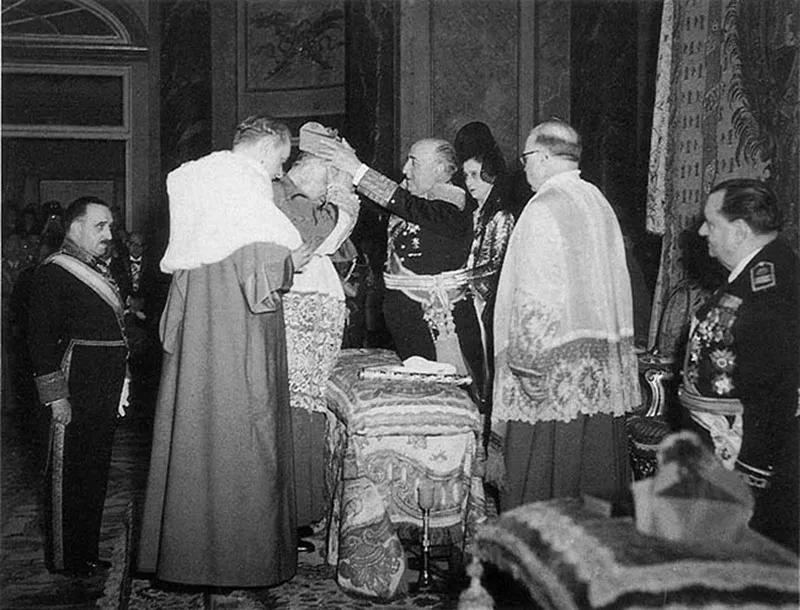
The Church also served the fascists in other ways. Spaniards in Latin America and other fascist groups set up their own versions of the Falange, so these countries could be brought under Spanish control. The Catholic Church in these countries was a primary motivating force in this scheme.131
The story of how various fascist regimes came to power is generally very much the same. For fascists, religion is an important tool to help them achieve their ends. As a result of tactics similar to those employed in other fascist countries, the Church in Spain supported Franco. However, as we have already seen, fascists only maintain this positive attitude towards religion until they are in power, after which they generally lose no time waging war against it. The same happened in Spain.
George Orwell describes the situation in revolutionary Barcelona six months after the revolution:
Almost every church had been gutted and its images burnt. Churches here and there were being systematically demolished by gangs of workman.132
When we examine Franco as an example of how fascists openly use religion, we find ourselves once again face to face with one of the truths mentioned earlier in this book. Fascism is an ideology that seeks to turn European societies back to the pagan religions of pre-Christian Europe. And not just in Europe. Everywhere in the world the true religion of fascists has been paganism. Every fascist movement takes its own society's pagan beliefs as a model. Their slogans, symbols and the like, all bear the features of a particular society's pagan past. Fascists try to generate an emotional fervor in their peoples by referring to their ancestors and traditions, contributing to a kind of mass hypnosis. They continually promise a return to the "glorious days" of the peoples' past. Essentially, they turn fascism into a religion, employing religious terms and symbols from their societies' pasts. No matter how much they may give the impression of being religious, they are nothing more than pagans.