

Reading time: ~3 min read
The documentary Humans: Who Are We?, one of the documentaries being broadcast on the National Geographic Channel (NGC), consists of the best-known scenarios of the myth of evolution. The scientific errors and deceptions in the documentary are explained below.
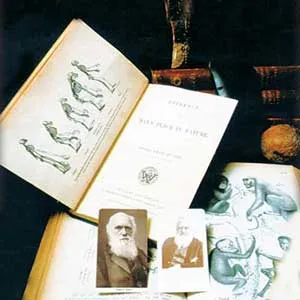
In the documentary on the NGC, there is first of all an address by the anthropologist Ian Tattersall. Among his first statements is the idea, "Human evolution did not happen as the result of needs, it was entirely coincidental." Yet the needs which might have caused ape-men to evolve into human beings are then described several times in the minutes which follow. This is one of the most obvious contradictions in the whole program.
Actually, this is a contradiction experienced by many evolutionists, not just the NGC or Ian Tattersall. In order to shed more light on this subject, let us summarize the difference between the concepts of "evolution as a response to need" and "evolution as the result of chance alone" (even though both are in fact unscientific fairy tales).
Before Darwin, another important figure put forward an evolutionary model on the subject of the origin of living things: the French biologist Jean-Baptiste Lamarck. Lamarck's claim was rather different from the contemporary evolutionist view. In his opinion, requirements or needs gave rise to their own organs. Let us illustrate Lamarckism with the example of the giraffe's neck. According to this theory, the necks of the first giraffes were the same length as those of deer or gazelles. However, giraffes experiencing food shortages wanted to be able to reach the rich sources of food in the upper levels of trees. A need was thus born. As a result of that need, the necks of giraffes wishing to reach up into the tops of trees grew longer.
Lamarckism based this claim on the thesis of "inheritance of acquired traits." In other words, the giraffe which had tried to reach up to trees' highest levels throughout its life should be able to hand this characteristic on to its young. Yet, with the discovery of the laws of genetics, it was seen that acquired traits could not actually be inherited at all.
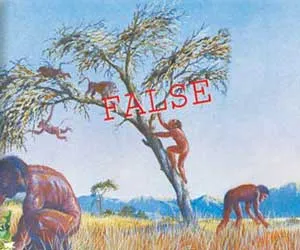
As a result, Lamarckism had been invalidated by science by the beginning of the twentieth century. Yet, evolutionists continued to put forward Lamarckian views between the lines. While fiercely criticizing Lamarckism on the one hand, their scenarios regarding the origins of living things still bore powerful traces of it. The myth of front legs' remaining free in order to make tools, making man a bipedal (two-footed) creature, the claim that Neanderthal man evolved in order to be able to live in cold climates, as put forward by the NGC, and that Australopithecus evolved in order to adapt to its environment as the thick forests thinned out—all of these rest on the assumption of evolution out of need.
The reason why evolutionists employ Lamarckian expressions, on the one hand, while fiercely criticizing the thesis, on the other, is this: According to the theory of evolution, in order for a monkey to be able to stand on two legs, for instance, it needs to be exposed to mutations that will bring about such a sensitive change in its skeleton, and which furthermore will not cause it any damage. This is in any case a scenario that cannot possibly happen. It would require a chance mutation to come about at just the very time when the living thing in question has need of it, and this would have to occur many times in individuals of the same species, bringing about a little more development each time. The impossibility of this scenario just reinforces the absurdity of the whole concept of evolution.
On the surface, evolutionists refuse to say, "there was evolution out of need," but underneath, they actually support that idea.