

Reading time: ~6 min read

According to the NGC, the species known as Australopithecus was the ancestor of the first man to walk upright. Yet that claim is not correct. All of the Australopithecus species are extinct apes that resemble the apes of today. Their cranial capacities are the same or smaller than those of the chimpanzees of our day. There are projecting parts in their hands and feet that they used to climb trees, just like in today's chimpanzees, and their feet are built for grasping to hold onto branches. Australopithecus specimens are short (130 cm, maximum) and, just as in modern apes, the males are much bigger than the females. Many other characteristics—such as the details in their skulls, the closeness of their eyes, their sharp molar teeth, their mandibular structure, their long arms, and their short legs—constitute evidence that these creatures were no different from today's apes.
NGC's claim that Australopithecus walked upright is a view that has been held by paleoanthropologists like Richard Leakey and Donald C. Johanson for decades. Yet many scientists who have carried out a great deal of research on the skeletal structures of Australopithecus have proved the invalidity of that argument. Extensive research done on various Australopithecus specimens by two world-renowned anatomists from England and the USA, Lord Solly Zuckerman and Prof. Charles Oxnard, showed that these creatures did not walk upright in the human manner, and had exactly the same movements as modern apes. Having studied the bones of these fossils for a period of 15 years thanks to grants from the British government, Lord Zuckerman and his team of five specialists reached the conclusion that Australopithecus was only an ordinary species of ape, and was definitely not bipedal—this even though Zuckerman is an evolutionist himself.1 Correspondingly, Charles E. Oxnard, who is another evolutionary anatomist famous for his research on the subject, also likened the skeletal structure of Australopithecus to that of modern orangutans.2
Probably the most important study demonstrating that Australopithecus could not have been bipedal came in 1994 from the research anatomist Fred Spoor and his team at the University of Liverpool, England. This group conducted studies in the inner ear of fossilized Australopithecus specimens. In the inner ears of human beings and other complex living beings, there is an organ named the "cochlea" that determines the position of the body in relation to the ground. The function of this organ, which maintains balance in human beings, is the same as the "gyroscope," which maintains correct flight attitude in airplanes. Fred Spoor investigated the involuntary balance mechanism found in this "snail-shell" like organ, and his findings showed conclusively that Australopithecus was quadrupedal (four legged).3
This means Australopithecus is an extinct ape species and has no relation with human beings.
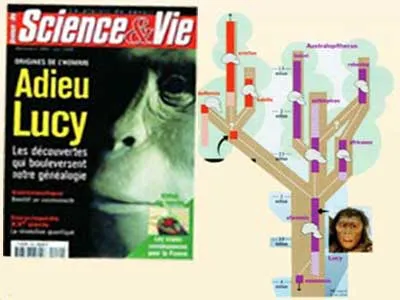
That Australopithecus cannot be counted an ancestor of man has recently been accepted by evolutionist sources. The famous French popular-science magazine, Science et Vie, made the subject the cover of its May 1999 issue. Under the headline "Adieu Lucy" ("Goodbye, Lucy"—Lucy being the most important fossil example of the species Australopithecus afarensis), the magazine reported that apes of the species Australopithecus would have to be removed from the human family tree. In this article, based on the discovery of another Australopithecus fossil known simply as St W573, the following sentences appear:
A new theory states that the genus Australopithecus is not the root of the human race… The results arrived at by the only woman authorized to examine St W573 are different from the normal theories regarding mankind's ancestors: this destroys the hominid family tree. Large primates, considered the ancestors of man, have been removed from the equation of this family tree… Australopithecus and Homo [human] species do not appear on the same branch. Man's direct ancestors are still waiting to be discovered.4
Another important discovery concerning Australopithecus is the realization that this creature's hands were used for walking, just like those of present-day apes. Apes employ a four-legged mode of walking in which they lean on the knuckles of their fingers. Known as "knuckle walking," this is one of the major structural differences between apes and men. The skeletal studies performed in 2000 on Lucy by two evolutionist scientists called B. G. Richmond and D. S. Strait, resulted in a conclusion that astonished the two evolutionists: Lucy's hand possessed a four-legged "knuckle walking structure," just like those of the apes of today. Strait's comment in an interview regarding this discovery, the details of which were covered by the journal Nature, is striking: "I walked over to the cabinet, pulled out Lucy, and—shazam!—she had the morphology that was classic for knuckle walkers."5
References
- - Solly Zuckerman, Beyond The Ivory Tower, New York: Toplinger Publications, 1970, p. 75-94 ↩