

Reading time: ~4 min read
In the NGC documentary Homo erectus is portrayed as a half-ape, half-man creature which walked upright and tried to speak by making peculiar noises. The fact is, however, that Homo erectus was a human race, with no ape characteristics at all.
There is no difference between the Homo erectus skeleton and that of modern man. The primary reason for evolutionists' defining Homo erectus as "primitive" is the cranial capacity of its skull (900-1,100 cc), which is smaller than the average modern man, and its thick eyebrow projections. However, there are many people living today in the world who have the same cranial capacity as Homo erectus (pygmies, for instance) and other races have protruding eyebrows (Native Australians, for instance).
It is a commonly agreed-upon fact that differences in cranial capacity do not necessarily denote differences in intelligence or abilities. Intelligence depends on the internal organization of the brain, rather than on its volume.6
The fossils that have made Homo erectus known to the entire world are those of Peking man and Java man in Asia. However, in time it was realized that these two fossils are not reliable. Peking Man consists of some elements made of plaster whose originals have been lost, and Java Man is "composed" of a skull fragment plus a pelvic bone that was found meters away from it with no indication that these belonged to the same creature. This is why the Homo erectus fossils found in Africa have gained such increasing importance.
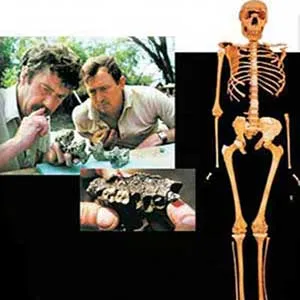
The most famous of the Homo erectus specimens found in Africa is the fossil of the "Turkana Boy," which was found near Lake Turkana in Kenya. It is confirmed that the fossil was that of a 12-year-old boy, who would have been 1.83 meters tall in adolescence. The upright skeletal structure of the fossil is no different from that of modern man.
The American paleoanthropologist Alan Walker said that he doubted that "the average pathologist could tell the difference between the fossil skeleton and that of a modern human." Concerning the skull, Walker wrote that he laughed when he saw it because "it looked so much like a Neanderthal."7 Since Neanderthals are a modern human race, Homo erectus is also a modern human race.
Even the evolutionist Richard Leakey states that the differences between Homo erectus and modern man are no more than racial variance:
One would also see differences in the shape of the skull, in the degree of protrusion of the face, the robustness of the brows and so on. These differences are probably no more pronounced than we see today between the separate geographical races of modern humans. Such biological variation arises when populations are geographically separated from each other for significant lengths of time.8
Professor William Laughlin from the University of Connecticut made extensive anatomical examinations of Inuits and the people living on the Aleutian islands, and noticed that these people were extraordinarily similar to Homo erectus. The conclusion Laughlin arrived at was that all these distinct races were in fact different races of Homo sapiens (modern man):
When we consider the vast differences that exist between remote groups such as Eskimos and Bushmen, who are known to belong to the single species of Homo sapiens, it seems justifiable to conclude that Sinanthropus [an erectus specimen] belongs within this same diverse species.9
There is a huge gap between Homo erectus, a human race, and the apes that preceded Homo erectus in the "human evolution" scenario (Australopithecus, Homo Habilis, and Homo rudolfensis). This means that the first men appeared in the fossil record suddenly and without any prior evolutionary history.