

Reading time: ~4 min read
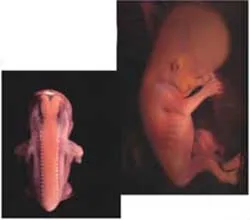
Human and fish embryos are compared in the BBC documentary The Human Body, and the theory of "recapitulation," which ceased to be part of scientific literature years ago, is still portrayed as a scientific fact. The term "recapitulation" is a condensation of the dictum "ontogeny recapitulates phylogeny," put forward by the evolutionary biologist Ernst Haeckel at the end of the nineteenth century.
This theory of Haeckel's postulates that living embryos re-experience the evolutionary process that their pseudo-ancestors underwent. He theorized that during its development in its mother's womb, the human embryo first displayed the characteristics of a fish, and then those of a reptile, and finally those of a human.
It has since been proven that this theory is completely bogus. It is now known that the "gills" that supposedly appear in the early stages of the human embryo are in fact the initial phases of the middle-ear canal, parathyroid, and thymus. That part of the embryo that was likened to the "egg yolk pouch" turns out to be a pouch that produces blood for the infant. The part that was identified as a "tail" by Haeckel and his followers is in fact the backbone, which resembles a tail only because it takes shape before the legs do.
These are universally acknowledged facts in the scientific world, and are accepted even by evolutionists themselves. Two leading neo-Darwinists, George Gaylord Simpson and W. Beck, have admitted: "Haeckel misstated the evolutionary principle involved. It is now firmly established that ontogeny does not repeat phylogeny."12 In an article published in American Scientist, we read:
Surely the biogenetic law is as dead as a doornail. It was finally exorcised from biology textbooks in the fifties. As a topic of serious theoretical inquiry it was extinct in the twenties…13
The following was written in an article in New Scientist, dated October 16, 1999:
[Haeckel] called this the biogenetic law, and the idea became popularly known as recapitulation. In fact Haeckel's strict law was soon shown to be incorrect. For instance, the early human embryo never has functioning gills like a fish, and never passes through stages that look like an adult reptile or monkey.14
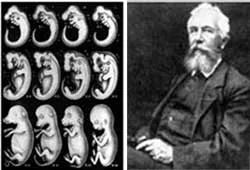
Another interesting aspect of "recapitulation" was Ernst Haeckel himself, a faker who falsified his drawings in order to support the theory he advanced. Haeckel's forgeries purported to show that fish and human embryos resembled one another. When he was caught out, the only defense he offered was that other evolutionists had committed similar offences:
After this compromising confession of 'forgery' I should be obliged to consider myself condemned and annihilated if I had not the consolation of seeing side by side with me in the prisoner's dock hundreds of fellow-culprits, among them many of the most trusted observers and most esteemed biologists. The great majority of all the diagrams in the best biological textbooks, treatises and journals would incur in the same degree the charge of 'forgery,' for all of them are inexact, and are more or less doctored, schematised and constructed.15
In the September 5, 1997, edition of the well-known scientific journal Science, an article was published revealing that Haeckel's embryo drawings were the product of a deception. The article, called "Haeckel's Embryos: Fraud Rediscovered," had this to say:
The impression they [Haeckel's drawings] give, that the embryos are exactly alike, is wrong, says Michael Richardson, an embryologist at St. George's Hospital Medical School in London… So he and his colleagues did their own comparative study, reexamining and photographing embryos roughly matched by species and age with those Haeckel drew. Lo and behold, the embryos "often looked surprisingly different," Richardson reports in the August issue of Anatomy and Embryology.
In short, despite its having emerged as early as 1901 that Haeckel's drawings were counterfeit, defenders of the theory of evolution such as BBC portray this theory as if it were scientific fact and attempt to keep the evolution deception alive.
References
- - G. G. Simpson, W. Beck, An Introduction to Biology, New York, Harcourt Brace and World, 1965, p. 241 ↩
- - Keith S. Thompson, "Ontogeny and Phylogeny Recapitulated," American Scientist, volume 76, May / June 1988, p. 273 ↩
- - Ken McNamara, "Embryos and Evolution," New Scientist, 16 October 1999 ↩
- - Francis Hitching, The Neck of the Giraffe: Where Darwin Went Wrong, New York: Ticknor and Fields 1982, p. 204 ↩