

Reading time: ~4 min read
BBC's evolutionary tall tales begin with the sentence that there were first of all bacteria in the primitive world, and plants and animals later evolved from these bacteria. The fact is, of course, that the expression "there were bacteria in the primitive world" is meaningless because the problem is how those bacteria came into being. Those who prepared this documentary on BBC might have thought they could gloss over this crucial question on the assumption that their viewers would adopt a superficial view of the matter such as "those bacteria must probably have come into being by themselves." (Even worse, they themselves might hold just such a view.) In truth, however, even the origin of the very simplest bacterium represents a major difficulty for the theory of evolution, one that cannot be glossed over with the words just mentioned.
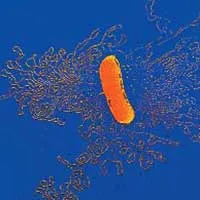
The origin of bacteria is a problem for the theory of evolution because the theory maintains that life on the primitive earth came about from random chemical reactions. Yet even the simplest bacterium contains such a complex organization and information that these can never be accounted for by any chemical reaction.
Let us examine this information: A bacterium has around 2,000 genes, each gene consisting of up to 1,000 letters (codes). This means that the information in its DNA must be at least 2-million letters long. That, in turn, means that the information contained in the DNA of just one bacterium is equivalent to 20 novels of 100,000 words each.1 That being the case, it is quite impossible for a single bacterium to come about by chance or to evolve as the result of chance effects. Any chance intervention to a structure containing information on such a scale would damage the functioning of the bacterium's entire system. A deficiency in a bacterium's genetic code would mean damage to the working system, and therefore death.
Robert Shapiro, a professor of chemistry at New York University, calculated the probability that all 2,000 of the different types of proteins that it takes to make up even a simple bacterium could have come into being completely by chance. According to Shapiro, the probability is one in 1040,000.2 (That number is "1" followed by forty thousand zeros and it has no equivalent in the universe.)
Chandra Wickramasinghe, a professor of applied mathematics and astronomy at the University of Cardiff, commented on Shapiro's result:
… One to a number with 1040,000 noughts after it…It is big enough to bury Darwin and the whole theory of evolution. There was no primeval soup, neither on this planet nor on any other, and if the beginnings of life were not random, they must therefore have been the product of purposeful intelligence.3
Sir Fred Hoyle, the British mathematician and astronomer, has this to say about these figures:
Indeed, such a theory [that life was assembled by an intelligence] is so obvious that one wonders why it is not widely accepted as being self-evident. The reasons are psychological rather than scientific.4
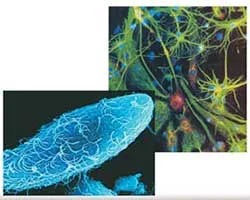
It is therefore impossible for even the simplest bacterium to have come about by chance, as evolutionists claim. In fact, the theory of evolution is even unable to account for the emergence of just one of the 2,000 kinds of protein that go to make up a simple bacterium. For that reason, saying "first there were bacteria, and plants and animals later developed from bacteria" is a huge deception, devoid of any scientific foundation. Those who prepared the BBC documentary must in any case be aware of this, since they avoided the subject of how the first bacterium came into being, simply beginning their tale with "bacteria that somehow came into being."
Furthermore, evolutionists have not one shred of evidence for their evolutionary fantasy; no intermediate form between bacteria and the first plants and animals exists, and they themselves admit the fact. One such evolutionist is Professor Ali Demirsoy, a prominent Turkish defender of evolution, who confesses:
One of the most difficult stages to be explained in evolution is to scientifically explain how organelles and complex cells developed from these primitive creatures. No transitional form has been found between these two forms. One- and multicelled creatures carry all this complicated structure, and no creature or group has yet been found with organelles of a simpler construction in any way, or which are more primitive. In other words, the organelles carried forward have developed just as they are. They have no simple and primitive forms.5
References
- - Mahlon B. Hoagland, The Roots of Life, Houghton Mifflin Company, 1978, p.18 ↩
- - Robert Shapiro, Origins: A Sceptics Guide to the Creation of Life on Earth, New York, Summit Books, 1986. p.127 ↩
- - Fred Hoyle, Chandra Wickramasinghe, Evolution from Space, New York, Simon & Schuster, 1984, p. 148 ↩
- - Fred Hoyle, Chandra Wickramasinghe, Evolution from Space, p. 130. ↩
- - Prof. Dr. Ali Demirsoy, Kalitim ve Evrim (Inheritance and Evolution), Ankara, Meteksan Yayınları, p.79 ↩