

Reading time: ~6 min read
The Industrial Revolution, which began in the 18th-19th centuries in Great Britain, was a major turning point in the history of mankind. With the building of factories and growth in industrial plants, the hitherto unknown problem of air pollution emerged. Heavy pollution afflicted such main industrial centers as Manchester, Liverpool and Birmingham. At the same time, color changes were recorded in various plants and animals around these cities.
Light-colored members of this species are known as typic, and dark- colored individuals as melanic. In subsequent years, observations revealed that dark-colored individuals now constituted the majority of the population—so much so that by the 1950s, 90% of the moths in the region were melanic, or dark. (This situation was revered when air pollution was reduced as a result of legislation mandating stricter emission controls. Light-colored moths again began to represent the majority, as they had before the Industrial Revolution.)

The phenomenon of a population composed of light-colored individuals gradually assuming a dark color is known as industrial melanism. Some 100 examples of this, mainly of nocturnal moths, have been reported in the scientific literature.261 The protein melanin leads moths to assume a darker shade: Therefore, a darker moth produces more melanin than a lighter- colored one.262
But clearly, the 19th century statistics regarding melanism in moths are deficient and flawed, when compared to modern scientific standards. One of the two scientists who spent years researching this subject, Bruce Grant from William and Mary University, express this fact: "During the last century and the early part of this one few people kept records about morph frequencies, so our picture of the rise and spread of melanism is sketchy."263
The British biologist James William Tutt first examined this color change in his book British Moths.264 According to Tutt, typic butterflies on light-colored lichens in unpolluted forest areas were less visible; therefore, they were spared being hunted by birds. (Lichens are a symbiotic plant community consisting of algae and fungi.) In the wake of the Industrial Revolution, lichens died out because of pollution caused by soot and acid rain and revealed darkened tree trunks. In this way, melanic forms came to appear better camouflaged. Tutt maintained that moth-eating birds were able to hunt light-colored moths more easily as they were more visible, so that the number of melanic individuals increased. To put it another way, he attempted to account for the phenomenon in question through evolution caused by natural selection stemming from environmental conditions—in this case, birds.
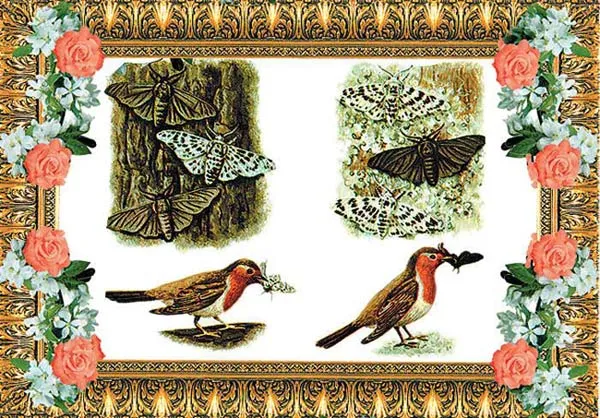
J.W. Tutt's claim may appear reasonable at first sight, but it received little acceptance at the time. There was no evidence that these moths—which flew by night and rested on trees by day—were actually hunted by birds. This led to entomologists and ornithologists looking askance at his theory.265
Then in the 1920s, the British biologist J. W. Heslop Harrison developed a different theory: that melanism in animals stemmed directly from chemical substances in the air. Harrison reported that melanism could be produced in several other moth species if their larvae were fed on leaves contaminated with metallic salts.266 Harrison's claim was evaluated as a challenge to Darwinism.267 However, with the birth of neo-Darwinism in the 1940s, it lost esteem and the idea gained ground that melanism in moths was the result of natural selection..
The British entomologist Bernard Kettlewell, of Oxford University, was a researcher whose name became equated with the Industrial-Revolution moths after his research on the subject in the 1950s. Kettlewell carried out a number of experiments and field studies that placed the subject firmly on the scientific agenda. As one might expect, he was an evolutionist, and set out with the aim of finding evidence to support the theory.
Professor Kettlewell performed his first experiment in an aviary. He observed that peppered moths he released into the aviary first alighted, and were then hunted by the birds. This way, he determined that the birds caught and ate moths when they were at rest.268
In his second experiment, he marked dark and light colored moths and released them during the daytime in a forested area affected by air pollution. He determined that the moths settled on tree trunks and that birds could more easily catch the more visible moths. That night, he released a number of moths he had captured in a trap; of 447 melanics released, he recaptured 123; while of 137 released typicals, he recaptured only 18. Statistically, he recaptured 27.5% of the melanics, but only 13% of the typicals. Kettlewell concluded that "birds act as selective agents, as postulated by evolutionary theory."269
He also performed the same experiment in a forest unaffected by air pollution. He was accompanied by Niko Tinbergen, known for his work in the field of animal behavior, and together they filmed the birds hunting moths in the trees. This time, the dark- colored melanic moths were more easily visible on trees covered in light lichens. He encountered the exact opposite results to those in the forest area with high pollution, recapturing 12.5% of the typicals compared to 6.3% of the melanics.270
Kettlewell thought these statistics were adequate to confirm the thesis, and announced the results of his research with enormous excitement.
Evolutionist circles lost no time in backing Kettlewell's research. Scientific American magazine broadcasted the study in an article titled "Darwin's Missing Evidence."271 Such was the importance ascribed to the subject that it soon became one of the fundamental examples in evolutionist literature.
The Industrial-Revolution moths are still touted as the No. 1 piece of evidence for Darwinism, despite the passage of the intervening half century. Several evolutionists after Kettlewell repeated the experiment (for example, Clarke and Sheppard in 1966,272; Bishop in 1972,273 Lees and Creed in 1975,274 Bishop and Cook in 1975,275 Steward in 1977,276 and Murray and his team in 1980277),
However, this whole tale is invalid. Together with the errors of the research results mentioned above, the Industrial Revolution moths gained nothing at all for the theory of evolution.
References
- Michael Majerus, Melanism: Evolution in Action, Oxford: Oxford University Press, 1998.p.233 ↩
- Lee Spetner, Not By Chance!, p. 66. ↩
- Bruce Grant, "Fine Tuning The Peppered Moth Paradigm," Evolution 53 (3), 199, pp. 980-984. ↩
- J.W. Tutt, British Moths, London, G. Routledge and Sons, 1896. ↩
- Jonathan Wells, "Second Thoughts about Peppered Moths," 1999, http://www.arn.org/docs/wells/jw_pepmoth.htm ↩
- J.W. Heslop Harrison, "Genetical studies in the moths of the geometrid genus Oporabia (Oporinia) with a special consideration of melanism in the Lepidoptera," Journal of Genetics, Vol. 9, 1920, pp. 195-280; J.W. Heslop Harrison, "The Experimental Induction of Melanism, and Other Effects, in the Geometrid Moth Selenia bilunaria esp.," Proceedings of the Royal Society of London B 117, 1935, pp. 78-92. ↩
- Bruce Grant, "Fine Tuning The Peppered Moth Paradigm," Loc. cit. ↩
- Bernard Kettlewell, "Selection experiments on industrial melanism in the Lepidoptera," Heredity, Vl. 9, 1955. ↩
- Ibid. p. 342. ↩
- Bernard Kettlewell, "Further selection experiments on industrial melanism in the Lepidoptera," Heredity, Vol. 10, 1956, pp. 287-301. ↩
- Bernard Kettlewell, "Darwin's Missing Evidence," Scientific American, Vol. 200, March 1959, pp. 48-53. ↩
- C.A. Clarke, P.M. Sheppard, "A local survey of the distribution of industrial melanic forms in the moth Biston betularia and estimates of the selective values of these in an industrial environment," Proceedings of the Royal Society of London B 165, 1966, pp. 424-439. ↩
- J.A. Bishop, "An experimental study of the cline of industrial melanism in Biston betularia (L.) (Lepidoptera) between urban Liverpool and rural North Wales," Journal of Animal Ecology, Vol. 41, 1972, pp. 209-243. ↩
- D.R. Lees, E.R. Creed, "Industrial melanism in Biston betularia: the role of selective predation," Journal of Animal Ecology, Vol. 44, 1975, pp. 67-83. ↩
- J.A. Bishop, L.M. Cook, "Moths, melanism and clean air," Scientific American, Vol. 232, 1975, pp. 90-99. ↩
- R.C. Steward, "Melanism and selective predation in three species of moths," Journal of Animal Ecology, Vol. 46, 1977, pp. 483-496. ↩
- N.D. Murray, J.A. Bishop, M.R. MacNair, "Melanism and predation by birds in the moths Biston betularia and Phigalia pilosauria," Proceedings of the Royal Society of London B 210, 1980, pp. 277-283. ↩