

Reading time: ~2 min read
Whenever Industrial-Revolution moths are mentioned, images of them resting on tree trunks come to mind. Books about evolution contain photographs of dark and light-colored moths on different trunks. But since peppered moths rest underneath horizontal branches, where do the photos of them on perpendicular trunks come from?
The photographs in question originated with various researchers who carried out experiments on the moths in the last half century, and were determined to have been used taken using either one of two different fraudulent techniques.
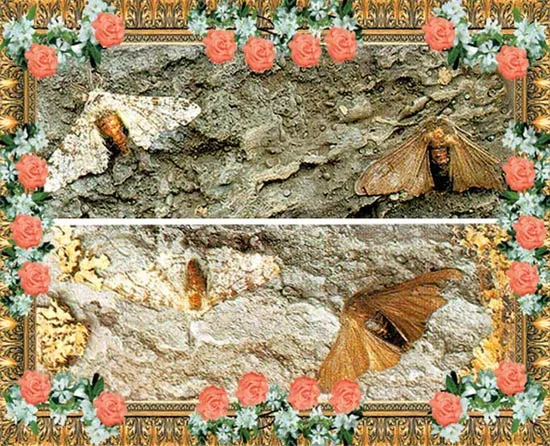
One was to stick dead moths to a tree trunk with pins or glue (the method preferred by many researchers after Kettlewell).298 Photographs of the affixed moths were later duly used in books, with no explanation given, as if these insects were photographed alive, in their natural environment. Documentaries and television programs have also employed this same method in.299
A second and different technique exploits the fact that B. betularia moths have only limited ability to move in the daytime. The insects in a rather somnolent state, have been placed on tree trunks by hand. Since they remained immobile, they were easy to photograph. As stated by the Massachusetts University biologist Theodore Sargent, many photographs have been obtained in this way and used in textbooks.300
This practice "is not science, but myth-making,"301 in the words of Dr. Jonathan Wells, from the California University Department of Molecular Cell Biology.
This practice cannot, of course, be regarded as in any way excusable. For the last 20 years, it has been known that these moths do not rest on tree trunks. In other words, the phtographs in question do not reflect the truth. Yet these fraudulent illustrations are still used in evolutionary textbooks, for the sake of providing supposed evidence for the theory. They thus deserve a special place in the history of Darwinism, filled as it is with falsehoods and scandals.
References
- Bernard Kettlewell, The Evolution of Melanism, Oxford: Clarendon Press, 1973, p. 150; J.A. Bishop, L.M. Cook, "Moths, melanism and clean air," Scientific American, Vol. 232, 1975, pp. 90-99. ↩
- Larry Witham, "Darwinism icons disputed: Biologists discount moth study," The Washington Times, National Weekly Edition, 25-31/1/1999, p. 28. ↩
- T.D. Sargent, C.D. Millar, and D.M. Lambert, "The ‘classical' explanation of industrial melanism: assessing the evidence," Evolutionary Biology, Vol. 30, 1998, pp. 299-322. ↩
- Jonathan Wells, Icons of Evolution, New York: Regnery Publishing, Inc., 2000, p. 155. ↩