

Reading time: ~6 min read
When Darwin proposed genetic variation and natural selection as the mechanisms of the imaginary process of evolution, he assumed that life was based on very simple foundations. He was unable to even imagine the complexity inside the cell, given the primitive scientific climate of his day. In the second half of the 20th century, however, advances in the field of molecular biology illuminated the cell’s complex structure, and it emerged that the cell contained features that could not be imitated even using the most advanced technologies. Life, even at the most basic level, refuted claims based on chance.
This totally eliminated the claim of evolution by way of natural selection. Professor of biochemistry Garret Vanderkooi describes this process:
In the past, evolutionists were confident that the problem of the origin of life would be solved by the new science of biochemistry. To their dismay, the converse has occurred. The more that is learned about the chemical structure and organization of living matter, the more difficult it becomes even to speculate on how it could have developed from lower forms by natural processes. From the scientific point of view, evolution may have been a plausible hypothesis in Darwin’s day, but it has now become untenable, as a result of fairly recent developments in molecular biology [emphasis added].174
Developments in molecular biology on the one hand and advances in the understanding of the Cambrian explosion on the other led to a fundamental realization that the combination of natural selection and mutation could not cause supposed evolution. Long before the 1980s, when the facts regarding the Cambrian explosion began to emerge, molecular biology had already revealed that mutation and natural selection had no evolutionary impact.
Darwinists claimed that mutations were the mechanism for genetic variation in the living world, before it emerged that their effect on an organism were always destructive.
To recapitulate briefly, mutations are random changes in the base sequences of genes. An organism’s body is constructed according to its DNA’s genetic blueprint. This blueprint, in turn, is encoded through nucleotides arranged in the DNA, which contains sufficient information to fill volumes of encyclopedias.
Each protein structure is based upon a very particular nucleotide sequence, and every cell contains tens of thousands of proteins. Mutations consisting of random changes have no ability to bring about such large amounts of information.
Pierre Paul Grassé, former president of the French Academy of Sciences, compared mutations to spelling mistakes in the copying of a written text, which comment is particularly illuminating. Spelling mistakes cannot represent information, only damage information that already exists. As Grassé explains:
Mutations, in time, occur incoherently. They are not complementary to one another, nor are they cumulative in successive generations toward a given direction. They modify what preexists, but they do so in disorder, no matter how. . . . As soon as some disorder, even slight, appears in an organized being, sickness, then death follow. There is no possible compromise between the phenomenon of life and anarchy. 175
For that reason, “No matter how numerous they may be, mutations do not produce any kind of evolution,” to quote from another statement by Grassé.176
Even in 1977, when Grassé published this statement, it was perfectly well known that natural selection was not a mechanism that caused organisms to evolve. In 1982, Colin Patterson, senior paleontologist at London’s Natural History Museum, said:
No one has ever produced a species by the mechanisms of natural selection. No one has ever got near it, and most of the current argument in neo-Darwinism is about this question. 177
In the 1980s, in short, although Darwinism’s mechanisms of natural selection and random mutation served no purpose and were of no use, they were on display for want of a better alternative, like junk in an antique shop.
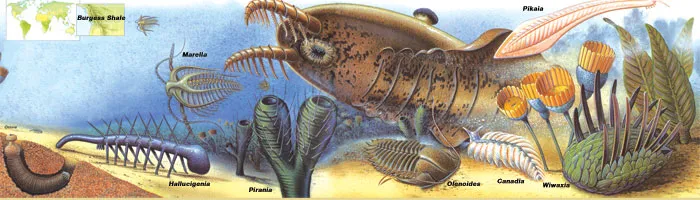
The emergence of the facts regarding Burgess Shale and the later discovery of new Cambrian beds created a wave of information contradicting Darwinism. Darwinists, already reeling from the findings of molecular biology, were now under fire from paleontology. Cambrian animals had emerged with already highly complex structures. All the phyla existing today appeared at that period. Their numbers had decreased up to the present, rather than increasing. Phyla had diversified before species did.
All these facts about the Cambrian explosion definitively revealed the invalidity of Darwinist interpretations of natural history. In the 1990s, another fact about the Cambrian struck Darwinism from yet another direction, striking its mechanisms. This was the “great complexity in little time” paradox, confirmed by the use of zircon dating. All the phyla in the animal world emerged within a mere 5 million years. Indeed, James Valentine estimated that the phylum Brachiopoda appeared in much less than 5 million years, probably in less than 1 million years.178He even spoke of a time span of just hundreds of thousands of years in some cases.179
The pre-Cambrian had single-celled organisms and Ediacaran life forms with no complex organs. These constituted three phyla. To these were added more than 45 more, in the 5 million years between 530 and 525 million years ago. In that interval were added organs and structures such as eyes, antennae, limbs and guts, with no previous examples pre-dating them, as well as immune systems, nervous systems, physiological and developmental systems. In addition, this happened not locally but on a world-wide ecological basis.
Since Darwin was aware of the damaging effect of wide-ranging random changes on complex systems, he allowed for only very small changes and fantasized that this evolutionary process could produce new species only over long periods of time, in a large portion of the history of the Earth. The establishment of all the phyla in the animal world in as brief a time as roughly one thousandth of the history of the Earth was not something that the slow workings of natural selection and mutation could explain.
Darwinists were perfectly aware that mutations had yet to produce a single new protein and always had damaging effects on genetic information. Discoveries regarding the complexity in life made it increasingly difficult to defend the mutation scenario. In addition, the Cambrian explosion added the problem of time, and reducing its duration to 5 million years narrowed the window still further. It was already realized that the mechanism of natural selection could not bring about evolution. Now, the Cambrian’s increase in genetic information through mutations alone emerged as a mathematical impossibility. In other words, the scenario of evolution through its illusory mechanisms consisted of a deception.180
Today, no evolutionist claims to explain the Cambrian explosion in terms of the Darwinian combination of natural selection and mutation. On the contrary, evolutionist experts openly state that the mechanisms of Darwinism are invalid in light of the Cambrian explosion. Darwinists who still hope for assistance from these mechanisms are in dire straits, and all their endeavors consist of stumbling around in the dark. As Almighty Allah states in Surat al-An‘am:
Those who deny Our signs are deaf and dumb in utter darkness. Allah misguides whoever He wills, and puts whoever He wills on a straight path. (Surat al-An‘am, 39)