

Reading time: ~4 min read
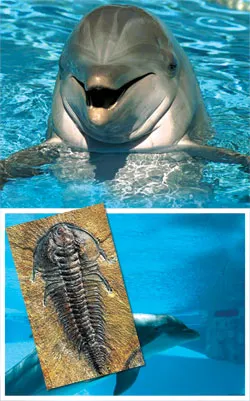
Darwin’s theory claimed that all the complexity in present-day forms of life emerged as the result of an imaginary evolutionary process that allegedly has continued over millions of years. Complex structures such as a dolphin’s sonar system, a chameleon’s tongue, the wing of a hummingbird or an octopus’s tentacles must—according to this hypothesis—have developed gradually from inferior, rudimentary systems.
Darwin’s hypothesis placed an imaginary first cell, with none of these complex systems, at the start of the fictitious evolutionary process. Therefore, according to Darwinism, the supposed natural evolution of life forms must have followed a developmental course from the simple to the complex. But the Cambrian explosion irrefutably demolished that claim.
First of all, the living things that appeared in the Cambrian already had very complex structures. University of London biochemist D. B. Gower states this fact in clear terms:
In the oldest rocks we did not find a series of fossils covering the gradual changes from the most primitive creatures to developed forms, but rather in the oldest rocks developed species suddenly appeared.166
Second, both the fossil record and the species that lived in the period after the Cambrian suggest the exact opposite of Darwin’s gradual-development model. They indicate no gradualism. George Gaylord Simpson, one of the 20th century’s foremost paleontologists, expresses this:
It is a feature of the known fossil record that most taxa appear abruptly. They are not, as a rule, led up to by a sequence of almost imperceptibly changing forerunners such as Darwin believed should be usual in evolution.167
Third, despite all the searching by evolutionists, there is not the slightest evidence that any biological complexity ever emerged by way of evolution. Ernst Mayr, a Harvard University biologist and one of the 20th century’s most influential proponents of Darwinism, admitted evolutionists’ despair on this point:
[Research reveals that there is] no clear evidence … for the gradual origin of an evolutionary novelty.168
Kevin Kelly, a researcher into complexity, makes a similar confession:
No one has yet witnessed, in the fossil record, in real life, or in computer life, the exact transitional moments when natural selection pumps its complexity up to the next level.169
Life began with already complex creatures. There is no evidence that complexity increased through evolution. Therefore, the idea of an increasing scale of complexity throughout natural history was a deception, since the true course that complexity followed was totally at odds with the Darwinist scenario.
A pamphlet of the American Geological Institute, an authority on fossil strata, makes this admission:
The old Darwinian view of evolution as a ladder of more and more efficient forms leading up to the present is not borne out by the evidence.170
Scientists seeking to gather evidence that complexity could have developed out of simpler structures encountered the exact opposite. The vertebrate jaw, for example, is a complex structure whose every component functions in a very sensitive manner. According to Darwinism, this complex structure must have been simpler in fish, at the lower branches of the imaginary tree of life, and then have evolved further in later vertebrates. Yet the facts reveal the very opposite; the jaw is more highly developed in fish, in the supposedly lower section of the vertebrate tree of life. John G. Maisey from the Department of Vertebrate Paleontology at the American Museum of Natural History expresses this fact:
As we move back down our evolutionary ladder, jaw structure becomes more instead of less complex, and in fishes the jaws are very elaborate indeed.171
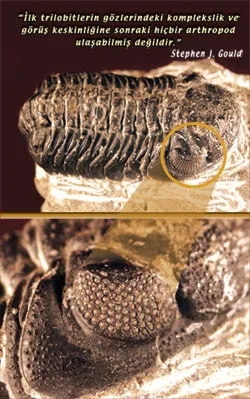
Another important example in this regard is the eye of the extinct trilobite. The complexity of this organ in one of the most ancient animals was not passed on to any subsequent arthropod. The counterexamples are not confined to trilobites. No life form possesses any fossil record of such a kind as to confirm the kind of development hypothesized by Darwinism. Stephen Jay Gould writes:
The eyes of early trilobites, for example, have never been exceeded for complexity or acuity by later arthropods . . . I regard the failure to find a clear “vector of progress” in life’s history as the most puzzling fact of the fossil record.172
The fossil record has always reminded paleontologists just how much Darwin’s theory is at odds with the scientific facts. As Ernst Mayr admits:
Paleontologists had long been aware of a seeming contradiction between Darwin’s postulate of gradualism . . . and the actual findings of paleontology.173
As you can see from these statements, the natural history of life forms cannot be explained in terms of Darwinism. The complexity displayed in the Cambrian explosion was already at an exceedingly high level. In later periods, species did not progress from the simple to the complex, but remained exactly as they were when first created by Almighty Allah.