

Reading time: ~4 min read

To provide an idea of the impressive richness of micro-organism, fungi, plant and animal species on Earth, a few examples can be cited. According to Professor Wilson's calculation, a catalogue describing merely a million species would fill a 60-meter library shelf.12
To view biodiversity from another angle, let us now include species' genetic richness in the calculation. The information controlling the body's functions, encoded in the human DNA molecule in the nucleus of every cell, would fill an encyclopedia containing a million pages. Bear in mind that Man is only one of 10 million species, and a truly extraordinary picture emerges: Were we to write down all the genetic information for all those species, there would not be enough paper in the world to do so.
The number of single-celled eukaryotes (Protista), algae, bacteria, fungi, seaweeds, flowering plants, sponges, corals, insects, birds, reptiles, fish and mammals—in short, the number of the categories of all living things—is so huge that some scientists and researchers think that the target of determining and describing all species is unattainable.13
Two researchers from London's Imperial College, Andy Purvis and Andy Hector, published an article in Nature magazine titled "Getting the Measure of Biodiversity." They emphasized the point that computer databases and internet technology have prepared far more comprehensive species lists than ever before; and that trillions of bytes of information have been collected together in data banks. However, all this information is no more than "a small drop in the ocean," as Purvis and Hector put it.14
But the really impressive thing is not just the total number and diversity of species. Within each species, there are also a large number of variations. For instance, all dogs belong to the single species of Canis familiaris. But in addition, there are hundreds of diverse breeds with different appearances, sizes, body structures, colors, and forms of behavior.

Another phenomenon is that some animal species exhibit different body structures at different periods in their lives. During its pupa, larva and adult stages for example, a butterfly or moth exhibits an enormous variety in terms of structure, size, color, life style, behavior and biological systems.
Table Of Biodiversity
Anyone realizing the wealth of biodiversity on Earth needs to ask an important question: How did such a variety of life emerge?
This question has always given evolutionists a major headache, and will always continue to do so. Writing a so-called evolutionary scenario for even a single species is a major problem for Darwinism, and the evolution of millions of species is an irresolvable one. People who set aside preconceptions on the other hand, clearly understand that all living species came into being by the wish and creation of God, Lord of the worlds. This is the sole explanation for the magnificent diversity of species, and looking for any other is a waste of time.
No matter how much large, attractive animals like birds, reptiles and mammals attract notice, insects are actually the group with the greatest diversity. According to contemporary findings, insects represent over two-thirds of the total number of species on Earth.15 Approximately 1 million species belonging to this group have been named and described so far.16
As research deepens, brand- new scientific discoveries are made, and new plants, animals, insects and marine life forms are discovered every year. Every new study sheds light on one unknown aspect of the world's wealth of variety. Therefore, the numbers and proportions in the above table will change over time.
The distribution of Earth's biodiversity is not fully known. One fact observed so far is a general increase in the number of species as one descends from the poles towards the equator. Nothing more definite can be said, mainly because countless ecosystems, on both land and in the sea, are still waiting to be studied. Many regions on Earth have still not been comprehensively examined.
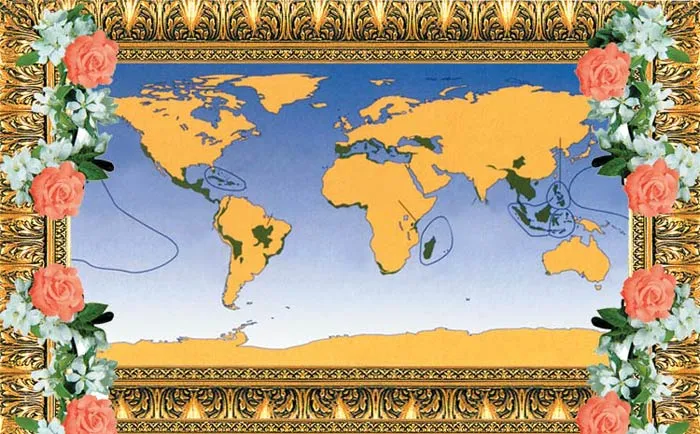
Places particularly rich in terms of species are known as hot spots, and found generally in tropical regions and islands. The organization called Conservation International has stated that while land-dwelling life forms comprise only 1.4% of life on Earth, some 25 hot spots contain roughly half of all land-dwelling species.17
References
- E.O. Wilson, "The Current State of Biological Diversity" in E.O. Wilson, F.M. Peter (editors), Biodiversity, Washington D.C.: National Academy Press, 1988, p. 14. ↩
- E.O. Wilson, "Introduction," in Marjorie L. Reaka-Kudla, Don E. Wilson, Edward O. Wilson (editors), Biodiversity II, Washington D.C.: Joseph Henry Press, 1997, p. 2. ↩
- Andy Purvis, Andy Hector, "Getting the measure of biodiversity," Nature, Vol. 405, 11 May 2000, pp. 213-214. ↩
- Taylor H. Ricketts, "Conservation Biology and Biodiversity", Encyclopedia of Life Sciences, 2001, ğ.els.net. ↩
- Alessandro Minelli, "Diversity of Life", Encyclopedia of Life Sciences, 2000, ğ.els.net. ↩
- N. Myers, R.A. Mittermeier, C.G. Mittermeier, G.A.B. Da Fonseca, J. Kent, "Biodiversity hotspots for conservation priorities," Nature, vol. 403, 24 February 2000, p. 853. ↩