

Reading time: ~3 min read
A single cell nucleus, invisible to our eyes, contains a DNA strip that is 4 meters (13.12 feet) long, packaged inside the nucleus in the form of groups known as "chromosomes" The nuclei of the cells in your body contain a total of 23 chromosome pairs. When chromosomes are magnified under an electron microscope, the DNA molecule inside these chromosomes are seen to be compressed in a spiral form. Despite occupying a very small volume, this packaging system possesses a stunning data-storage capacity, as you'll see in a later chapter.
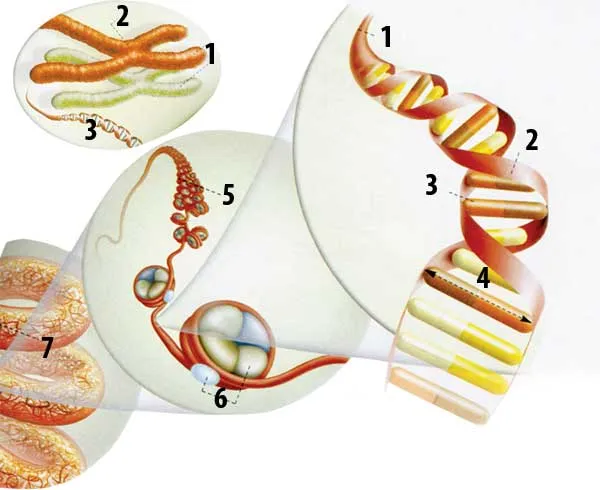
DNA strips contain all the information required to form proteins of all kinds–enzymes, molecular motors, hormones and other building blocks.23 The information encoded in the DNA molecule determines the symmetrical formation of the eyes and ears, the pumping of blood by the heart, the transportation of oxygen to the cells via that blood, the gastric acid that breaks down foodstuffs, and all the body's other physical features. There are around eighty thousand of these kinds of information packets, known as genes, in the human body.24
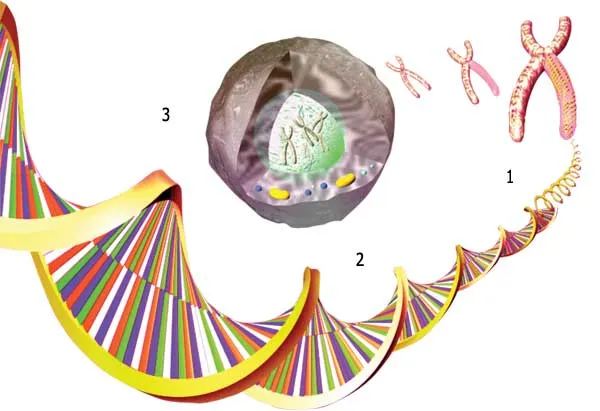
If the total amount of genetic information–the genome, in other words–is compared to a library, every book in that library represents a chromosome, and the chapters in the books are genes. Genes are rather like the headings in a giant encyclopedia, containing a detailed blueprint of a human being's biologic characteristics.25
The chromosomes passed on by way of inheritance are determined by the different arrangements of the four chemical bases constituting the DNA steps. Thousands of these steps, or base pairs, constitute a single gene. James Watson, one of the co-discoverers of DNA's structure, notes that base sequences are the source of the differences in genes:
The four nucleotides were not however, completely different, for each contained the same sugar and phosphate components. Their uniqueness lay in their nitrogenous bases, which were either a purine (adenine and guanine) or a pyrimidine (cytosine and thymine) . . . If the base sequences were always the same, all DNA molecules would be identical. And there would not exist the variability that must distinguish one gene from another.26
From these four base sequences, Allah has created billions of different human beings and keeps creating. Thanks to the flawless order that Allah created in DNA, human beings emerge with a detailed and complex structure and the rich characteristics they possess. In verse 45 of Surat an-Nur it is revealed that:
… Allah creates whatever He wills. Allah has power over all things. (Surat An-Nur, 45)