

Reading time: ~3 min read
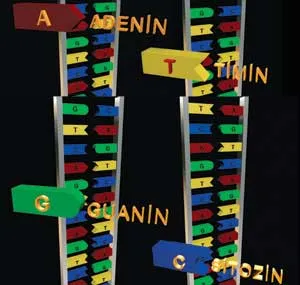
The giant molecule of DNA (deoxyribonucleic acid) that plays a role in all the cell's vital functions consists of carbon, hydrogen, oxygen, nitrogen and phosphate atoms. There are billions of these atoms in a single human DNA molecule,14 all arranged in a manner particular to that individual.
DNA is an acronym of the words deoxyribo, nucleic and acid that express the molecule's chemical structure. This molecule in the nucleus of every human cell consists of nucleic acid arranged in a helix shape like a miniature sphere just 5 microns in diameter.15 (One micron equals one thousandth of a millimeter.) Nucleic acids are exceedingly important compounds, despite making up only 2% of our bodies. The basic structural units of nucleic acids are nucleotides. Some 6 billion nucleotides combine in the double helix that gives rise to DNA.16
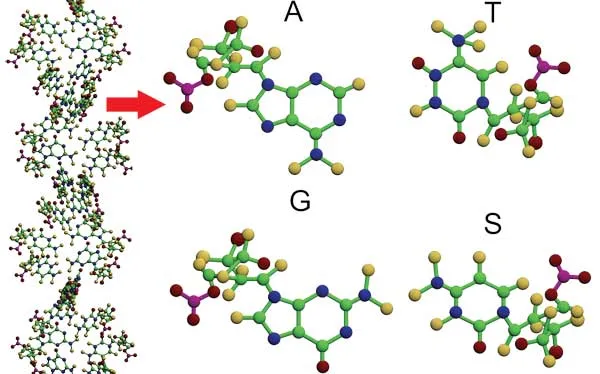
The DNA molecule's structure resembles a spiral staircase, and its architectural regularity amazes scientists. The sides of the staircase, made up of various sugars and phosphates, represent the DNA molecule's dual backbones. The steps, on the other hand, consist of pairs of four conjoined chemical substances known as bases: adenine, thymine, cytosine and guanine. Bases are molecules consisting of between 12 and 16 atoms including carbon, oxygen, hydrogen and nitrogen.17 These chemicals are also specially arranged on the DNA spiral. Only two combinations of arrangements are possible: adenine (A) always bonds to thymine (T), and cytosine (C) always bonds to guanine (G).18
Scientists have established the special sequence in which the atoms making up DNA give rise to nucleotides. But knowing the structure of the building blocks of life is not the same thing as producing them. Indeed, although the correct materials–atoms and the technology to combine them–are available to scientists, they are utterly incapable of making a living DNA molecule. In the Qur'an our Lord reveals that:
It is He Who gives life and causes to die. When He decides on something, He just says to it, "Be!" and it is. (Surah Ghafir, 68)
Your deity is Allah alone, there is no deity but Him. He encompasses all things in His knowledge'. (Surah Ta Ha, 98)
A special creation is evident in the arrangements of the atoms. Every nucleotide contains some 34 atoms. Since there are 6 billion nucleotides in DNA, 204 billion atoms (34 times 6,000,000,000) need to combine chemically to form a single DNA molecule.19 Were you able to process one atom a second and worked eight hours a day for 350 days a year, it would still take you longer than 20,000 years to produce a single DNA molecule.20 Since this is beyond the capacity of even rational human beings, can anyone imagine that the DNA molecule came into existence by chance? Such a thing is of course out of the question. In addition, bear in mind that in the absence of DNA molecules, living things could not exist. Indeed, the slightest error in DNA's structure gives rise to very serious consequences, as the well-known science writer Richard Milton describes:
… [E]ach nucleotide has to be "written" in precisely the correct order and in precisely the correct location in the DNA molecule for the offspring to remain viable, and as described earlier, major functional disorders in humans, animals, and plants are caused by the loss or displacement of a single DNA molecule, or even a single nucleotide within that molecule.21
Every base sequence in the DNA strip–the arrangement of the nucleotides adenine, thymine, cytosine and guanine in the cell nucleus–constitutes a genetic text containing information needed for the building of essential proteins. From that point of view, it is noteworthy that DNA maintains its regular structure on the one hand while on the other having an arrangement that permits information diversity.
References
- Walter L. Starkey, The Cambrian Explosion, WLS Publishing, Ohio, 1999, p. 155. ↩
- Michael J. Denton, Nature's Destiny, Free Press, New York, 1998, p. 149. ↩
- Walter L. Starkey, The Cambrian Explosion, p. 41. ↩
- Lee M. Spetner, Not By Chance, Shattering The Modern Theory of Evolution, The Judaica Press Inc., 1997, p. 213. ↩
- The Incredible Machine, National Geographic Society, Washington DC., 1986, s. 43. ↩
- Walter L. Starkey, The Cambrian Explosion, p. 41. ↩
- Walter L. Starkey, The Cambrian Explosion, p. 41. ↩
- Richard Milton, Shattering the Myths of Darwinism, Park Street Press, Rochester, USA, 1997, p. 170. ↩