

Reading time: ~4 min read
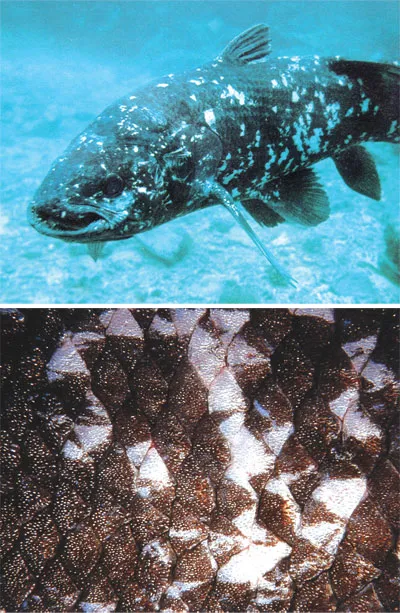
The latest information concerning the coelacanth's complex structure continues to represent a problem for evolutionists. Professor Michael Bruton, director of the world-renowned South African JLB Smith Institute of Ichthyology, says this about the complex characteristics of the coelacanth that have been discovered:
Birth is one of the complex features of this creature. Coelacanths bring their young into the world by giving birth to them. The eggs, the size of an orange, hatch inside the fish. The discovery has also been made that the young are fed thanks to an organ in the mother's body resembling a placenta. As well as providing the young with oxygen and food, the placenta is also a complex organ which removes wastes from respiration and digestion from the babies' bodies. Fossil embryos from the Carboniferous period (360-290 million years ago) show that this complex system existed long before mammals appeared.25
The discovery that the coelacanth is sensitive to electromagnetic currents around it indicates the presence of a complex sensory organ. Looking at the nerves that connect the fish's rostral organ to its brain, scientists agreed that this organ is responsible for detecting electromagnetic currents. The fact that this perfect organ is present in even the most ancient coelacanth fossils, together with its other complex structures, gives rise to a difficulty that evolutionists are unable to resolve.
The problem was described as follows in Focus magazine:
According to fossils, fish emerged some 470 million years ago. The coelacanth emerged 60 million years after that. It is astonishing that this creature, which would be expected to possess very primitive features, actually has a most complex structure.26
For evolutionists expect a gradual evolutionary process. The appearance of the coelacanth with its complex structures, at a time when they expect fictitious primitive life forms to have existed, is of course astonishing. However, for rational people—able to comprehend that God has created all living things and their complex structures in the form and at the time of His choosing—there is nothing at all surprising about it. The flawless specimens created by God are all means whereby we can appreciate His might and power.
A coelacanth caught and frozen in 1966 provided new information about the animal's blood. Apart from the coelacanth, all bony fish (Osteichthyes) meet their water requirements by drinking sea water and expelling the excess salt from their bodies. The coelacanth's system, however, resembles that in cartilaginous fish (Chondrichthyes), which include the shark. The shark converts the ammonia released as the result of the breaking down of proteins into urea, and maintains a level of urea in its bloodstream that would be lethal to human beings. It adjusts the level of these substances in its blood according to the salinity of the water around it. Since the blood assumes an isotonic level with the sea water around it (since the internal and external osmotic pressures are equalized, achieving the same intensity), no water is lost to the outside.
It was revealed that the coelacanth's liver possesses the enzymes necessary to manufacture urea. In other words, it has unique blood properties not found in any other members of its class and that emerged only tens of millions of years later in sharks—members of an entirely different classification.27
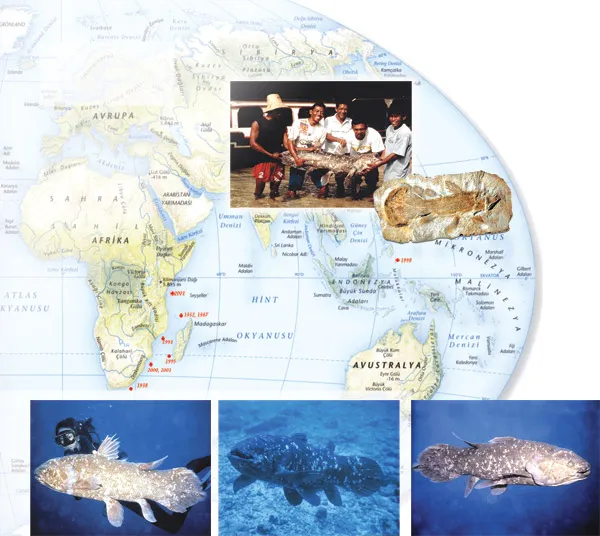
All this goes to show that the coelacanth, portrayed as the greatest link in the supposed evolution of living things, refutes all evolutionist claims, as do countless specimens still living today.
This example clearly demonstrates the kind of wide-ranging propaganda that evolutionists are capable of, based on a single fossil, and how they are able to disseminate that deception with no concrete evidence. Even after the capture of a living coelacanth, notice that they still did not abandon their claims, but continued looking in the living specimen for "a fin undergoing changes to permit walking." They found no evidence to the effect that the coelacanth, whose complex features clearly show it to have been created, was an intermediate form.
They sought to produce evidence against God, but He eliminated all their false proofs. What there is instead, is proof of an immaculate creation.