

Reading time: ~8 min read
The coelacanth is a large fish some 1.5 meters long. Its entire body is covered with scales, reminiscent of armor plating. It belongs to the Osteoichthyes class of bony fishes, of which the earliest fossils date back to the Devonian Period, 360 to 408 million years ago.
Before 1938, coelacanth fossils were depicted as the solution to a major difficulty for evolutionists. They had not found the slightest trace of any of the millions or even billions of intermediate forms that supposedly must have existed. Evolutionists needed evidence to back up the supposed transition of vertebrates from the sea to dry land. For that reason, they took the fossil coelacanth, whose anatomy they believed was ideally suited to this scenario, and began using it for propaganda purposes. They interpreted the creature's fins as "feet about to walk," and a fossilized fat-filled swimbladder in its body as "a primitive lung." The coelacanth was literally a savior for evolutionists bedeviled by such a lack of evidence. Evolutionists had at last laid hands on "one" of the countless missing links that should have numbered in the millions.
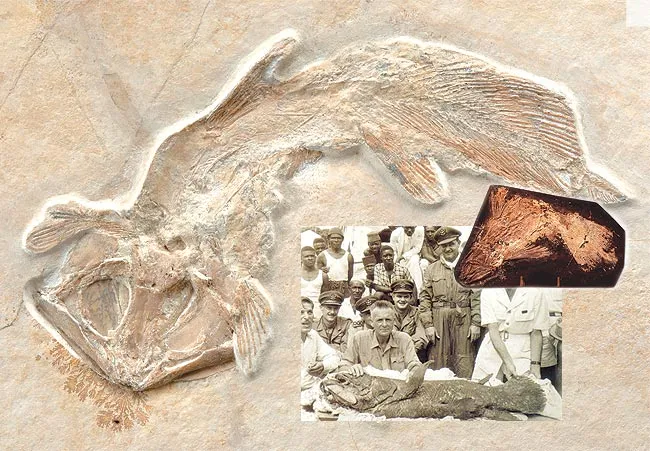
The well known French evolutionist Dr. Jacques Millot, who spent years studying the coelacanth, described how many hid behind it as a lone piece of evidence:
One of the great problems of evolution has been to find anatomical links between the fishes and their land-invading descendants . . . For a long time evolutionists were troubled by this major gap between fishes and the amphibians. But the gap has now been bridged by studies of ancient fishes, and this is where the coelacanth comes in.16
However, this evolutionist excitement was short-lived, when a living coelacanth specimen was captured by fishermen in 1938. This inflicted a terrible disappointment on evolutionists. James Leonard Brierley Smith, an instructor in the Rhodes University Chemistry Department and also honorary director of various fish museums on the South Coast of England, expressed his astonishment in the face of this captured coelacanth:
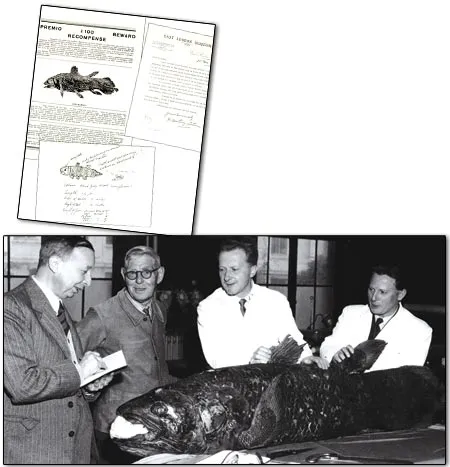
Although I had come prepared, that first sight hit me like a white-hot blast and made me feel shaky and queer, my body tingled. I stood as if striken to stone. Yes, there was not a shadow of doubt, scale by scale, bone by bone, fin by fin, it was true Coelacanth.17
The discovery of this imaginary missing link, once believed to have close links to man's alleged ancestors, in the form of a living fossil, was a most significant disaster for Darwinist circles. The coelacanth, the greatest supposed proof of the theory of evolution, had suddenly been demolished. The most important potential candidate in the fictitious transition from the sea to dry land turned out to be an exceedingly complex life form still alive in deep waters and bearing no intermediate-form characteristics at all. This living specimen dealt a heavy blow to Darwin's theory of evolution. When the fish was introduced to the press in the middle of March 1939, articles about it appeared in newspapers and magazines all over the world, from New York to Sri Lanka. Full-size illustrations of the creature were printed in the Illustrated London News. Alongside the picture was an article by Dr. E. I. White of the British Museum. Titled "One of the Most Amazing Events in the Realm of Natural History in the Twentieth Century," the article described the discovery as "sensational" and claimed that the discovery was as as surprising as the finding of a living example of the 2.5-meter-long Mesozoic dinosaur Diplodocus.18
J. L. B. Smith conducted countless investigations into the coelacanth in the years that followed, devoting literally his entire life to it. He led research in various parts of the world in order to find a living coelacanth at the sea bottom and examine its internal organs in detail. (Since the first captured coelacanth was submitted to Smith only long after the event, it had been impossible to preserve its internal organs.)
A second coelacanth was found in later years. However, the fish died soon after being removed from the deep waters in which it lived and brought to the warm, shallow surface waters. Nonetheless it was still possible to examine its internal organs. The reality encountered by the investigating team, led by Dr. Jacques Millot, was very different to that which had been expected. Contrary to expectations, the fish's internal organs had no primitive features at all, and it bore no features of being an intermediate form, nor of a supposedly primitive ancestor. It had no primitive lung, as evolutionists had been claiming. The structure that evolutionist investigators imagined to be a primitive lung was actually a fat-filled swimbladder.19In addition, the fish, which had been portrayed as a precursor of reptiles, about to emerge onto dry land, was a bottom-dwelling animal, living in the depths of the ocean and never rising above 180 meters.20Even raising it into shallow water led to its death. Therefore, according to Millot, this creature that should have represented the "missing link" they were searching for lacked all the primitive characteristics of a life form alleged to be undergoing a process of evolution.21In other words, the fish was no intermediate form and had lived in the ocean depths with exactly the same complex features for the last 400 million years.
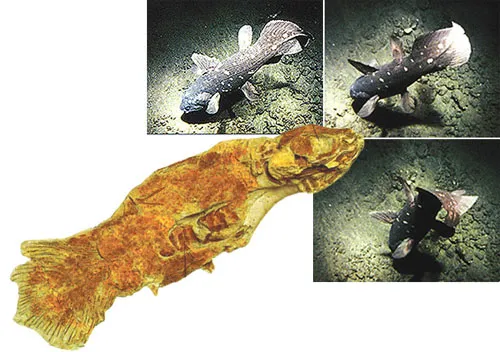
In an article published in Nature magazine, the evolutionist paleontologist Peter Forey said the following:
The discovery of Latimeria [the scientific name of the coelacanth] raised hopes of gathering direct information on the transition of fish to amphibians, for there was then a long-held belief that coelacanths were close to the ancestry of tetrapods. . . . But studies of the anatomy and physiology of Latimeria have found this theory of relationship to be wanting and the living coelacanth's reputation as a missing link seems unjustified.22
All the coelacanths subsequently encountered and studied in their natural habitats again confirmed this fact, and in an even more explicit manner. The idea that the creature had fins undergoing a process of change to enable it to walk was no more than a deception. As the German evolutionist and biologist Hans Fricke, from the Max Planck Institute, said, "I confess I'm sorry we never saw a coelacanth walk on its fins." 23
For Darwinists, the existence and numbers of living fossils was enough of a dilemma all by itself. But when the coelacanth—which they had depicted as an intermediate form and used as propaganda however they chose and portrayed as the "greatest proof of evolution"—turned out to be another living fossil, the problem facing them became a very great difficulty.
This state of affairs did away with all the theories developed by evolutionists regarding living fossils. Darwinists had claimed that in order for a life form to remain unchanged, it had to be "generalized." That is, in order to remain the same, a creature had to be able to live in any environment and feed in every possible way. But with the coelacanth, they were now faced with a highly complex and "specialized" species. The coelacanth lived in deep waters, in a specific environment, and had its own particular way of feeding. This meant that all these claims made by evolutionists were untrue.
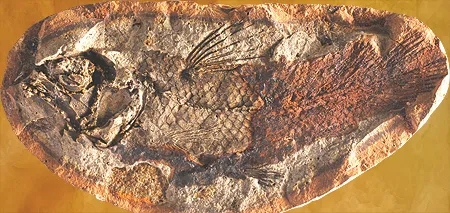
How had this fish managed to withstand changes on the Earth during the course of its own history and thus remained unchanged? According to evolutionists, the continents had undergone changes some 250 million years ago—and thus should have had an effect on the coelacanth, which had already been in existence for 150 million years. Yet for some reason, and despite the changes to its environment, the animal exhibited no alterations at all.
Focus magazine described the position as follows:
According to the scientific facts, all the continents were joined together some 250 million years ago. This enormous area of land was surrounded by a single giant ocean. Around 125 million years ago, the Indian Ocean opened up as the result of continents changing places. The volcanic caves in the Indian Ocean, which form a large part of the coelacanth's natural habitat, came about under the influence of this movement of continents. An important truth emerges in the light of all these facts. These animals, which have been in existence for some 400 million years, have remained unchanged despite the many changes in their natural environment!
This state of affairs precludes any possibility of further debate and confirms that this fish has remained unchanged for millions of years—in other words, that it never evolved. In his book The Story of the Coelacanth, Prof. Keith S. Thomson has this to say on the subject:
Similarly, for instance, the oldest known Coelacanth (Diplocercides) possessed a rostral organ (the term used by zoologists to refer to the sac filled with a jelly-like substance in the skull, and the six tubes attached to it), a special skull articulation, a hollow spinal chord (notochord) and few teeth. In the same way that this shows that the group has remained almost unchanged since the Devonian Period (for 400 million years), it also reveals that there is a huge gap in the fossil record, since we lack the chain of ancestral fossils showing the emergence of all the common features observed in all coelacanths.24
References
- Jacques Millot, "The Coelacanth", Scientific American, vol. 193, December 1955, s. 34 - http://www.creationscience.com/onlinebook/ReferencesandNotes65.html ↩
- Samantha Weinberg, A Fish Caught in Time; The Search For the Coelacanth, Perennial Publishing, 2000, s. 20 ↩
- Samantha Weinberg, A Fish Caught in Time; The Search For the Coelacanth, Perennial Publishing, 2000, s. 28-29-30 ↩
- www.ksu.edu/fishecology/relict.htm ↩
- Bilim ve Teknik, Kasım 1998, Sayı 372, s. 21; http://www.cnn.com/TECH/ Science /9809/23/living.fossil/index.html ↩
- Samantha Weinberg, A Fish Caught in Time; The Search For the Coelacanth, Perennial Publishing, 2000, s. 102 ↩
- P. L. Forey, Nature, vol 336, 1988. s. 7 ↩
- Hans Fricke, "Coelacanths: The Fish That Time Forgot", National Geographic, Vol. 173, No. 6, June 1988, p. 838 - http://www.creationscience.com/onlinebook/ReferencesandNotes65.html ↩
- Focus, Nisan 2003 ↩