

Reading time: ~8 min read
Darwin maintained that if certain chemicals representing the raw material of life were present in a warm lake, proteins could form, and would multiply and combine to give rise to a cell.201 Thousands of scientists attempting to make Darwin's hypothesis a reality and to provide an evolutionary explanation for the origin of life have ventured down that same dead-end road.
In the 1920s, the Russian biochemist Alexander Oparin and the British geneticist J. B. S. Haldane put forward their theory known as "chemical evolution." They maintained what Darwin had imagined-that with the addition of energy, the molecules comprising the raw material, life could develop spontaneously and form a living cell. However, no evolutionist, Oparin included, was able to come up with any evidence to back up the claims of chemical evolution. On the contrary, every new discovery made in the 20th century showed that life was far too complex to have come about by chance. The well-known evolutionist Leslie Orgel makes this confession: " . . . at first glance, one might have to conclude that life could never, in fact, have originated by chemical means."202
Leaving aside the cell for a moment, it is impossible for the nucleotides in DNA's basic structure to have emerged by chance and maintained their chemical properties under the conditions of the primeval Earth. The magazine Scientific American, which follows a pro-evolution line, expresses evolutionist admissions on the subject:
Even the simpler molecules are produced only in small amounts in realistic experiments simulating possible primitive earth conditions. What is worse, these molecules are generally minor constituents of tars: It remains problematical how they could have been separated and purified through geochemical processes whose normal effects are to make organic mixtures more and more of a jumble. With somewhat more complex molecules, these difficulties rapidly increase.203
The German scientists Reinhard Junker and Siegfried Scherer note that the synthesis of the molecules essential for life require very different conditions. This, according to them, shows that there is no possibility of the many different substances necessary for life combining together:
Until now, no experiment is known in which we can obtain all the molecules necessary for chemical evolution. Therefore, it is essential to produce various molecules in different places under very suitable conditions and then to carry them to another place for reaction by protecting them from harmful elements like hydrolysis and photolysis. This combination of events has seemed an incredibly unlikely happenstance, and has often been ascribed to divine intervention.204
In his book The Origin of Life, Dr. John Keosian admits the despairing position in which evolutionists find themselves:
Claims of chemical evolution are unreal. We are asked to believe that biochemical compounds, biochemical reactions and mechanisms, energy metabolism, and storage, specific polymerizations, codes, transcription and translation apparatus, and more, appeared in probiotic [inaudible word], with a function they would have, in a living thing, before there were living things. Chemical evolution has become an end in itself. In many cases it represents contrived or ingenious laboratory syntheses which have no counterpart in abiotic organic chemical synthesis in an acceptable range of probiotic conditions . . . there has been an good deal of uncritical acceptance of experiments, results and conclusions which we are all too ready to acknowledge because they support preconceived convictions. . . All present approaches to a solution of the problem of the origin of life are either irrelevant or lead into a blind alley. Therein lies the crisis.205
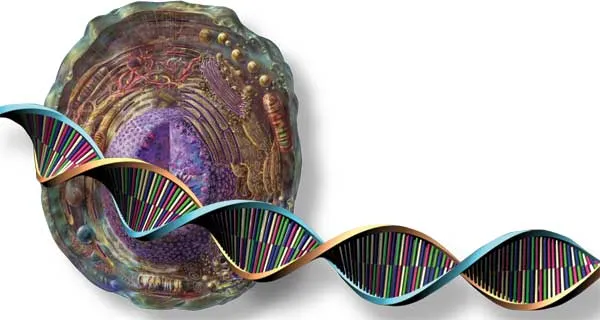
The structure of the DNA molecule also confirms the impossibility of the chemical evolution scenario because when left to itself, the DNA molecule loses its stability. External factors can easily impair the molecule's structure. To a large extent, DNA is stable inside the cell because that it is monitored and repaired by specialized enzymes. It is impossible for the DNA molecule to remain stable and preserve its structure outside the cell, while swimming in the primeval oceans, as evolutionists claim. On the contrary, in the supposed primeval ocean, the molecule would be impaired far more quickly than the rate at which it was synthesized.206 Thaxton, Dr. Roger L. Olsen and Prof. Walter L. Bradley mention how the substances essential for life could not preserve their stability: "It seems probable that in an oceanic chemical soup, the synthesis of RNA and other essential biomolecules would have been short-circuited at nearly every turn by many cross-reactions."207
In fact, when biochemists separate DNA from the cell or synthesizes it in the laboratory, they do not leave it in water-which would cause it to dissolve-or in a jar on the bench at room temperature. In all probability, they store it in a tube with a tightly closed stopper, and in liquid nitrogen in a deep freeze. Yet even under these conditions, the chemical bonds inside the molecule gradually fall apart, and biological effectiveness is gradually lost.208
Evolutionists totally ignore the fact that DNA, RNA and protein molecules would soon be eliminated under natural conditions in the supposed primeval ocean. In his book The Origins of Prebiological Systems, Dr. Carl Sagan admits that the existing scenarios regarding the origin of life are unsatisfactory:
The problem we're discussing is a very general one. We use energy sources to make organic molecules. It is found that the same energy sources can destroy these organic molecules. The organic chemist has an understandable preference for removing the reaction products from the energy source before they are destroyed. But when we talk of the origin of life, I think we should not neglect the fact that degradation occurs as well as synthesis, and that the course of reaction may be different if the products are not preferentially removed. In reconstructing the origin of life, we have to imagine reasonable scenarios which somehow avoid this difficulty.209
In the absence of a cell with the mechanism to read the information in DNA-and to act on those instructions and manufacture protein-the information in DNA will be meaningless. Even if we assume the completely impossible, that the DNA molecule did form spontaneously under the primitive world conditions suggested by evolutionists, the existence of DNA by itself would be meaningless. Despite being evolutionists, Prof. David E. Green and Prof. Robert F. Goldberger express the invalidity of the idea that the cell emerged gradually and spontaneously:
… the macromolecule-to-cell transition is a jump of fantastic dimensions, which lies beyond the range of testable hypothesis. In this area, all is conjecture. The available facts do not provide a basis for postulating that cells arose on this planet.210
In an article titled "Life's Origins Get Murkier and Messier," published in The New York Times in June 2000, the science writer Nicholas Wade wrote, "Everything about the origin of life on earth is a mystery, and it seems the more that is known, the more acute the puzzles get."211 The biochemist Prof. Michael J. Behe summarizes the position of science in terms of the evolutionary scenario:
In private, many scientists admit that science has no explanation for the beginning of life. On the other hand, many scientists think that given the origin of life, its subsequent evolution is easy to envision, despite the major difficulties outlined in this book. The reason for this peculiar circumstance is that while chemists try to test origin-of-life scenarios by experiment or calculation, evolutionary biologists make no attempt to test evolutionary scenarios at the molecular level by experiment or calculation. As a result, evolutionary biology is stuck in the same frame of mind that dominated origin-of-life studies in the early fifties before most experiments had been done: imagination running wild. Biochemistry has, in fact, revealed a molecular world that stoutly resists explanation by the same theory so long applied at the level of the whole organism. Neither of Darwin's black boxes-the origin of life or the origin of vision or other complex biochemical systems-has been accounted for by his theory. Darwin never imagined the exquisitely profound complexity that exists even at the most basic levels of life.212
The point that evolutionists seem determined not to acknowledge is that Darwin was an amateur scientist whose knowledge was too superficial to foresee the molecular complexity of life, and whose analyses were based solely upon observation. Many scientists blindly attached to the theory of evolution are in the same state of ignorance today. Since they lack the courage to tell the truth, out of a fear of losing their prestige, and since they are also unwilling to admit the existence of Allah, they have become part of a mass deception. However, the facts are so evident that apart from a few admissions, evolutionists are left quite speechless. Despite being an evolutionist, the contemporary biochemist Klaus Dose admits the impossibility of life forming spontaneously in the so-called primeval environment:
A further puzzle remains, namely the question of the origin of biological information, i.e., the information residing in our genes today. . . not even the physical building blocks required for the storage of the information can construct themselves: The spontaneous formation of simple nucleotides or even pf polynucleotides which were able to be replicated on the pre-biotic earth should now be regarded as improbable in the light of the very many unsuccessful experiments in this regard.213
Saying that it is "improbable" for life to have emerged by chemical means is tantamount to saying that it is impossible for life to have emerged by chance. Therefore, the theory of evolution, which seeks to account for the origin of life in terms of chance, collapses right at the outset. Since chance cannot represent the origin of life, science clearly demonstrates that life has been created in a flawless manner. Not only the earliest organisms, but all the different living classes on Earth were created individually. Indeed, the fossil record confirms that all species on Earth emerged in a single moment and with all their own particular structures, and without undergoing any previous process of evolution.