

Reading time: ~6 min read
The genetic system does not consist of DNA alone. The enzymes to read the DNA code, the messenger RNA to be produced by this reading, the ribosome to which the messenger RNA travels and bonds with, the transporter RNA that carries the amino acids to be used in that production to the ribosome, and the highly complex enzymes that permit countless other secondary functions-all must be present in the same environment. Moreover, such an environment can only be a cell, where all the requisite raw materials and energy are isolated, available, and completely controlled in all respects.
An organic substance can reproduce itself only in a fully formed cell together with all its various organelles. This means that the first cell with its all extraordinarily complex structures must have come into being in a single moment. In his book Chance and Necessity, the Nobel Prize-winning French biologist Jacques Monod elaborates:
The code is meaningless unless translated. The modern cell's translating machinery consists of at least 50 macromolecular components, which are themselves coded in DNA: the code cannot be translated otherwise than by products of translation themselves. It is the modern expression of omne vivum ex ovo [All life comes from an egg]. When and how did this circle become closed? It is exceedingly difficult to imagine.188
Another Nobel Prize winner, the French scientist Andre Lwoff, states that every molecule inside the cell is a component of an interconnected whole:
An organism is a system of interdependent structures and functions. It consists of cells, and the cells are made of molecules which have to cooperate smoothly. Every molecule must know what the others are doing. It must be able to receive messages and act on them.189
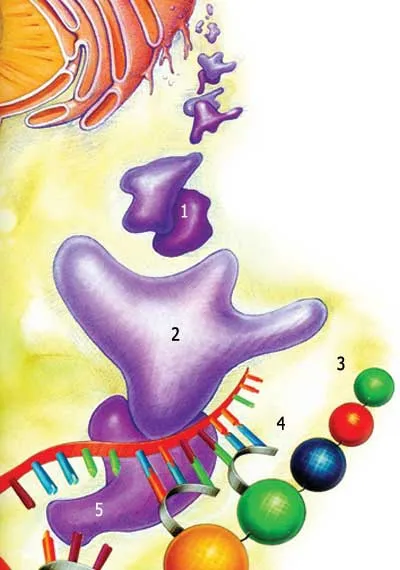
Probability calculations show that complex molecules such as proteins and nucleic acids (RNA and DNA) cannot form one by one as the result of chance. For evolutionists, however, an even greater problem is that these molecules need to be present all together, and at one and the same time, for a cell to function and life to exist. This places the theory of evolution in a completely hopeless position, as is admitted from time to time by evolutionists. One of these is Douglas R. Hofstadter from Indiana University, a professor in a number of fields:
"How did the Genetic Code, along with the mechanisms for its translation (ribosomes and RNA molecules), originate?" For the moment, we will have to content ourselves with a sense of wonder and awe, rather than with an answer. 190
The same truth is also admitted by Prof. Karl Raimund Popper, a 20th century philosopher of science with evolutionist views, who describes this dilemma:
What makes the origin of life and of the genetic code a disturbing riddle is this: the genetic code is without any biological function unless it is translated; that is, unless it leads to the synthesis of the proteins whose structure is laid down by the code. But… the machinery by which the cell translates the code consists of at least fifty macromolecular components which are themselves coded in the DNA. Thus the code cannot be translated except by using certain products of its translation. This constitutes a baffling circle; a really vicious circle, it seems, for any attempt to form a model or theory of the genesis of the genetic code. 191
As Prof. Popper stresses, all the building blocks of the cell and the information belonging to its organelles are recorded in DNA. However, in order for the information in DNA to be used, those building blocks and organelles must already be in existence. This clearly refutes the theory of evolution's claims of gradual development: Organelles cannot exist without the coded information in DNA, just as the coded information in DNA cannot be used without those organelles. Both need to be present at the same time. Therefore, the claim of a transition from simple cells to complex ones is a myth. Despite holding evolutionist views, the zoologist David E. Green and the biochemist Prof. Robert F. Goldberger have this to say in a paper in a scientific journal:
The popular conception of primitive cells as the starting point for the origin of the species is really erroneous. There was nothing functionally primitive about such cells. They contained basically the same biochemical equipment as do their modern counterparts. How, then, did the precursor cell arise? The only unequivocal rejoinder to this question is that we do not know. 192
The theory of evolution seeks to account for all of life in terms of chance, but can never explain the origin of the extraordinary information carefully and flawlessly encoded in DNA. The question, therefore, is not how the DNA chain emerged, because as you have seen, the DNA chain and its extraordinary data capacity would serve no purpose on its own. There must be enzymes to read and replicate the DNA chain, and produce proteins in the light of these copies. In order for life to exist, the data bank of DNA and the systems to reading that data must both exist together. This most important property of the cell is referred to as irreducible complexity. As Prof. Frank B Salisbury says,
Now we know that the cell itself is far more complex than we had imagined. It includes thousands of functioning enzymes, each one of them a complex machine itself. Furthermore, each enzyme comes into being in response to a gene, a strand of DNA. The information content of the gene-its complexity-must be as great as that of the enzyme it controls.193
The absence of even one organelle from a cell, every part of which consists of interconnected systems, will mean that cell fails to function. The cell cannot wait for such a vital deficiency to be rectified gradually, through any supposed process of evolution. It is therefore impossible for a living cell to emerge by random coincidences assembling tiny components over a span of millions of years. The cell's complete unity is too complex for its components to have emerged in stages. In order to survive, the cell must exist as a complete with all its components, right from the very outset. This is another dilemma that the theory of evolution cannot explain away.