

Reading time: ~8 min read
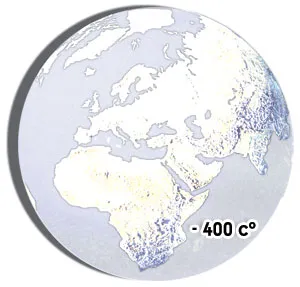
Basically, the hypothesis maintains that the Earth experienced intense ice ages during very early geological periods. Scientists supporting this hypothesis claim that between 750 and 590 million years ago, there were a number of ice ages, each lasting up to 10 million years. During these periods, glaciers up to 1 kilometer (0.621 mile) thick descended as far as the equator, turning the Earth into a ball coated with ice.
This hypothesis, which has been debated since the 1960s, was once again raised by the Harvard University geologist Paul F. Hoffman and Daniel P. Schrag in the 1990s. According to this claim, in the pre-Cambrian, the entire world, without exception—from the Poles to the equator—was covered in a layer of ice. The average surface temperature on Earth was -40 degrees Celsius (-40 degrees Fahrenheit). Again according to this hypothesis, the last of these ice ages lasted for 10 to 20 million years.
The claim that evolutionists use to cloak for the supposed evolutionary appearance of species in the Cambrian Period lies basically in what came next. They suggest that at the end of this ice age, a sudden global warming took place and all the ice melted. Life forms that had existed before the Earth entered this glacial period consisted of single-celled organisms. Afterwards, in some way, matchless, perfect and complex multi-celled organisms evolved among the melting ice caps!
Of course, it is easy to come up with fairy tales. On one evolutionist website, for instance, this allegedly scientific theory is described as follows:
And when that ice started melting in the heat, models show the melting process would have been rapid, taking perhaps as little as 100 years to complete the process. As the heat worked into the ocean, it would have produced hyper-hurricanes and enormous mega-typhoons, unlike anything we see today in scope and severity. The weather would have gone crazy. Storms could have lasted for centuries. Photosynthetic cyano-bacteria rapidly radiated into the now vast swaths of open water and into new coastal shallows which were free of thick ice, and carried the entire ecosystem along with it, producing a burst of evolutionary adaptation we see in the record as the Cambrian Explosion.129
The supposed freeze proposed in the snowball Earth hypothesis caused great excitement among evolutionist scientists, although they were all aware that it was only a hypothesis. Even if such severe freezing did take place, there could have been no possible thaw from it. The freezing’s aftereffects would have left the Earth a barren planet for all eternity. All life would have been eliminated, and it would have been impossible for new species, human beings included, to develop. An article by Kevin Peterson of Dartmouth University in New Hampshire in the 12 April, 2003, edition of New Scientist magazine tackled the question of whether bacteria or algae could have survived in such a great freeze:
I don’t say it’s impossible. You never say “impossible” when you’re talking about life, because there are always some bacteria out there that will prove you wrong. But it’s highly unlikely. You just can’t freeze the whole world over and expect life to survive it [emphasis added].130

The words “a burst of evolutionary adaptation” are actually completely empty. There is no scientific basis for linking changing climatic conditions with the scenario of a transition from single-celled to multi-celled organisms. For that reason, evolutionists have never touched on which fictitious evolutionary mechanisms might have entered the equation to give rise to 50 entirely different phyla.
7 How, for instance, did melting glaciers add new genetic information to the DNA of single-celled organisms? What climatic factors could have endowed the DNA of a single-celled organism with new genetic information for such complex organs as eyes, limbs and antennae? What experimental evidence supports such a scenario? For example, have bacteria kept at very low temperatures in laboratory conditions ever been observed to acquire new genes and develop into multi-celled organisms?
Evolutionists cannot answer these questions, which is why they try to gloss over the subject with far-fetched explanations such as “It happened somehow. Much more complex life forms suddenly evolved as climatic conditions improved.”
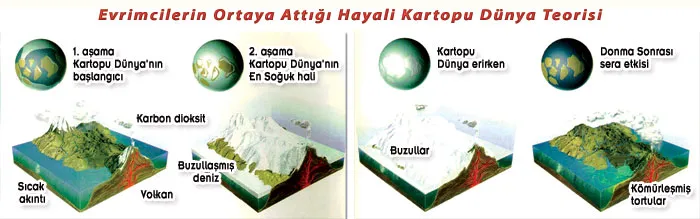
There is no cause-and-effect relationship between the Snowball Earth hypothesis and the Cambrian explosion, merely a chronological link between the two. The explosion took place after—as evolutionists claim—the hypothetical ice ages ended.
In short, any attempt to link the Snowball Earth hypothesis and the origin of multi-celled organisms has no scientific foundation. Evolutionist advocates of the hypothesis are following an empty belief. This article on the subject, published on the BBC’s website, is an indication:
There are some tantalising geological clues that show this theory may be true but the problem is, the clues and the Snowball Earth theory defy the laws of nature.131

It is of course irrational to accept so-called clues opposed to the laws of nature and to subscribe to the Snowball Earth hypothesis. The rational response is to recognize that this theory is bereft of any scientific foundation and is supported for ideological reasons alone; and to accept that the true origin of living things is Allah’s flawless creation.
Gabrielle Walker is a Princeton University science writer and an adherent of evolution. She sought to muster support for the hypothesis in her book Snowball Earth. In an article she wrote for New Scientist, she said the following:
Not a single alternative theory exists to explain one of the most dramatic evolutionary innovations—the leap from single to multicellular organisms. . . . The problem for the Snowball idea is that this explosion happened around 545 million years ago, a good 45 million years after the Snowballs ended. That’s far too long to sit around with a lighted fuse, waiting for the bang. Even Paul [Hoffman] admits this.132
Time is not the only problem, of course. Andrew Parker of the Oxford University Zoology Department declares the invalidity of the Snowball Earth hypothesis in his book In the Blink of an Eye:
[This idea] assumes the course of evolution was predetermined from the beginning. We are given a situation where the Precambrian worm-like bodies of all animal phyla are just itching to take on their Cambrian forms, but ice puts everything on hold. Then, when the ice has gone, it is time for evolution again. This is not an objective view. As we have considered before, why should a convenient worm shape have to change? If the course of evolution was predetermined, why did it not continue in the water under the ice? The second major doubt cast over this laboured explanation for the why of the Cambrian explosion is that the figures simply do not balance. The Cambrian explosion took place between 543 and 538 million years ago. The last Snowball Earth event ended 575 million years ago at the latest. So there is a difference of at least 32 million years between these two events. This is fact. So a Precambrian Snowball Earth event cannot explain the Cambrian explosion, although it could have played a role in the Precambrian “surge.”133
Despite his being an evolutionist, Parker’s words clearly demonstrate the contradictions and logical flaws in the Snowball claim, emphasizing with considerable detail that it is inconsistent in many regards. In fact, many evolutionists have now accepted the Snowball Earth hypothesis as invalid.
To resolve the many uncertainties of that hypothesis, a new theory was put forward. Certain evolutionists regarded the oxygen theory as a lifebelt in order to account for the imaginary evolutionary origin of life.