

Reading time: ~2 min read
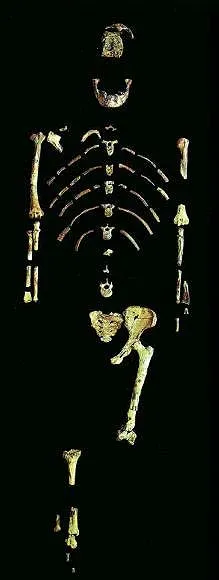
During the course of research in Ethiopia's Hadar Desert in 1974, a 25% intact hominid skeleton estimated to be 3 million years old was discovered and was given the nickname "Lucy." This skeleton, which evolutionists claimed was of a forerunner of present-day man, was 1.20 meters high and had a skull volume of 410 cubic centimeters, which is very small, even by the standard of present-day apes.
Although evolutionists were perfectly well aware that Lucy was nothing more than an extinct form of ape, they ignored all her ape-like characteristics for the sake of the role as the ancestor of man that they had ascribed to her.
The fact is, however, that some Darwinists and Darwinist publications were forced to admit that this creature was nothing more than a monkey. The prestigious French scientific journal Science et Vie adopted Lucy as its cover story in May 1999. The report, titled "Adieu Lucy," stated that apes from the species Australopithecus should be removed from the human family tree.
Evolutionist scientists admitting that Lucy did not constitute evidence for the supposed evolution of man issued these statements.
Richard Leakey:
Echoing the criticism made of his father's habilis skulls, he added that Lucy's skull was so incomplete that most of it was "imagination made of plaster of Paris," thus making it impossible to draw any firm conclusion about what species she belonged to.314
Albert W. Mehlert is an evolutionist and paleoanthropology researcher:
The evidence given above makes it overwhelmingly likely that Lucy was no more than a variety of pygmy chimpanzee, and walked the same way (awkwardly upright on occasions, but mostly quadrupedal). The "evidence" for the alleged transformation from ape to man is extremely unconvincing.315
Jeremy Cherfas is an evolutionist author and has written many books on science:
Lucy, alias Australopithecus afarensis, had a skull very like a chimpanzee's, and a brain to match.316