

Reading time: ~3 min read
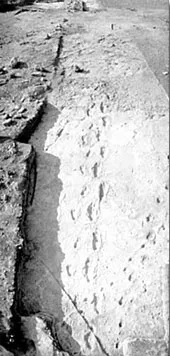
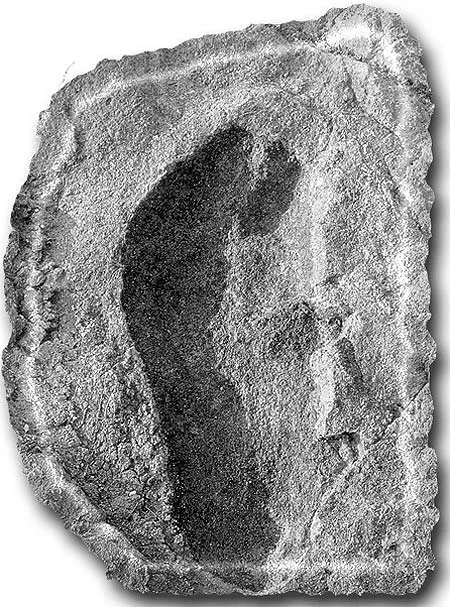
In 1977, Mary Leakey discovered footprints in the Laetoli region of Tanzania. These were in a stratum calculated to be 3.6 million years old and, even more importantly, were identical to those any present-day human being would leave. These footprints were later examined by eminent paleoanthropologists, evolutionist Tim White among them.
Tim White:
Make no mistake about it,... They are like modern human footprints. If one were left in the sand of a California beach today, and a four-year old were asked what it was, he would instantly say that somebody had walked there. He wouldn't be able to tell it from a hundred other prints on the beach, nor would you.329
Louise Robbins is the anthropologist who worked closely with Mary Leakey on the Laetoli project:
The arch is raised-the smaller individual had a higher arch than I do-and the big toe is large and aligned with the second toe... The toes grip the ground like human toes. You do not see this in other animal forms.330
Russell H. Tuttle is professor of anthropology at the University of Chicago:
A small barefoot Homo sapiens could have made them... In all discernible morphological features, the feet of the individuals that made the trails are indistinguishable from those of modern humans.331
In sum, the 3.5 million-year-old footprint traits at Laetoli site G resemble those of habitually unshod modern humans. None of their features suggest that the Laetoli hominids were less capable bipeds than we are. If the G footprints were not known to be so old, we would readily conclude that there were made by a member of our genus Homo... In any case, we should shelve the loose assumption that the Laetoli footprints were made by Lucy's kind, Australopithecus afarensis.332
Elaine Morgan is an evolutionist writer and researcher for documentary television in Britain:
Four of the most outstanding mysteries about humans are: 1) Why do they walk on two legs? 2) why have they lost their fur? 3) why have they developed such large brains? 4) why did they learn to speak?
The orthodox answers to these questions are: 1) "We do not yet know"; 2) "We do not yet know"; 3) "We do not yet know"; 4) "We do not yet know." The list of questions could be considerably lengthened without affecting the monotony of the answers.333
Lord Solly Zuckerman is professor of anatomy at Birmingham University and chief scientific adviser to the British government:
We then move right off the register of objective truth into those fields of presumed biological science, like extrasensory perception or the interpretation of man's fossil history, where to the faithful, anything is possible-and where the ardent believer is sometimes able to believe several contradictory things at the same time.334
Lord Zuckerman candidly stated that if special creation did not occur, then no scientist could deny that man evolved from some apelike creature, without leaving any fossil traces of the steps of the transformation.335
Robert Eckhardt is Professor of Anthropology at Penn State University:
Neither is there compelling evidence for the existence of any distinct hominid species during this interval, unless the designation "hominid" means simply an individual ape that happens to have small teeth and a correspondingly small face.336