
Reading time: ~6 min read
Because the claim that different species descended from a common ancestor is not supported by the findings of observational biology, the main branch of science that can shed light on the subject is paleontology, the science of fossils. Evolution is a process claimed to have happened in the past, and the only scientific source that can tell us about the history of life is the fossil record. The famous French zoologist Pierre Grassé says:
Naturalists must remember that the process of evolution is revealed only through fossil forms… only paleontology can provide them with the evidence of evolution and reveal its course or mechanisms.1
According to the theory of evolution, all living things descended from one another. A previously existing species turned into another over time, and all species came into being this way. According to the theory, this transformation took place gradually over hundreds of millions of years. In that case, countless “intermediate species” must have formed and lived during this supposed long process of transformation (see The Claim of Intermediate-Form Fossils Is a Deception).
The number of these intermediate forms should even be greater than the number of animal species we know today. Darwin himself explained the great dilemma this posed for his theory in the chapter of The Origin of Species titled “Difficulties on Theory”:
Why, if species have descended from other species by insensibly fine gradations, do we not everywhere see innumerable transitional forms? Why is not all nature in confusion instead of the species being, as we see them, well defined?… But, as by this theory innumerable transitional forms must have existed, why do we not find them embedded in countless numbers in the crust of the earth?… Why then is not every geological formation and every stratum full of such intermediate links? Geology assuredly does not reveal any such finely graduated organic chain; and this, perhaps, is the most obvious and gravest objection which can be urged against my theory.2
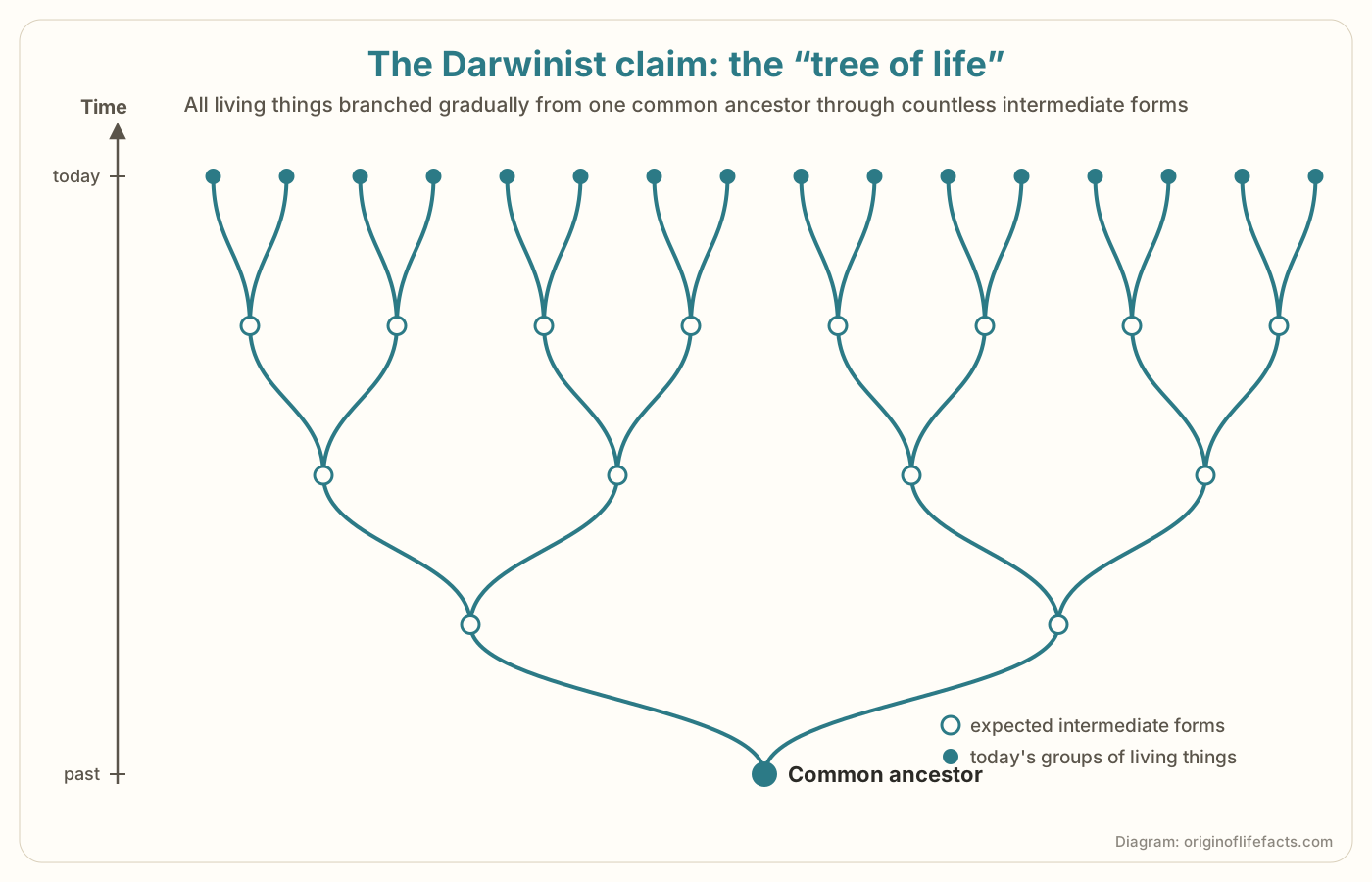
The theory of evolution claims that the main groups of living things (phyla) arose from a single common ancestor and developed by diverging over time. The diagram above expresses this claim: according to Darwinism, living things should have separated from one another like an ever-branching tree.
The fossil record shows exactly the opposite. As the diagram below shows, different groups of living things appeared on Earth all at once, each with its own distinct structure.
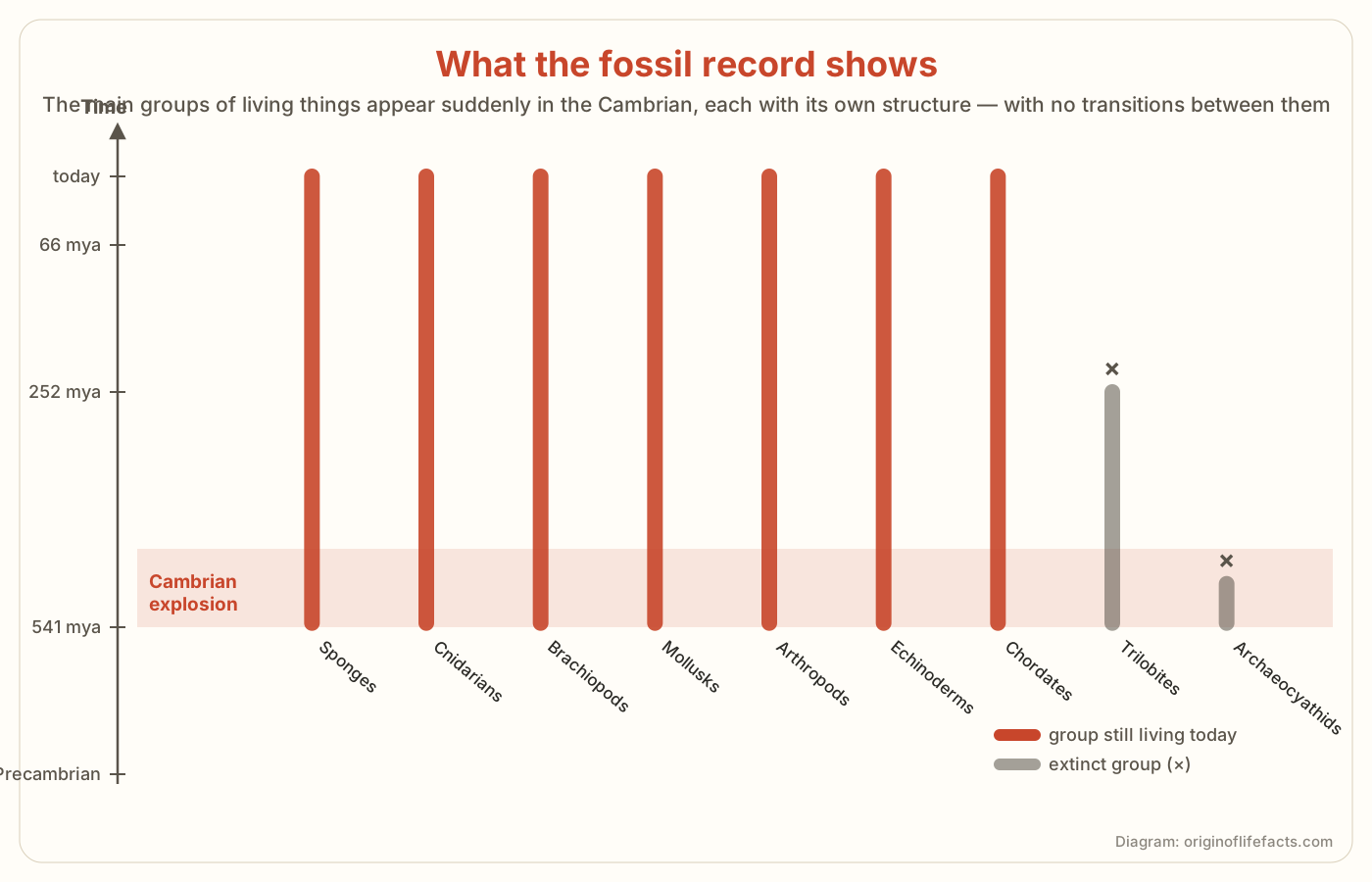
In the Cambrian period, nearly 100 basic types of living things (phyla) appeared all at once. Afterwards the number of these types did not increase; on the contrary, it decreased (because some of them became extinct).
The “Intermediate Forms Will Be Found in the Future” Argument
Faced with the absence of intermediate-form fossils, Darwin argued in the 19th century that “intermediate forms are missing now, but they may be found by further research.” That argument no longer holds. Today's paleontological data show that the fossil record is extraordinarily rich. From billions of fossil specimens collected in different parts of the world, 250,000 different species have been identified, and these bear a striking resemblance to the roughly 1.5 million species living today.3 Since not a single intermediate form has been found despite such a rich fossil supply, it does not seem possible that new excavations will turn them up. T. Neville George, professor of paleontology at the University of Glasgow, acknowledged this truth years ago:
There is no need to apologize any longer for the poverty of the fossil record. In some ways it has become almost unmanageably rich, and discovery is outpacing integration… The fossil record nevertheless continues to be composed mainly of gaps.4
Niles Eldredge, the well-known paleontologist of the American Museum of Natural History, explains that Darwin's claim — “the fossil record is insufficient, that is why we cannot find intermediate forms” — is not valid:
The record jumps, and all the evidence shows that the record is real: the gaps we see reflect real events in life's history — not the artifact of a poor fossil record.5
A False Impression in the Scientific World
When the fossil record is mentioned, many people get the impression that there is a positive relationship between it and Darwin's theory. An article in the journal Science describes this misconception:
A large number of well-trained scientists outside of evolutionary biology and paleontology have unfortunately gotten the idea that the fossil record is far more Darwinian than it is. This probably comes from the oversimplification inevitable in secondary sources: low-level textbooks, semipopular articles, and so on. Also, there is probably some wishful thinking involved. In the years after Darwin, his advocates hoped to find predictable progressions. In general these have not been found yet the optimism has died hard, and some pure fantasy has crept into textbooks.6
Eldredge and Tattersall make this important comment on the subject:
That individual kinds of fossils remain recognizably the same throughout the length of their occurrence in the fossil record had been known to paleontologists long before Darwin published his Origin. Darwin himself… prophesied that future generations of paleontologists would fill in these gaps by diligent search… One hundred and twenty years of paleontological research later, it has become abundantly clear that the fossil record will not confirm this part of Darwin's predictions. Nor is the problem a miserably poor record. The fossil record simply shows that this prediction is wrong.
The observation that species are amazingly conservative and static entities throughout long periods of time has all the qualities of the emperor's new clothes: everyone knew it but preferred to ignore it. Paleontologists, faced with a recalcitrant record obstinately refusing to yield Darwin's predicted pattern, simply looked the other way.7
The American paleontologist S. M. Stanley explains how this truth revealed by the fossil record has been overlooked — and forced to be overlooked — by the Darwinist dogma that dominates the scientific world:
The known fossil record is not, and never has been, in accord with gradualism. What is remarkable is that, through a variety of historical circumstances, even the history of opposition has been obscured… as the biological historian William Coleman has recently written, “The majority of paleontologists felt their evidence simply contradicted Darwin's stress on minute, slow, and cumulative changes leading to species transformation.”… but their story has been suppressed.8
References
- Pierre Grassé, Evolution of Living Organisms, New York, Academic Press, 1977, p. 82 ↩
- Charles Darwin, The Origin of Species, pp. 172, 280 ↩
- David Day, Vanished Species, Gallery Books, New York, 1989 ↩
- T. N. George, “Fossils in Evolutionary Perspective,” Science Progress, vol. 48, January 1960, pp. 1, 3 ↩
- N. Eldredge and I. Tattersall, The Myths of Human Evolution, Columbia University Press, 1982, p. 59 ↩
- Science, July 17, 1981, p. 289 ↩
- N. Eldredge and I. Tattersall, The Myths of Human Evolution, Columbia University Press, 1982, pp. 45–46 ↩
- S. M. Stanley, The New Evolutionary Timetable: Fossils, Genes, and the Origin of Species, Basic Books, New York, 1981, p. 71 ↩