Reading time: ~2 min read
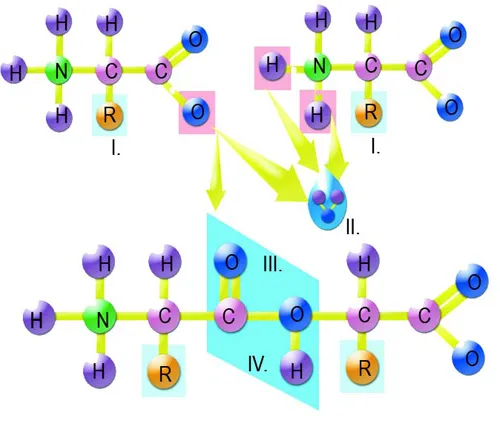
It’s not enough for the varieties of amino acid necessary to form a protein to be in the appropriate number and sequence and to have the needed three-dimensional structure. They must also bond to one another by specific amino acid molecules with more than one arm. The bond formed in this way is known as a peptide bond.
Amino acids may attach to one another by a variety of different bonds, but proteins can emerge only from amino acids attached to one another by peptide bonds.
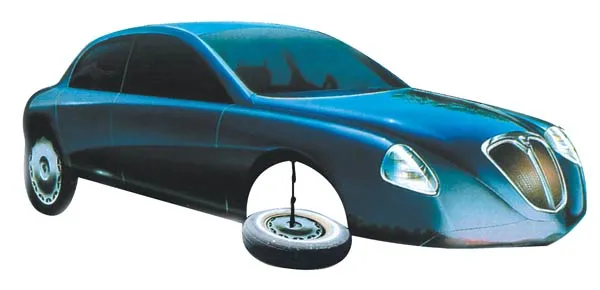
To use analogy, imagine that all the components of an automobile are present, and in just the right place. However, let one of the wheels be attached by a coil of wire rather than by bolts. No matter how powerful or how technologically advanced that car’s engine may be, that car will still be unable to cover any distance. Everything else appears to be in order, yet one of the wheels being attached in a wrong way makes the whole car functionless. In the same way, if just a single amino acid in a protein molecule is attached by some other bond than a peptide bond, the entire molecule will be useless.
Research has revealed that random bonding of amino acids results in 50% peptide bonds at most, the rest being attached by bonds that are not found in proteins. Therefore, in calculating the probability of a protein coming into being by chance, we must include the requirement that all amino acids be left-handed, and the fact that every amino acid can only be attached to the others by a peptide bond. If we consider a 400-amino acid protein, the chances of all the amino acids being attached to one another by peptide bonds alone is 1 in 2399 —a figure that cannot possibly be achieved by random factors.