

Reading time: ~7 min read

The German biologist Hoimar von Ditfurth, a prominent evolutionist, is a good example of this bigoted materialist understanding. After Ditfurth cites an example of the extremely complex composition of life, this is what he says concerning the question of whether it could have emerged by chance or not:
Is such a harmony that emerged only out of coincidences possible in reality? This is the basic question of the whole of biological evolution. Answering this question as "Yes, it is possible" is something like verifying faith in the modern science of nature. Critically speaking, we can say that somebody who accepts the modern science of nature has no other alternative than to say "yes", because he aims to explain natural phenomena by means that are understandable and tries to derive them from the laws of nature without reverting to supernatural interference. However, at this point, explaining everything by means of the laws of nature, that is, by coincidences, is a sign that he has nowhere else to turn. Because what else could he do other than believe in coincidences?177
As Ditfurth states, the materialist scientific approach adopts as its basic principle explaining life by denying "supernatural interference", i.e. creation. Once this principle is adopted, even the most impossible scenarios are easily accepted. It is possible to find examples of this dogmatic mentality in almost all evolutionist literature.
Professor Ali Demirsoy, the well-known advocate of evolutionary theory in Turkey, is just one of many. As we have already pointed out, according to Demirsoy: the probability of the coincidental formation of cythochrome-C, an essential protein for life, is "as unlikely as the possibility of a monkey writing the history of humanity on a typewriter without making any mistakes"178
There is no doubt that to accept such a possibility is actually to reject the basic principles of reason and common sense. Even one single correctly formed letter written on a page makes it certain that it was written by a person. When one sees a book of world history, it becomes even more certain that the book has been written by an author. No logical person would agree that the letters in such a huge book could have been put together "by chance".
However, it is very interesting to see that the "evolutionist scientist" Professor Ali Demirsoy accepts this sort of irrational proposition:
In essence, the probability of the formation of a cytochrome-C sequence is as likely as zero. That is, if life requires a certain sequence, it can be said that this has a probability likely to be realised once in the whole universe. Otherwise some metaphysical powers beyond our definition must have acted in its formation. To accept the latter is not appropriate for the scientific goal. We thus have to look into the first hypothesis.179
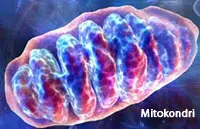
Demirsoy writes that he prefers the impossible, in order "not to have to accept supernatural forces"-in other words, the existence of a Creator. It is clear that this approach has no relation whatsoever with science. Not surprisingly, when Demirsoy cites another subject-the origins of the mitochondria in the cell-he openly accepts coincidence as an explanation, even though it is "quite contrary to scientific thought".
The heart of the problem is how the mitochondria have acquired this feature, because attaining this feature by chance even by one individual, requires extreme probabilities that are incomprehensible... The enzymes providing respiration and functioning as a catalyst in each step in a different form make up the core of the mechanism. A cell has to contain this enzyme sequence completely, otherwise it is meaningless. Here, despite being contrary to biological thought, in order to avoid a more dogmatic explanation or speculation, we have to accept, though reluctantly, that all the respiration enzymes completely existed in the cell before the cell first came in contact with oxygen.180
The conclusion to be drawn from such pronouncements is that evolution is not a theory arrived at through scientific investigation. On the contrary, the form and substance of this theory were dictated by the requirements of materialistic philosophy. It then turned into a belief or dogma in spite of concrete scientific facts. Again, we can clearly see from evolutionist literature that all of this effort has a "purpose"-and that purpose precludes any belief that all living things were not created no matter what the price.
Evolutionists define this purpose as "scientific". However, what they refer to is not science but materialist philosophy. Materialism absolutely rejects the existence of anything "beyond" matter (or of anything supernatural). Science itself is not obliged to accept such a dogma. Science means exploring nature and deriving conclusions from one's findings. If these findings lead to the conclusion that nature is created, science has to accept it. That is the duty of a true scientist; not defending impossible scenarios by clinging to the outdated materialist dogmas of the 19th century.