

Reading time: ~9 min read
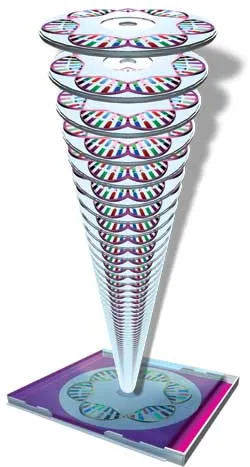
Can the information inside DNA be reduced to matter, as materialists would have us believe? Or can DNA be regarded as only a collection of matter, with the information it contains emerging through random interactions of matter?
All the scientific research carried out in the 20th century, the results of all the experiments and observations, show that life definitely does not consist of matter alone. As the leading information theoretician and biophysicist Hubert Yockey puts it: "Like all messages, the life message is non-material but has an information content measurable in bits and bytes."133
The scientist Dean Overman says that "information contained in the genetic code, like all information or messages, is not made of matter . . . The meaning is not a property of the arrangement of the symbols or alphabet of the code. The message or meaning in the genetic code is non-material and cannot be reduced to a physical or chemical property."134
Prof. Phillip Johnson says:
First, life consist not just of matter (chemicals) but of matter and information. Second, information is not reducible to matter, but is a different kind of "stuff" altogether. A theory of life thus has to explain not just the origin of matter but also the independent origin of the information. Third complex, specified information of the kind found in a book or a biological cell cannot be produced either by chance or at the direction of physical and chemical laws.135
In his book In the Beginning Was Information, the information theoretician Prof. Werner Gitt also states that life cannot be reduced to matter alone:
Matter and energy are basic prerequisites for life, but they cannot be used to distinguish between living and inanimate systems. The central characteristic of all living beings is the "information" they contain, and this information regulates all life processes and procreative functions. Transfer of information plays a fundamental role in all living organisms. When, for example, insects carry pollen from one flower to another, this is in the first place an information-carrying process (genetic information is transferred); the actual material employed is of no concern. Although information is essential for life, information alone does not at all comprise a complete description of life.136
The fact that the genetic code contains non-material information shows that evolutionists' dreams regarding the genetic code are unfounded right from the outset. Their scenarios assume that matter somehow organized itself in order to give rise to the genetic code and genetic information. But since matter is unable to spontaneously produce that genetic code, all materialist explanations are totally meaningless.
Furthermore, the arrangement of the genetic letters in DNA is of vital importance for life. Nucleotides are meaningless on their own, by coming together in particular sequence, they give rise to genes that carry meaningful information that significantly distinguishes DNA from other structures seen in nature. Prof. Phillip Johnson refers to this property of DNA in these terms:
The important thing about DNA is not the chemicals but the information in the software, just as the important thing about a computer program or a book is the information content and not the physical medium in which that information is recorded. … metabolism and reproduction cannot get started until an enormous amount of complex information is already in existence.137
As Johnson states, the random combination of chemical substances cannot establish the necessary conditions for organisms to live and reproduce. Chemical substances must be assembled in such a way as to constitute the comprehensive and meaningful information in DNA. It is impossible to find such an intention in atoms and molecules. The source of this information is Omniscient and Almighty Allah, the Creator of all things on the Earth and in the sky. The well-known theoretical physicist Paul Davies describes the value of genetic information from this perspective:
... [T]he distinctive feature of biological information is that it is replete with meaning. DNA stores the instructions needed to build a functioning organism; it is a blueprint or an algorithm [a logical step-by-step procedure] for a specified, predetermined product. Snowflakes don't code for, or symbolize, anything, whereas genes most definitely do. . . It is the quality, not the mere existence, of information that is the real mystery here.138
Paul Davies refers to the origin of genetic information as a "mystery" because no materialist account for the information inside DNA can be given. Materialism has once again collapsed in the face of the fact of creation. The chemist Michael Polanyi, an eminent 20th century philosopher of science, states that there can be no materialist explanation for the transmission of the information in DNA:
The life process is essentially the development of a fertilized cell, as the result of information imparted by DNA. Transmission of this information is nonchemical and nonphysical, and is the controlling factor in the life process. The description of a living system therefore transcends the chemical and physical laws which govern its constituents.139
In "Information in the Holographic Universe" an article published in Scientific American magazine, the theoretical physicist Prof. Jacob D. Bekenstein describes the importance of information:
Ask anybody what the physical world is made of, and you are likely to be told "matter and energy." Yet if we have learned anything from engineering, biology and physics, information is just as crucial an ingredient. The robot at the automobile factory is supplied with metal and plastic but can make nothing useful without copious instructions telling it which part to weld to what and so on. A ribosome in a cell in your body is supplied with amino acid building blocks and is powered by energy released by the conversion of ATP to ADP, but it can synthesize no proteins without the information brought to it from the DNA in the cell's nucleus. Likewise, a century of developments in physics has taught us that information is a crucial player in physical systems and processes.140
When you look at evolutionist writings, you can see that they sometimes admit that their theory is at a complete impasse in the face of the information in living things. One outspoken authority on this subject is the French zoologist Pierre-Paul Grassé. Despite being a materialist and an evolutionist, Grassé admits that the most important fact to invalidate Darwinism is the information constituting life:
Any living being possesses an enormous amount of "intelligence," very much more than is necessary to build the most magnificent of cathedrals. Today, this "intelligence" is called "information," but it is still the same thing. It is not programmed as in a computer, but rather it is condensed on a molecular scale in the chromosomal DNA or in that of any other organelle in each cell. This "intelligence" is the sine qua non of life. If absent, no living being is imaginable. Where does it come from? This is a problem which concerns both biologists and philosophers and, at present, science seems incapable of solving it.141

The reason why Grassé says "science seems incapable of solving it" is his unwillingness to regard any non-materialist explanation as scientific. In fact, however, that science itself refutes the assumptions of materialist philosophy and proves the existence of a Creator. Grassé and other materialist scientists close their eyes to this, or else say "Science is unable to explain." Because they are materialists first and scientists second, and they persist in believing in materialism, even if science proves the exact opposite.
This striking fact concerning DNA-the fact that genetic information cannot be accounted for in terms of matter and energy or natural laws-continues to represent an insuperable barrier in front of the theory of evolution. Prof. Werner Gitt, director of the German Federal Institute of Physics and Technology says this:
The fundamental quantity information is nonmaterial (mental) entity. It is not a property of matter, so that purely material processes are fundamentally precluded as sources of information…there is no known law of nature, no known process and no known sequence of events which can cause information to originate by itself in matter.142
In another extract, Gitt states that information can only exist by being created:
Biological information . . . has a very high storage density and that it obviously employs extremely ingenious concepts. . . .it is clear that the information present in living organisms requires an intelligent source. Man could not have been this source, so that the only remaining possibility is that there must have been a Creator.143

Gitt's words are also the conclusions reached by the Information Theory, regarded as part of thermodynamics and developed over the last 20 to 30 years. Information theory investigates the structure and origin of the information in the universe. The conclusion reached thanks to lengthy research by information theoreticians is that information is something different from matter. It can never be reduced to matter. The origins of information and matter must be investigated separately.
The origin of the information in DNA is a dilemma that materialists can never resolve. The origin of the information encoded in the DNA molecule can never be accounted for through any natural mechanism. All observations, experiments, and experience show that information can emanate only from a conscious entity. The information in DNA is the work of Almighty Allah, the Creator of all life. In the Qur'an, our Lord's creative artistry and infinite power are described in these terms:
That is Allah, your Lord. There is no deity but Him, the Creator of everything. So worship Him. He is responsible for everything. Eyesight cannot perceive Him but He perceives eyesight. He is the All-Penetrating, the All-Aware. (Surat al-An'am, 102-103)
References
- Hubert Yockey, "Information in Bits and Bytes", BioEssays, 1995, Vol. 17, p. 85. ↩
- Dean L. Overman, A Case Against Accident and Self-Organization, Rowman & Littlefield Publishers, 1997, p. 37. ↩
- Phillip E. Johnson, Defeating Darwinism by Opening Minds, InterVarsity Press, Illionis, 1997, p. 75. ↩
- Werner Gitt, In the Beginning was Information, p. 89. ↩
- Phillip E. Johnson, The Wedge of Truth, p. 53. ↩
- Paul Davies, The Fifth Miracle: The Search for the Origin and Meaning of Life, Simon & Schuster, 1999, p. 60. ↩
- Michael Polanyi, "Life Transcending Physics and Chemistry", Chemical & Engineering News, Vol 45, no. 35, 21 August 1967, p. 56. ↩
- Jacob D. Bekenstein, "Information in the Holographic Universe", Scientific American, 14 July 2003, p. 59. ↩
- Pierre P. Grassé, The Evolution of Living Organisms, 1977, p. 2. ↩
- Werner Gitt, In the Beginning was Information, pp. 47, 107. ↩
- Ibid., p. 97. ↩