

Reading time: ~4 min read
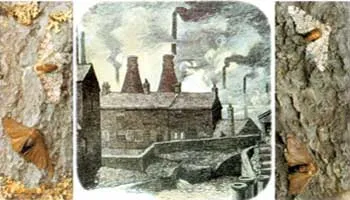
In 1986 Douglas Futuyma published a book, The Biology of Evolution, which is accepted as one of the sources explaining the theory of evolution by natural selection in the most explicit way. The most famous of his examples on this subject is about the colour of the moth population, which appeared to darken during the Industrial Revolution in England. It is possible to find the story of the Industrial Melanism in almost all evolutionist biology books, not just in Futuyma's book. The story is based on a series of experiments conducted by the British physicist and biologist Bernard Kettlewell in the 1950s, and can be summarised as follows:
According to the account, around the onset of the Industrial Revolution in England, the colour of the tree barks around Manchester was quite light. Because of this, dark-coloured (melanic) moths resting on those trees could easily be noticed by the birds that fed on them and therefore they had very little chance of survival. Fifty years later, in woodlands where industrial pollution has killed the lichens, the barks of the trees had darkened, and now the light-colored moths became the most hunted, since they were the most easily noticed. As a result, the proportion of light-coloured moths to dark-coloured moths decreased. Evolutionists believe this to be a great piece of evidence for their theory. They take refuge and solace in window-dressing, showing how light-coloured moths "evolved" into dark-coloured ones.
However, even if we assume these to be correct, it should be quite clear that they can in no way be used as evidence for the theory of evolution, since no new form arose that had not existed before. Dark colored moths had existed in the moth population before the Industrial Revolution. Only the relative proportions of the existing moth varieties in the population changed. The moths had not acquired a new trait or organ, which would cause "speciation". In order for one moth species to turn into another living species, a bird for example, new additions would have had to be made to its genes. That is, an entirely separate genetic program would have had to be loaded so as to include information about the physical traits of the bird.
This is the answer to be given to the evolutionist story of Industrial Melanism. However, there is a more interesting side to the story: Not just its interpretation, but the story itself is flawed. As molecular biologist Jonathan Wells explains in his book Icons of Evolution, the story of the peppered moths, which is included in every evolutionist biology book and has therefore, become an "icon" in this sense, does not reflect the truth. Wells discusses in his book how Bernard Kettlewell's experiment, which is known as the "experimental proof" of the story, is actually a scientific scandal. Some basic elements of this scandal are:
- Many experiments conducted after Kettlewell's revealed that only one type of these moths rested on tree trunks, and all other types preferred to rest beneath small, horizontal branches. Since 1980 it has become clear that peppered moths do not normally rest on tree trunks. In 25 years of fieldwork, many scientists such as Cyril Clarke and Rory Howlett, Michael Majerus, Tony Liebert, and Paul Brakefield concluded that "in Kettlewell's experiment, moths were forced to act atypically, therefore, the test results could not be accepted as scientific".
- Scientists who tested Kettlewell's conclusions came up with an even more interesting result: Although the number of light moths would be expected to be larger in the less polluted regions of England, the dark moths there numbered four times as many as the light ones. This meant that there was no correlation between the moth population and the tree trunks as claimed by Kettlewell and repeated by almost all evolutionist sources.
- As the research deepened, the scandal changed dimension: "The moths on tree trunks" photographed by Kettlewell, were actually dead moths. Kettlewell used dead specimens glued or pinned to tree trunks and then photographed them. In truth, there was almost no possibility of taking such a picture as the moths rested not on tree trunks but underneath the leaves.16
These facts were uncovered by the scientific community only in the late 1990s. The collapse of the myth of Industrial Melanism, which had been one of the most treasured subjects in "Introduction to Evolution" courses in universities for decades, greatly disappointed evolutionists. One of them, Jerry Coyne, remarked:
My own reaction resembles the dismay attending my discovery, at the age of six, that it was my father and not Santa who brought the presents on Christmas Eve.17
Thus, "the most famous example of natural selection" was relegated to the trash-heap of history as a scientific scandal which was inevitable, because natural selection is not an "evolutionary mechanism," contrary to what evolutionists claim. It is capable neither of adding a new organ to a living organism, nor of removing one, nor of changing an organism of one species into that of another.