

Reading time: ~3 min read
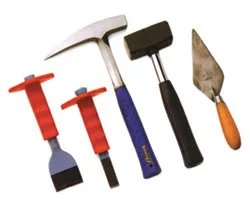
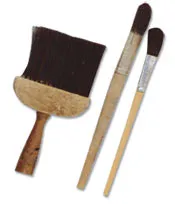
The tools used to collect fossils are simple ones such as those used by geologists: hammers, trowels, various cutting implements, compasses, brushes and sieves.
Fossils sometimes appear on the surface when eroded out of the soft rock strata around them. In such cases, it is sufficient to clean the fossils with a brush. However, fossil collecting is not usually that easy. The rocks inside which they are concealed are generally very hard, and it can take hours to extract a fossil from its rocky matrix. First, it is important to determine from what point the rock should be broken. Fracture lines are identified in the light of the rock bed itself. Every type of rock is broken in different ways. Schists, for example, have layers through which fracture lines can be established. Chalk, on the other hand, offers no such layers. At the same time, it is very important to watch for such indications as color changes or structural differences, if the fossils contained inside are not to be damaged.
After the fossil has been extracted from the rock, it undergoes a number of different processes. It must be protected and reinforced while being transported to the laboratory where it will be examined. One of the methods employed is to stabilize the fossil with chemical adhesives. Plaster casts are used for very large fossils. Those parts of the fossil that will be at risk during transportation are wrapped in dampened newspaper and then dipped in plaster.
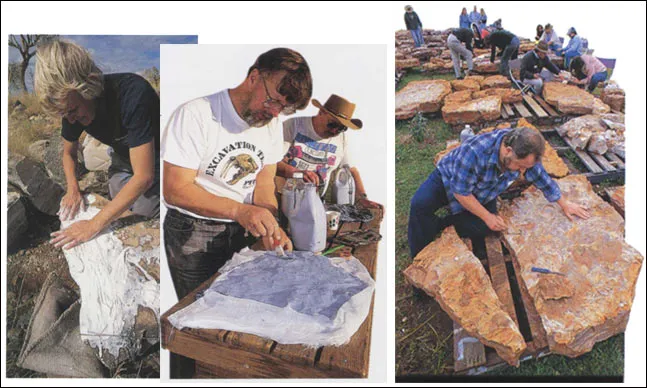
The fossil then must be cleaned in order for all its details to become visible. If the fossil is harder than the rock surrounding it, then the cleaning process is a great deal easier. However, if the fossil has a softer structure, then chemical substances need to be used. One of the most commonly used methods is to clean away the matrix with acid. This enables all the fossil's details to be brought out. In some situations—particularly when the fossil is very delicate and possesses the same structure as the rock surrounding it—X-rays and computer-scanning devices are used to determine the fossil's structure before it is extracted from its location.