

Reading time: ~5 min read
In 1995, two paleontologists by the names of Lianhai Hou and Zhonghe Zhou, researching at the Vertebrate Paleontology Institute in China, discovered a new bird fossil they named Confuciusornis. This bird, the same age as Archaeopteryx, had no teeth, but its beak and feathers exhibited the same features as present-day birds. The wings of this creature, whose skeleton was also the same as that of present-day birds, had claws.
Hoatzin
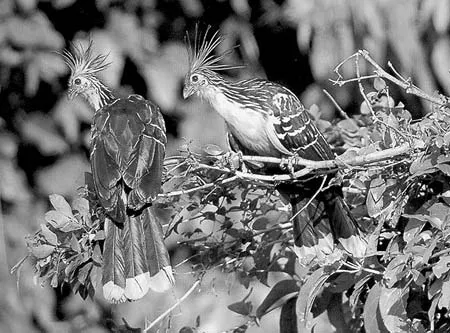
Another fossil, discovered in China in November 1996, provoked yet more controversy. The existence of this 130-million-year-old bird, called Liaoningornis, was announced by Hou, Martin and Alan Feduccia in a paper published in Science magazine. This creature was identical to present-day birds in all respects, and yet was a contemporary of Archaeopteryx. The only difference was the absence of teeth in its mouth. This went to show that, in contrast to evolutionist claims, toothed birds were in no way "primitive."
Another fossil that totally discredited evolutionist claim regarding Archaeopteryx was Eoalulavis. This animal was said to be 30 million years younger than Archaeopteryx-in other words, around 120 million years old-and its wing structure can still be seen in slow-flying birds today. This proved that living things, no different in many ways to present-day birds, were flying in the skies 120 million years ago.
These data proved beyond the shadow of a doubt that Archaeopteryx and other birds resembling it were not intermediate forms. These fossils did not demonstrate that different species of bird evolved from one another. On the contrary, they proved that various independent bird species not unlike Archaeopteryx and those alive today lived alongside one another.
In fact, the majority of evolutionists are well aware that Archaeopteryx cannot be an intermediate form, and that is simply an extinct species of bird.
Scientists describe such creatures as the platypus as mosaic creatures. That mosaic creatures do not count as intermediate forms is also accepted by such foremost paleontologists as Stephen Jay Gould and Niles Eldredge.245
The evolutionist magazine Nature described how, with every new Archaeopteryx fossil discovery, it was realized that the animal cannot have been half-bird and half-reptile, still unable to fly, but that on the contrary it was a fully flying bird:
The recently discovered seventh specimen of the Archæopteryx preserves a partial, rectangular sternum, long suspected but never previously documented. This attests to its strong flight muscles.246
Alan Feduccia:
In conclusion, the robust furcula of Archæopteryx would have provided a suitable point of origin for a well developed pectoralis muscle... thus the main evidence for Archæopteryx having been a terrestrial, cursorial predator is invalidated. There is nothing in the structure of the pectoral girdle of Archæopteryx that would preclude its having been a powered flier.247
But in Archaeopteryx, it is to be noted, the feathers differ in no way from the most perfectly developed feathers known to us.248
Well, I've studied bird skulls for 25 years and I don't see any similarities whatsoever. I just don't see it... The theropod origins of birds, in my opinion, will be the greatest embarrassment of paleontology of the 20th century.249
John H. Ostrom is Professor of Geology Chair at Yale University:
No fossil evidence exists of any pro-avis. It is a purely hypothetical pre-bird, but one that must have existed.250
John H. Ostrom from Yale University, who actively studied specimens, has said that it is evident that we now need to look to periods porior to Archaeopteryx in order to seek the ancestor of flying birds.
From Science magazine:
No dinosaur had an embryonic thumb, though all birds have them, on the feet they use for landing … All dinosaurs have saw-edged teeth, with razor-like molars. Confuciosornis (a 142-million-year-old bird fossil) has no teeth. Although Archaeopteryx has teeth, they are not saw-edged, but are arranged in rows like nails. There are two wide spaces at the back of all dinosaur skulls. Birds do not have these. There is no link between them at all, not even down to the finest detail.251
True birds have existed at least as long as Archaeopteryx so that the latter could hardly have been their ancestor...252
Carl O. Dunbar is professor of paleontology and stratigraphy at Yale University:
Because of its feathers, [Archaeopteryx is] distinctly to be classed as a bird.253
Larry Martin is an American vertebrate paleontologist and curator of the Natural History Museum and Biodiversity Research Center at the University of Kansas:
To tell you the truth, if I had to support the dinosaur origin of birds with those characters, I'd be embarrassed every time I had to get up and talk about it.254
Nicholas Hotton is an American paleontologist at the University of Chicago:
Protoavis has a well-developed furcula bone and chest bone, assisting flight, hollow bones and extended wing bones... Their ears indicate that they communicate with sound, while dinosaurs' are silent.255
Richard L. Deem is an American biologist at the University of Southern California:
The results of the recent studies show that the hands of the theropod dinosaurs are derived from digits I, II, and III, whereas the wings of birds, although they look alike in terms of structure, are derived from digits II, III, and IV... There are other problems with the "birds are dinosaurs" theory. The theropod forelimb is much smaller (relative to body size) than that of Archaeopteryx. The small "proto-wing" of the theropod is not very convincing, especially considering the rather hefty weight of these dinosaurs. The vast majority of the theropod lack the semilunate wrist bone, and have a large number of other wrist elements which have no homology to the bones of Archaeopteryx. In addition, in almost all theropods, nerve V1 exits the braincase out the side, along with several other nerves, whereas in birds, it exits out the front of the braincase, though its own hole. There is also the minor problem that the vast majority of the theropods appeared after the appearance of Archaeopteryx.256