

Reading time: ~6 min read
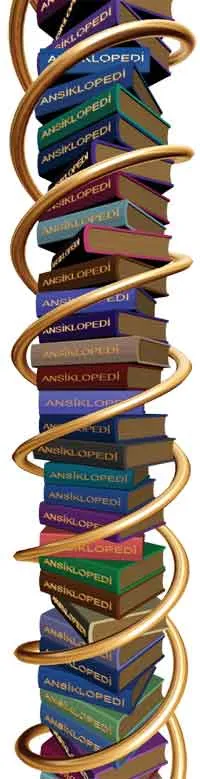
Modern technological progress in the field of data storage is truly amazing. Computer hard discs, CDs, diskettes, data sticks and similar products are becoming more advanced and efficient every day. Computer firms are seeking answers to how the maximum amount of data can be stored in the minimum space without being impaired, and how that information can be downloaded in the fastest possible manner. Even though whole encyclopedias of data can be compressed onto a single CD, it is still large enough to cover your hand. The astonishing data-miniaturizing or data-compression ability of DNA, on the other hand, far surpasses modern technology. According to calculations by Leonard Adleman of Los Angeles South California University, just 1 gram (0.0022 pounds) of DNA can contain the equivalent amount of data to 1 trillion CDs.38 This shows that data are concealed in a million, million times more efficiently in DNA than in a CD.39
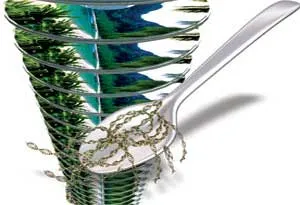
The volume of a human being's DNA is 3 billionths of a cubic millimeter (3 x 10⁻⁹ mm3).40 According to G. G. Simpson, if all the features of all the species that have ever lived were to be loaded onto DNA, the resulting total volume of DNA would fill only a small part of a teaspoon. Enough space would even be left over the rest of the teaspoon to contain all the books that have ever been written.41
Dr. Leonard Adleman, the inventor of the DNA computer, which represents a new sphere of technology, says this about the mechanism in DNA and the cell:
If we look inside the cell, we see extraordinary machines that we couldn't make ourselves. It's a great tool chest.42
According to Darwinists, however, this giant data bank in the cell –capable of holding the equivalent of tens of thousands of books– came into being spontaneously as the result of chance. In the eyes of Darwinists, who have no qualms about building another total impossibility on top of that one, chance has compressed all the data in a library large enough to fill an entire football stadium, undamaged, into a space too small to be seen with the naked eye. Darwinists still blindly advocate such a total impossibility. Yet neither the cell nor DNA, its data bank, can emerge from the chance combination of unconscious atoms. Even the very smallest components of living things have been created for a specific purpose, and every one of them are far too complex to admit any possibility of chance.
Michael George Pitman, a professor of biology from University of Sydney, uses the German philosopher Arthur Schopenhauer's words to express how life is not just a collection of inanimate substances:
Every organism is organic through and through in all its parts, and nowhere are these, not even in their smallest particles, mere aggregates of inorganic matter.43
If we were to express the volume of data in DNA in numerical terms, then a 4-meter (13.12-foot) long DNA molecule has been packaged and compressed into a cell only 3 to 5 microns in diameter (1 micron = 1/1000 millimeter). If the DNA codes in every one of the body's 100 trillion cells were laid out end to end, the resulting length would stretch to the Sun and back 600 times.44 Prof. Jerry Bergman, known for his scientific papers, emphasizes the engineering in DNA in an analogy:
Suppose you were asked to take two long strands of fisherman's monofilament line –125 miles [201 kilometers] long– then form it into a double-helix structure and neatly fold and pack this line so it would fit into a basketball. Furthermore, you would need to ensure that the double helix could be unzipped and duplicated along the length of this line, and the duplicate copy removed, all without tangling the line. Possible? This is directly analogous to what happens in the billions of cells in your body every day. Scale the basketball down to the size of a human cell and the line scales down to six feet [2 meters] of DNA. . . . The DNA packing process is both complex and elegant and is so efficient that it achieves a reduction in length of DNA by a factor of 1 million. 45
The molecular biologist Michael Denton describes the extraordinary nature of DNA's data compression ability:
... it is clear that cells are immensely complex entities. . . more than a number in a jumbo jet. . . the complexity of a jumbo jet packed into a speck of dust invisible to the human eye. It is hardly conceivable that anything more complex could be compacted into such a small volume. Moreover, it is a speck-sized jumbo jet which can duplicate itself quite effortlessly46
DNA's ability to hold information is so efficient that all the data concerning to a human being can be compressed into an area weighing just a few trillionths of a gram.47 According to Yale University's Prof. George Gaylord Simpson, the data belonging 1 billion living things can be squeezed with ease into a single grain of salt.48 Prof. Francis S. Collins, a physicist and geneticist and also director of the National Human Genome Research Institute, describes the results of his study of DNA:
Now fifty years since Watson and Crick unraveled the structure of the double helix, I think it is amazing to contemplate the elegance of DNA carrying information . . . This digital code allows, in a very easily copyable form, such a massive amount of information to be carried inside each cell of the human body. This double helix DNA is made up of base pair letters. The whole human genome consists of three billion of these base pairs all packaged inside the cell's nucleus. . . The three billion letters are able to direct all of the biological properties of a human being.49
The well-known molecular biologist Michael Denton mentions that biological information to be packed into the tiny volume of the cell nucleus seems to be specifically arranged for human beings.50 If DNA did not have this data compression ability, the cell would have to be very much larger in order to hold irregular DNA strips. But it is impossible for cells to be any larger, because the cell's sources of oxygen and nutrients are efficient only given the existing diameter of the cell.51 From that point of view, the cell's size and therefore, its ability to hold DNA, is of vital importance..
This glorious packaging system is made possible by the DNA molecule's ability to coil and form long spirals that bend and give rise to intertwined, regular helixes. This packaging technology evidencing highly advanced engineering, can be seen in the nucleus of every cell. By means of this packaging system that our Almighty Lord created in our cells, millions of kilometers of DNA "letters" remain contained in a volume we cannot see with the naked eye.
References
- John Whitfield, "Physicists Plunder Life's Tool Chest", Nature, 24 April 2003. ↩
- Carl Wieland, "The Marvellous 'Message Molecule'", Creation,September 1995, Vol. 17, no. 4, pp. 10-13; [New Scientist, 26 November 1994, p. 17.] ↩
- Werner Gitt, The Wonder of Man, p. 75. ↩
- Michael Denton, Evolution: A Theory in Crisis, Burnett Books, London, 1985, p. 334; [G. G. Simpson, "The History of Life", Evolution of Life, University of Chicago Press, Chicago, 1960, p. 135.] ↩
- John Whitfield, "Physicists Plunder Life's Tool Chest", Nature, 24 April 2003. ↩
- Michael Pitman, Adam and Evolution, River Publishing, London, 1984, pp. 26-27. ↩
- http://www.ntvmsnbc.com/news/13800.asp ↩
- Michael J. Denton, Nature's Destiny, pp. 212-213. ↩
- Ibid., p. 154. ↩
- Ibid. ↩
- Francis S. Collins, "Faith and the Human Genome Project", Perspectives on Science and Christian Faith, Vol. 55, no. 3, September 2003, pp. 145-146. ↩
- Michael J. Denton, Nature's Destiny, p. 381. ↩
- Ibid., p.154. ↩