

Reading time: ~5 min read
With the production of the human gene map, the findings from the Human Genome Project are being distorted and used as a propaganda tool in some evolutionist publications, claiming that there is a 98% resemblance between human and chimpanzee genes, which is proposed as evidence for evolution. In fact, however, these claims give no support to evolution; on the contrary, they are false evidence based on distortions.
Even if there is a 98% resemblance between the chimpanzee and human genomes, it is illogical to infer that man is 98% chimpanzee. Human beings share specific genes with a great many other living things. For example, according to analyses carried in New Scientist magazine, a 75% resemblance has been determined between human DNA and that of nematode worms.122 However, this hardly means that human beings are 75% worm, or that there is only a 25% difference between them! Some evolutionists even see and speak of the illogicality of such inferences. Prof. Steven Jones issued a reminder if a 50% similarity is revealed between human beings and bananas, that will not mean that human beings are 50% banana. It is known that even if the genes in two life forms are the same, they can still work in entirely different ways. Moreover, genes are sometimes involved in more than one function, and one function is controlled by more than one gene. This broadens the mathematical difference to a very considerable extent.
But analyses of various proteins show that human beings are very close related to very different life forms. In one study, researchers from Cambridge University compared the proteins of various terrestrial life forms. Astonishingly, in just about all the examples used, human beings and chickens turned out to be one another's closest relatives. Our next closest "relative" is the crocodile.123
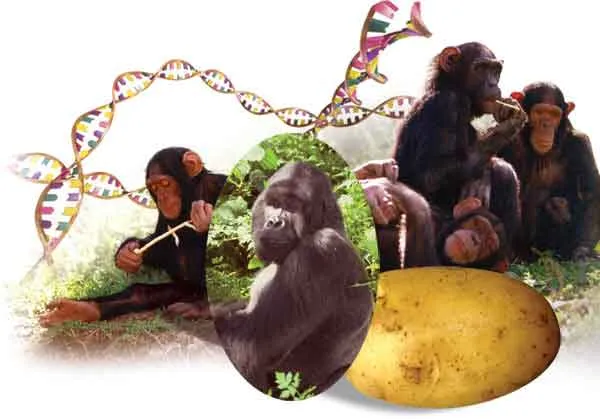
Another example that evolutionists use to claim genetic similarity between man and ape is the fact that humans have 46 chromosomes, and chimpanzees and gorillas have 48. Evolutionists regard similarity between chromosome numbers as an indication of an evolutionary relationship. Yet if their logic were correct, man would have another relative just as close as the chimpanzee: the potato! The potato has exactly the same number of chromosomes as the chimpanzee and the gorilla: 48. On the other hand, the wild hare has exactly the same number of chromosomes as human beings: 46.124 These examples show that similar numbers represent no evidence at all for the theory of evolution, because genetic similarities do not fit the scenario claimed, but actually produce completely opposite results to it.
The Darwinist media use information selectively, as propaganda tools. Since they claim that man and ape descended from a common ancestor, they emphasize the resemblance between the two species' DNA. Yet there are a number of studies –again carried out by evolutionists!– showing the invalidity of the "98% similarity" claimed by evolutionists for so many years. But these studies are deliberately not reported, or else given only very limited coverage.
A report titled "Humans, chimps more different than thought," carried on the CNN website on 25 September, 2002, reported the findings of this research:
There are more differences between a chimpanzee and a human being than once believed, according to a new genetic study. Biologists have long held that the genes of chimps and humans are about 98.5 percent identical. But Roy Britten, a biologist at the California Institute of Technology, said in a study published this week that a new way of comparing the genes shows that the human and chimp genetic similarity is only about 95 percent. Britten based this on a computer program that compared 780,000 of the 3 billion base pairs in the human DNA helix with those of the chimp. He found more mismatches than earlier researchers had, and concluded that at least 3.9 percent of the DNA bases were different. This led him to conclude that there is a fundamental genetic difference between the species of about 5 percent.125
On 23 September, 2002, the website of the British magazine New Scientist reported on the same subject, under the caption "Human-Chimp DNA Difference Trebled":
We are more unique than previously thought, according to new comparisons of human and chimpanzee DNA. It has long been held that we share 98.5 per cent of our genetic material with our closest relatives. That now appears to be wrong. In fact, we share less than 95 per cent of our genetic material, a three-fold increase in the variation between us and chimps. 126
In conclusion, the genome project has revealed no findings in favor of the theory of evolution. On the contrary, it shows that on the basis of DNA and gene structures, no evolutionary tree of life can be constructed between living things. This deals a severe blow to Darwinism. Living things' DNA codes clearly show that the tree of life, imposed as the truth ever since the 19th century, is actually specious.
The real aim of those sections of society blindly devoted to Darwinism is not to publicize the facts, but merely to propagate Darwinism. However, all the foundations on which their propaganda is built are crumbling away with ongoing scientific discoveries. Confronted by this, increasing numbers of people are realizing that the theory of evolution was a deception perpetrated for ideological reasons. In its place, the fact of creation is spreading rapidly. In the Qur'an, Allah reveals as follows:
Do not mix up truth with falsehood and knowingly hide the truth. (Surat al-Baqara, 42)
Rather We hurl the truth against falsehood and it cuts right through it and it vanishes clean away! Woe without end for you for what you portray! (Surat al-Anbiya, 18)