

Reading time: ~6 min read
As we already made clear, Darwin's views in The Origin of Species were most influenced by the British economist and demographer Thomas Robert Malthus.
In Essay on the Principle of Population, as it Affects the Future, first published in 1798, Malthus claimed that the human population was increasing every twenty-five years in a geometrical ratio (1, 2, 4, 8, 16, 32, 64, 128, 256…), while the food supply was increasing in an arithmetical ratio (1, 2, 3, 4, 5, 6, 7, 8, 9...); that as the population doubled, food resources showed a much more modest rise. Malthus claimed that within 300 years, the ratio of population to food resources would be 4,096 to 13. Again according to this unscientific claim, resources were insufficient for the rapidly rising population, and Malthus alleged that it was becoming essential to engage in a serious struggle for survival. This was the same claim expressed in the subtitle to Darwin's The Origin of Species: the Preservation of Favoured Races in the Struggle for Life...

In his Essay, Malthus stated that this rapid population rise needed to be halted, and came up with a number of solutions. According to him, misery and vice were the two main factors that checked population growth. Phenomena such as famine and epidemics were examples of misery, which kept population in check. Other examples were such phenomena as wars. Malthus wrote that rapid population increase could be checked by such means as war, famine, disease and the killing of newborn babies, to balance population and food resources. Anyone with common sense and a conscience will agree that such a claim is irrational, illogical, and horrendously brutal. Accurate planning of income and essential resources for the well-being and peace of societies is of course of the greatest importance for the future of those societies. However, it is also evident that planning wars, slaughter and murder will inflict nothing but tears and suffering on a society's future.
Malthus had a number of other illogical recommendations. For example, he suggested that all possible measures should be taken to prevent poor or laboring-class couples from having children. Malthus's views reached a peak in 1834 with a new law passed in England setting up special “workhouses” for the poor. Under that law, married couples in workhouses were kept apart by means of fixed rules to reduce the rise in population.
One of the factors underlying these measures was the longstanding fear that the rapidly rising numbers of the “lower classes” would eventually overwhelm more civilized individuals. That fear is groundless, of course, and the product of a grave deception. First, it is out of the question for an individual to enjoy superiority over anyone else because of his material status, social position, language, race or gender. God has created all human beings equal. What makes people valuable is the moral virtues and the fear of God they exhibit, not material means or physical attributes.
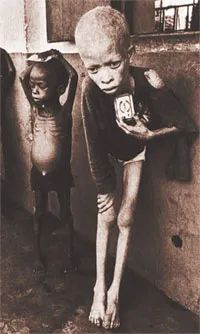
In the wake of the French Revolution, however, the British middle class provided enormous support for Malthusianism. Fearing that they might no longer maintain their former pre-eminence and power, they had no hesitation over adopting radical measures to preserve them. This is one of the characteristic errors made by those who distance themselves from religious moral values. The elite of that time thought that society's future lay in there being as many wealthy and as few poor as possible. Of course it is desirable to raise the number of wealthy people and the level of well-being in a society. However, the methods implemented to increase that well-being are of greatest importance. Raising the numbers of the wealthy by slaughtering the poor and oppressing the needy, as Social Darwinism suggests, is totally unacceptable, of course. Furthermore, increasing the number of wealthy individuals is, by itself, not enough for a society to progress. If those wealthy people lack such religious moral values as honesty, altruism, modesty, patience, and tolerance, their industry will damage a society instead of benefiting it. Plans aimed at advancing societies can achieve their objective only if that society reinforces its spiritual values at the same time as it makes material progress.
However, many in Malthus's time failed to realize this manifest truth and supported the perverted views that would later lead their societies into moral collapse.
To halt the rise in population, these were some of the ruthless solutions Malthus suggested:
Instead of recommending cleanliness to the poor, we should encourage contrary habits. In our towns we should make the streets narrower, crowd more people into the houses, and court the return of the plague. In the country, we should build our villages near stagnant pools, and particularly encourage settlements in all marshy and unwholesome situations. But above all, we should reprobate [strongly condemn] specific remedies for ravaging diseases; and those benevolent, but much mistaken men, who have thought they were doing a service to mankind by projecting schemes for the total extirpation of particular disorders.8
Malthus also encouraged the death of babies:
... we are bound in justice and honour formally to disclaim the right of the poor to support. To this end, I should propose a regulation to be made, declaring, that no child born... should ever be entitled to parish assistance... The [illegitimate] infant is, comparatively speaking, of little value to the society, as others will immediately supply its place... All the children born, beyond what would be required to keep up the population to this [desired] level, must necessarily perish, unless room be made for them by the deaths of grown persons.9
Malthus possessed a sufficiently twisted logical framework as to justify letting newborns die for the future of society. You might well assume that such perverted views are a thing of the past and could no longer be accepted by anyone today. Yet that is not the case. In modern-day China, population planning is carried out by means of the killing of newborn babies—making it easy to see the permanent effects on societies of the destructive views of Malthus and his follower Darwin. The communist Chinese state seeks to prevent its own people from living by religious moral values, and looks at them through a Darwinist eye. For that reason, in addition to the enormous social and moral collapse, human beings are forced to work in labor camps devoid of the most basic humane conditions. Children of parents with already more children than the number permitted by the state are collected and killed. People are executed for “thought crimes,” the executions themselves having assumed the form of societal ceremonies. Contemporary China is an example of what awaits a society that falls under the influence of Darwinist views.
Malthus's theses not only prepared an oppressive law that further worsened the conditions of the poor in England, they also made social problems even more intractable. These theses, which still have their proponents today, and which led the way to a theory such as Darwinism which inflicted disasters like chaos, war, racism and atheism on the 20th century, have no valid scientific foundations whatsoever. Indeed, Malthus's ideas were inspired by a story relating to goats and dogs, the truth of which nobody could be sure of.