At the Genetic Level, There Is No Racial Difference between Human Beings
Reading time: ~16 min read
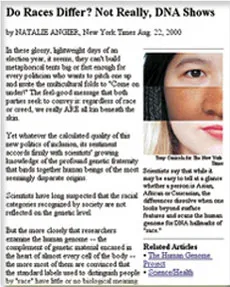
An article titled “Do Races Differ? Not Really, DNA Shows,” published in the New York Times
Particularly in the last ten years, the science of genetics has revealed that in biological terms, there are no differences between the races. The great majority of scientists agree on this. For instance, scientists attending the Advancement of Science Convention in Atlanta issued the following statement:
Race is a social construct derived mainly from perceptions conditioned by events of recorded history, and it has no basic biological reality.53
Two young blacks hanged in 1902, for being members of a different race. In the 21st century, however, it has been realized that in biological terms, there are no differences between races. Milliyet newspaper, February 13, 2001 You were wrong, Hitler! The arian race project proved to be a tale... The DNA map shows that 99% of the genes in white, black and yellow races are identical.
Research has determined that genetic differences between the races are very small, and that the races cannot be differentiated between in terms of genes. Scientists researching the subject state that typically there is a 0.2% genetic difference between any two people, even within the same group. Features that reveal racial differences such as skin color, and the shape of the eyes account only for 6% of this 0.2% variation. On the genetic level that means a 0.012% difference between races54—so small as to be irrelevant.
These latest findings are summarized in an article by Natalie Angier, “Do Races Differ? Not Really, DNA Shows,” in the 22 August 2000 New York Times:
Scientists have long suspected that the racial categories recognized by society are not reflected on the genetic level. But the more closely researchers examine the human genome — the complement of genetic material encased in the heart of almost every cell of the body — the more most of them are convinced that the standard labels used to distinguish people by “race” have little or no biological meaning. They say that while it may seem easy to tell at a glance whether a person is Caucasian, African or Asian, the ease dissolves when one probes beneath surface characteristics and scans the genome for DNA hallmarks of “race.”55
Dr. J. Craig Venter, head of the Cilera Genomics Corp. that runs the Human Genome Project, says that “race is a social concept, not a scientific one.56 Dr. Venter and scientists from the National Institutes of Health mapped the entire human genome and concluded that there was only one single human race.
Dr. Harold P. Freeman, president of North General Hospital, NYC, sums up the results of his work on the issue of biology and race:
If you ask what percentage of your genes is reflected in your external appearance, the basis by which we talk about race, the answer seems to be in the range of 0.01 percent. This is a very, very minimal reflection of your genetic makeup.5
Another scientist to arrive at the same conclusion is Alan R. Templeton, a professor of biology from Washington University, who analyzed the DNA of members of different human populations. He observed that despite the great genetic variety among human beings, most of such variations were on the individual level. There may be some variations among populations, he states, but these are very small. Templeton summarizes his conclusions, as well as maintaining his preconceived belief in evolution, in these terms:
Then when the Trumpet is blown, that Day there will be no family ties between them; they will not be able to question one another. (Surat al-Muminun, 101)
Race is a real cultural, political and economic concept in society, but it is not a biological concept, and that unfortunately is what many people wrongfully consider to be the essence of race in humans — genetic differences... I wanted to bring some objectivity to the topic. This very objective analysis shows the outcome is not even a close call: There's nothing even like a really distinct subdivision of humanity.58
According to Templeton's conclusions, the genetic similarity between Europeans and sub-Saharan Africans, and between Europeans and the Melanesians inhabiting islands northeast of Australia is greater than that between Africans and Melanesians. However, sub-Saharan Africans and Melanesians resemble each other in many ways, sharing dark skin, hair texture, and cranial-facial features. Though these features are typically used in describing a race, these populations resemble each other very little, genetically speaking. This finding, Templeton states, shows that “racial traits” are not observed in the genes.59
In their book The History and Geography of Human Genes, population geneticists Luca Cavalli-Sforza, Paolo Menozzi and Alberto Piazza arrive at the following conclusion:
Once the genes for surface traits such as coloration and stature are discounted, the human “races” are remarkably alike under the skin. The variation among individuals is much greater than the differences among groups.60
Time magazine's analysis of their book had this to say:
In fact, the diversity among individuals is so enormous that the whole concept of race becomes meaningless at the genetic level. The authors say there is “no scientific basis” for the theories touting the genetic superiority of any one population over another... Despite the difficulties, the scientists made some myth-shattering discoveries. One of them jumps right off the book's cover: a color map of world genetic variation has Africa on one end of the spectrum and Australia on the other. Because Australia's aborigines and sub-Saharan Africans share such superficial traits as skin color and body shape, they were widely assumed to be closely related. But their genes tell a different story. Of all humans, Australians are most distant from the Africans and most closely resemble their neighbors, the southeast Asians.61 The New Imperialism and
References
Robert Lee Hotz, "Race has no Basis in Biology, Researchers Say," Los Angeles Times, February 20, 1997. ↩