
Reading time: ~9 min read
Anarchy and terror are two of Marxism and Communism's indispensable tools. Marxism's tendency towards terrorism and violence appeared in the experiment of the Paris Commune while Marx was still alive. In particular, terrorism became an indispensable part of Communist ideology with Lenin, while he was making Marx's theory a practicality. Communists spilt the blood of millions of people in every part of the world, and made people undergo pain, fear, and violence by establishing terrorist organisations. As will be seen in the pages that follow, today all the Communist leaders are remembered for the oppression and killings they carried out. Yet despite this some circles still cover their walls with pictures of these pitiless, bloody-handed assassins, and still accept these sadistic people as their teachers.
No matter how much some Communists claim that violence and terrorism are not Communist practices and that they only took place in some individuals' applications of Communism, and no matter how much they try to whitewash Communism, there is an undeniable truth: The founders of Communism personally defended violence and terrorism and saw them as essential to their ideology. The American political scientist Samuel Francis has this to say on the subject:
Marx and Engels were generally specific in insisting that revolution will always be violent and that revolutionaries must use violence against the rulers, and in some instances they did express support of terrorism.100
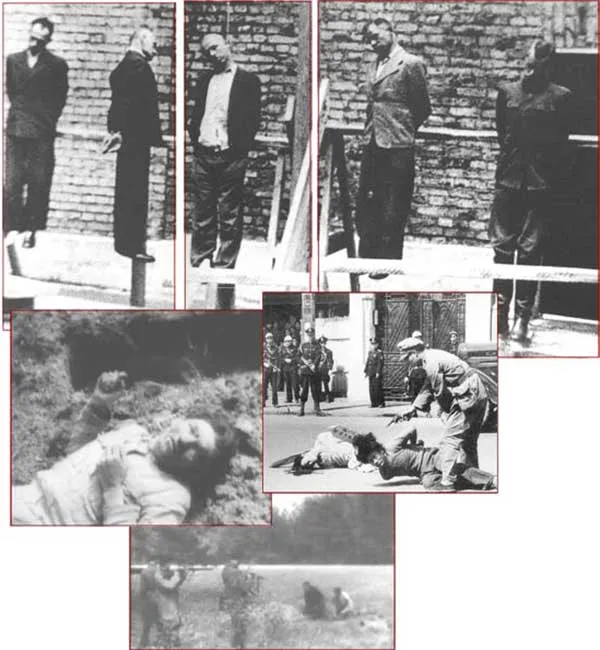
Karl Marx said "insurrection is an art quite as much as war" and took these words of Danton, one of the foremost names in "revolutionary politics" as a principle, "de l'audace, de l'audace, encore de l'audace" (Attack, attack, and attack again!)101
There are clear statements by Lenin regarding the necessity of systematically using terrorism. Here are a few of them:
In reality the state is nothing but a machine for the suppression of one class by another. Dictatorship is rule based directly on force and unrestricted by laws... The revolutionary dictatorship of the proletariat is rule won and maintained through the use of violence by the proleteriat against the bourgeoisie, rule that is unrestricted by any laws.102
We are not at all opposed to political killing… Only in direct, immediate connection with the mass movement can and must individual terrorist acts be of value.103
To become a power the class-conscious workers must win the majority to their side. As long as no violence is used against the people there is no other road to power.104
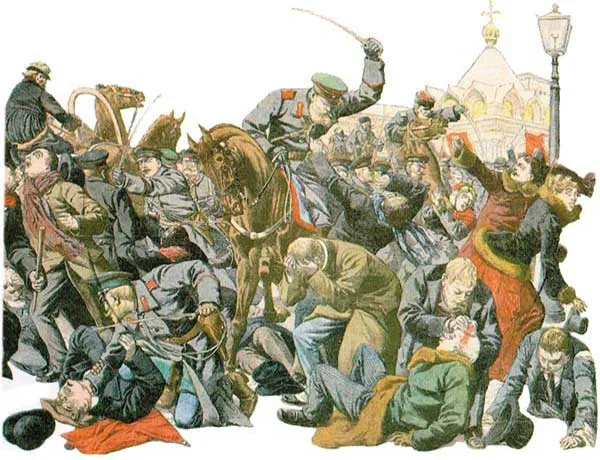
Speaking at a workers' meeting, Lenin gave a terrifying statement of how indispensable terrorism was to them:
If the masses do not rise up spontaneously, none of this will lead to anything… For as long as we fail to treat speculators the way they deserve – with a bullet in the head – we will not get anywhere at all.105
One of the most important leaders of the October Revolution in Russia, Trotsky, says this to confirm Lenin's words:
But the revolution does require of the revolutionary class that it should attain its end by all methods at its disposal—if necessary, by an armed rising: if required, by terrorism.106
Trotsky went even further in another speech,
Our only choice now is civil war. Civil war is the struggle for bread… Long live civil war!107
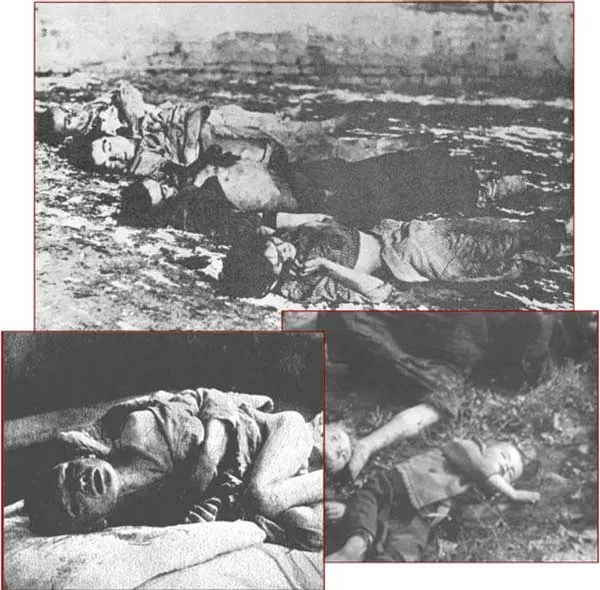
These principles of such Communist theoreticians as Lenin and Trotsky were put into practice in the Bolshevik revolution in Russia. During the revolutionary period of autumn 1917 there began wide-ranging massacres, looting, and terrible violence. Those people who were against the revolution, or who were suspected of being against the revolution, were rounded up for no reason, arrested, and shot: houses were looted and wrecked. Terrorism, which began with Lenin and Trotsky continued and grew worse in the Stalin years.
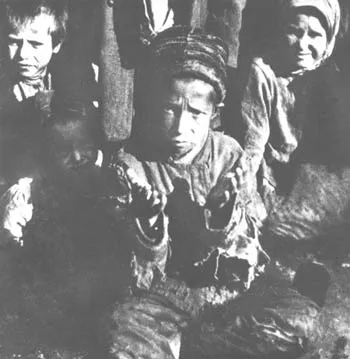
Harrison E. Salisbury of The New York Times described the Soviet system's prison camps as:
…a whole continent of terror… Compared with those who brought about the hundreds of thousands of executions and the millions of deaths in the Soviet terror system, the Czars seem almost benign… Our minds boggle at the thought of a systematized, routine evil, under which three or four or more million men and women were sentenced each year to forced labour and eternal exile–and in a manner so casual that the prisoners often were not even told what their sentences were...108
Non-Russian peoples, and particularly the Crimean Turks, the Central Asian Turks, and the Kazakhs, were exposed to the terrorism of the Soviet system. Special courts, troiki, were established to cleanse Russian society of the Kazakhs. In October 1920 alone these troiki sentenced more than 6,000 people to death, and these orders were immediately carried out. The families, and sometimes even the neighbours, of those who opposed the regime and were not apprehended, were systematically taken hostage and sent to concentration camps. Martin Latsis, the head of one of these camps in the Ukraine admitted that these were death camps in one of his reports:
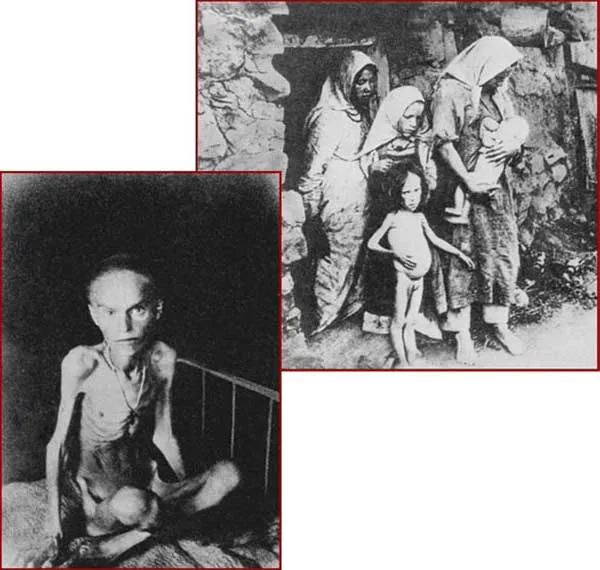
Gathered together in a camp near Maikop, the hostages, women, children, and old men survive in the most appalling conditions, in the cold and mud of October… They are dying like flies. The women will do anything to escape death. The soldiers guarding the camp take advantage of this and treat them as prostitutes.109
Under the influence of Darwin, the Communist revolutionaries were killing people in a crazed manner. It appears from documents of the time that the sole aim was total extermination. It was as if they believed that the more people they killed, the greater success they would have. That they planned to wipe out everybody they suspected of being against the revolution is revealed in one of their decisions:
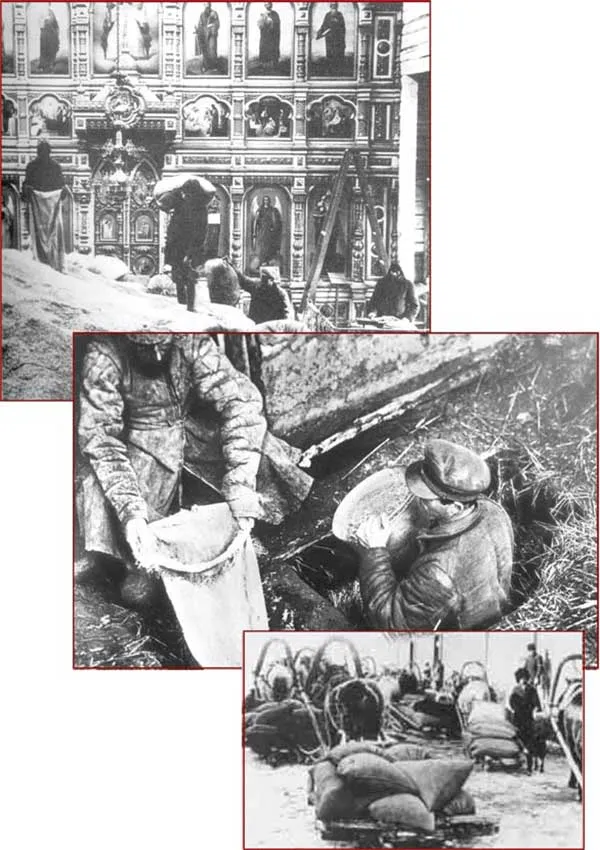
The Pyatigorsk Cheka (Extraordinary Committee for War Against the Counter-Revolution) decided straight out to execute 300 people a day. They divided up the town into various boroughs and took a quota of people from each, and ordered the Party to draw up execution lists…In Kislovodsk, for lack of a better idea, it was decided to kill people who were in the hospital.110
As was announced in the lead article of the newspaper Krasnyi Mech (The Red Sword), which was Communist supporting, the Communists saw everything as permissible and believed that blood had to be spilt for the colour of the Red flag to come about.
To us, everything is permitted, for we are the first to raise the sword not to oppress races and reduce them to slavery, but to liberate humanity from its shackles… Blood? Let blood flow like water! Let blood stain forever the black pirate's flag flown by the bourgeoisie, and let our flag be blood-red forever! For only through the death of the old world can we liberate ourselves forever from the return of those jackals!111
As well as all this torture, Stalin set up "requisitioning detachments" to take the peasants" produce by force. These units were responsible for all kinds of oppression. On 14 February 1922 one inspector wrote:
Abuses of position by the requisitioning detachments, frankly speaking, have now reached unbelievable levels. Systematically, the peasants who are arrested are all locked up in big unheated barns; they are then whipped and threatened with execution. Those who have not filled the whole of their quota are bound and forced to run naked all along the main street of the village and then locked up in another unheated hangar. A great number of women have been beaten until they are unconscious and then thrown naked into holes dug in the snow…112
Stalin believed that Spain represented opportunities for the USSR and that meddling in that country would bear fruit. For that reason he took sides and supported the Communists in the Spanish Civil War. But with that the terrorism in the USSR overflowed into Spain. One example of the oppression and torture there was the concentration camp that 200 anti-Stalinists were held in at the beginning of 1938. "When the Stalinists decided to open a cheka," one victim recalled;
There was a small cemetery being cleaned out nearby. The Chekists had a diabolical idea: they would leave the cemetery's tombs open, with the skeletons and the decomposing bodies in full view. That's where they locked up the most difficult cases. They had some particularly brutal methods of torture. Many prisoners were hung up by their feet, upside down, for whole days. Others they locked in tiny cupboards with just a tiny air hole near the face to breathe through… One of the worst methods was known as "the drawer"; prisoners were forced to squat in tiny square boxes for several days. Some were kept there unable to move for eight to ten days.113
In 1931 Pope Pius XI had this to say about the violence Communism had inflicted on the world in the encyclical Quadragesimo Anno:
Communism teaches and seeks two objectives: unrelenting class warfare and the complete eradication of private ownership. Not secretly or by hidden methods does it do this, but publicly, openly, and by employing any means possible, even the most violent. To achieve these objectives there is nothing it is afraid to do, nothing for which it has respect or reverence. When comes to power, it is ferocious in its cruelty and inhumanity. The horrible slaughter and destruction through which it has laid waste vast regions of Eastern Europe and Asia give evidence of this.114
As the above extract says, Communism's principle aims were a merciless class war and the complete doing away with private property. In other words the aim was to apply the theory of evolution, which Darwin had applied in the biological field, to human societies, and for human beings to be, like wild animals in nature, in conflict, at war.
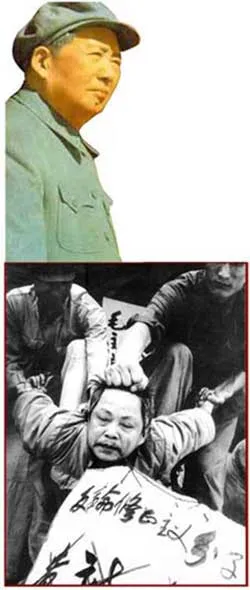
The disasters brought about by Communism did not stop in Russia. One of the countries worst affected among those to which it spread was China.