
Reading time: ~6 min read
In a report titled "British in Africa Lack Killer Urge" published in The New York Times of June 24, 1942, James Aldridge describes the Nazi view of war and killing in these words:
The German commanders are scientists, who are continually experimenting with and improving the hard, mathematical formula of killing. They are trained as mathematicians, engineers and chemists facing complicated problems. There is no art in it, there is no imagination. War is pure physics to them. The German soldier is trained with a psychology of the daredevil track rider. He is a professional killer, with no distractions. He believes he is the toughest man on earth.44
This model of "professional killer" employed by the Nazis is a common feature of fascism. Fascists regard the use of force and violence as an end in itself. The influence of Darwinism plays a major role here. The Darwinist superstitions that human beings are nothing but developed animals, and that only the strong can survive, did away with the ethical values. Love and compassion were replaced by feelings of aggression, revenge and struggle, sentiments that were presented to people as a scientific necessity.
Fascists see conflict as a law of nature, and believe that peace, security and comfort impede the progress of mankind. Mussolini's words, when opening the Fascist Culture and Propaganda School in Milan in 1921, are an indication of this, where he identified action as the force that would lead fascism to victory.45
Acts of violence, destruction, assaults and fighting are what keep fascists' morale at a high level. These are the exact opposite of peace, brotherhood, peace and tranquility.
The ignorance of the fascists also plays a pivotal role in their tendency towards violence. That is why Hitler felt the need for fighters in his racist regime, not intellectuals.
The Nazis' acts of violence were carried to that end by specially formed organizations. The first of these, the SA (Sturmabteilung, or Storm Troopers) were formed in 1920, and in 1921 they took on a paramilitary quality. There were a great many street thugs in the ranks of the SA. The group was also known as the "Brown Shirts," and was led by Ernst Röhm, known for his psychopathic nature (and his homosexual tendencies). The SA carried out countless acts of terrorism throughout the 1920s in order to strengthen the Nazi Party. SA units carried out sudden attacks on opponents of the Nazis, spilt blood in street fights, and tortured those opponents they took as "prisoners of war." Hitler took pride in the violence of the SA. In Mein Kampf, he described one "successful" attack that was carried out on opponents of the Nazis:
When I entered the vestibule of the Hofbräuhaus [beer hall] at a quarter of eight, there could indeed be no doubt with regard to the existing intention. The room was overcrowded and had therefore been closed by the police... The small S.A. awaited me in the vestibule. I had the doors to the large hall closed and then ordered the forty-five or forty-six men to line up... My storm troopers – for so they were called from this day on – attacked. Like wolves they flung themselves in packs of eight or ten again and again on their enemies, and little by little actually begun to thrash them out of the hall. After only five minutes I hardly saw a one of them who was not covered with blood.46
The SA began to fall from grace when the Nazis came to power, and the star of the more professional SS (Schutzstaffel, or Guard Detachments), with their military discipline, began to rise. This corp wore black shirts. Young people were selected according to "racial criteria" for membership in the SS. They had to possess Aryan racial features. The Waffen-SS was the military wing of the SS. The Totenkopf, or Deaths Head, Division within the Waffen-SS was particularly renowned for its cruelty, and was brought in to man the concentration camps.
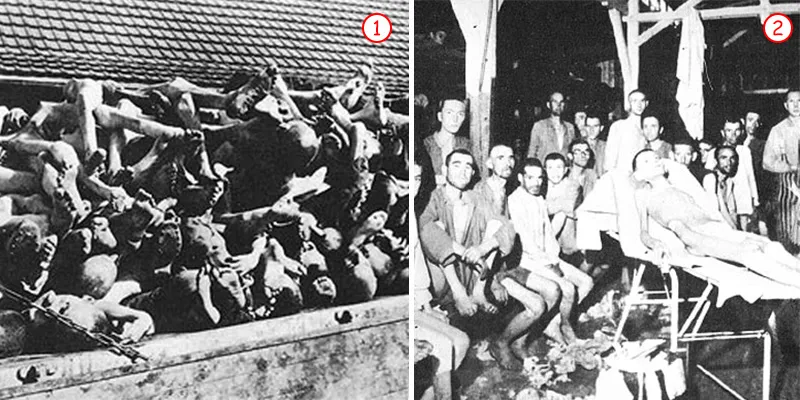
Similar camps had also been set up by Mussolini, and 18,000 of the 35,000 placed in these "extermination camps" were killed. There were a great many other deaths, murders, and unsolved killings throughout the fascist period in Italy. Mussolini admitted to the cruelty of fascism in one of his speeches: "Fascism is no longer liberation but tyranny, no longer the safeguard of the nation but the defense of private interests."47
It was also possible to see such examples of violence in Franco's Spain. Even at the very outset of the civil war, Franco's ruthless methods had attracted attention. For instance, in a small mountain village north of Madrid, 18 people were arrested for voting for the Popular Front. After questioning, 13 of these were taken out of the village by lorry and killed by the side of the road. When the fascists entered the small town of Loro del Rio with its population of 11,000 near Seville, they killed more than 300 people. Oppression took on a particularly violent form in the cities. To such an extent that the number of those killed is even today not known for certain.48 Franco had hundreds of thousands of his own people killed, even including the elderly, women and children. The words of a member of the anti-Franco resistance in June 1936 describe the situation:
Thousands of people have been tortured, women who refused to turn in their loved ones have been hung upside down, children have been shot, and the mothers who witnessed the torture of their children have gone mad…49
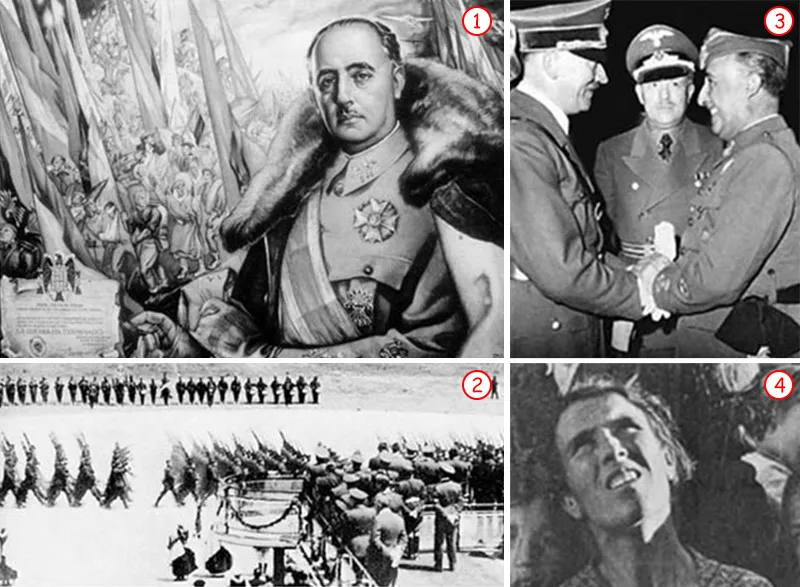
Franco dragged Spain into a terrible civil war. Brother fought against brother, and father against son. An average of 500 people died every day. Acts of violence, slaughter, mass torture, and killings went on without end. The Spanish Civil War left some 600,000 dead in its wake.
Hitler and Mussolini used Spain as a laboratory, a testing-ground for new troops and weapons.50 The most terrible example of this was a village that Franco presented to Hitler as a gift in return for his assistance. On the morning of May 5, 1937, the people of the village of Guernica were wiped out by the huge bomber planes manufactured by Nazi technology. Franco had left the little village as an experiment for Nazi planes.51