
Reading time: ~7 min read
The alleged scientific support that Social Darwinism provided for racism, fascism and imperialism, as well as communism, is a familiar subject that has been much written about. But one lesser known fact is that a great many Darwinists, including Charles Darwin himself, have believed in the error that women are biologically and mentally inferior to men. The mental difference that Darwinists claim to exist between the genders is of such a dimension that some evolutionists even divided them into different physical species: men being Homo frontalis and women Homo parietalis.137
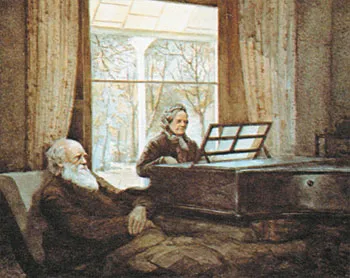
Darwin described women as an "inferior" species, according to his own lights, because his world view was based on natural selection. According to this unscientific and irrational view, men are proportionately more fit than women to compete in war, find a mate, and obtain food and clothing; while women have remained at a distance from such activities. According to this scientifically baseless deduction, natural selection exerts a stronger influence on men, so they achieved a superior position in all spheres, and evolved further than women. As the following pages will show, Darwin proposed these illusory deductions not on any scientific findings, but merely on the basis of evolutionist preconceptions.
Many researchers have revealed that Darwin's views on natural selection encouraged sexual discrimination. For instance, professor of history and philosophy of science Evelleen Richards concluded that Darwin's views of women's nature fed into his evolutionary theorizing, "thereby nourishing several generations of [so-called] scientific sexism."138 The evolutionist scientific writer Elaine Morgan states that using various branches of science such as biology and ethnology, Darwin encouraged men to think that women were "manifestly inferior and irreversibly subordinant."139
As the evolutionist scientist John R. Durant has stated, the two main consequences of the theory of evolution are racism and sexual discrimination:

Darwin rested his case upon a judicious blend of zoomorphic and anthropomorphic arguments. Savages, who were said to possess smaller brains and more prehensile limbs than the higher races, and whose lives were said to be dominated more by instinct and less by reason ... were placed in an intermediate position between nature and man; and Darwin extended this placement by analogy to include not only children and congenital idiots but also women, some of whose powers of intuition, of rapid perception, and perhaps of imitation were "characteristic of the lower races, and therefore of a past and lower state of civilization."140
The errors made by Darwin that Durant referred to appear in The Descent of Man:
It is generally admitted that with women the powers of intuition, of rapid perception, and perhaps of imitation, are more strikingly marked than in man; but some, at least, of these faculties are characteristic of the lower races, and therefore of a past and lower state of civilisation.141
When one considers Darwin's general views about women and marriage, one can clearly see how he regarded women as second-class citizens. This unscientific opinion was also reflected in his theory of evolution. This is how he described why marriage was useful:
… children—constant companion, (friend in old age) who will feel interested in one, object to be beloved and played with—better than a dog anyhow—Home, and someone to take care of house—Charms of music and female chit-chat. These things good for one's health.142

In short, Darwin regarded marriage desirable because "a woman's friendship is better than a dog's." His statements about marriage made no reference at all to features such as friendship, affection, love, devotion, loyalty, closeness, sincerity and trust between two people who spend their lives together. About marriage, Darwin also had this to say:
… loss of time—cannot read in the evenings—fatness and idleness—anxiety and responsibility—less money for books, etc.,—if many children, forced to gain one's bread ... perhaps my wife won't like London; then the sentence is banishment and degradation with indolent idle fool.143
These unconscionable statements are perfectly natural, coming as they do from one who saw no difference between human beings and animals, and thought that women and children in particular were actually closer to animals. Someone who regards his wife and children as an inferior species will of course feel little affection for them, make few sacrifices on their behalf, and take no interest in them for as long as it is to his advantage not to do so. In fact, Darwin's statements show once again that there is no room for human love, closeness and friendship in Darwinian morality.
Darwin claimed that men were superior to women:

The chief distinction in the intellectual powers of the two sexes is shown by man's attaining to a higher eminence, in whatever he takes up, than can women—whether requiring deep thought, reason, or imagination, or merely the use of the senses and hands. If two lists were made of the most eminent men and women in poetry, painting, sculpture, music, ... history, science, and philosophy ... the two lists would not bear comparison. We may also infer, from the law of the deviation from averages, so well illustrated by Mr. Galton, in his work on "Hereditary Genius" that if men are capable of a decided pre-eminence over women in many subjects, the average of mental power in man must be above that of women.144
Of course, Darwin had no scientific basis for proposing this, but his biased and prejudiced claims about women spread rapidly among his scientific contemporaries.
The materialist Carl Vogt, a professor of natural history at the University of Geneva, accepted all the conclusions drawn by Darwin, without subjecting them to any scientific analysis, and claimed that "the child, the female, and the senile white" all had the intellectual features and personality of the "grown up Negro."145 Vogt went even further, proposing that they were actually closer to animals than men. According to Vogt, a woman was "a stunted man" whose development had been obstructed because her evolution had come to a premature halt.146 Vogt even concluded that the gap between males and females increases with civilization's progress and is greatest in the advanced societies of Europe.147 Darwin was greatly influenced by Vogt's rantings, and felt honored to count him among his most important supporters.148
Many times in history, there have been mostly successful efforts to keep women in the background, due to the ignorance and backwardness of the societies in question. However, this is something that stems entirely from the influence of the established culture. There is absolutely no biological retardation, as Darwin and his supporters maintained, since God has created men and women equal. To claim that men are superior, and to use this allegation to treat women as second-class citizens, is a primitive behavior practiced by societies that do not live by religious moral values. In our day, when equal opportunities are ensured, there are countless examples of women known to be just as successful, intelligent and capable as men.
References
- EIaine Morgan, The Descent of Woman, New York: Stein and Day, 1972, p. 1. ↩
- John R. Durant, "The Ascent of Nature in Darwin's Descent of Man" in The Darwinian Heritage, Ed. by David Kohn, Princeton, NJ: Princeton University Press, 1985, p. 295. ↩
- Darwin, The Descent of Man and Selection in Relation to Sex, New York: D. Appleton and Company, 1871 (1896 ed.), p. 326. ↩
- Charles Darwin, The Autobiography of Charles Darwin 1809-1882, New York: W. W. Norton & Company, Inc., 1958, pp. 232-233. ↩
- Ibid. ↩
- Darwin, The Descent of Man and Selection in Relation to Sex, p. 564. ↩
- Carl Vogt, Lectures on Man: His Place in Creation, and the History of Earth, edited by James Hunt, London: Paternoster Row, Longman, Green, Longman, and Roberts, 1864, xv, p. 192. ↩
- Stephanie A. Shields, "Functionalism, Darwinism, and the Psychology of Women: A Study in Social Myth," American Psychologist, no. 1 (1975): p. 749. ↩
- Evelleen Richards, "Darwin and the Descent of Women," in David Oldroyd and Ian Langham (Eds.), The Wider Domain of Evolutionary Thought (Holland: D. Reidel, 1983), p. 75. ↩
- Ibid., pp. 74, 49. ↩