

Reading time: ~2 min read
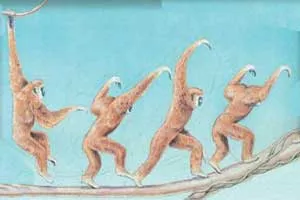
The article describes how apes' quadrupedal locomotion supposedly gradually changed into bipedal locomotion, and then considers the conditions that might have caused this so-called change. The best-known of the Australopithecus fossils that were put forward as the first species capable of upright walking were found in 1974 in a 40%-complete skeleton. This was the famous Australopithecus afarensis fossil, known as "Lucy." By looking at some of these bones, evolutionists claim that this species walked on two legs, for which reason it must have been the ancestor of man. The fact is, however, that much research into Australopithecus has revealed that it was a species of ape which did not walk in the same way as man at all:
1. Despite being a supporter of the theory of evolution, Lord Zuckerman arrived at the conclusion that Australopithecus was an ordinary species of ape, one that very definitely did not walk erect.1
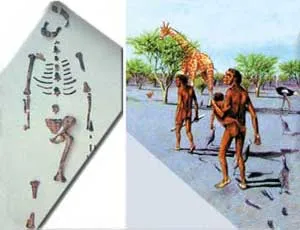
2. Another evolutionist anatomist, Charles E. Oxnard, well-known for his studies in this area, arrived at the conclusion that the Australopithecus skeleton resembles those of present-day orangutans.2
3. In 1994, Fred Spoor of Liverpool University and his team carried out a wide-ranging study to arrive at a definitive conclusion regarding the Australopithecus skeleton. The study was based upon an organ known as the "cochlea," which determines the position of the skeleton relative to the ground. Spoor's conclusion was that Australopithecus' mode of walking did not resemble that of man.3
4. In 2000, a study by the scientists B.G. Richmond and D.S. Strait published in the journal Nature, looked at Australopithecus' forearms. Comparative anatomical analyses showed that the species had just the same forearm anatomy as modern apes that walk on all four legs.4
These researches reveal that Australopithecus, which evolutionists put forward as an intermediate species, is actually an extinct species of ape.
References
- Solly Zuckerman, Beyond The Ivory Tower, New York: Toplinger Publications, 1970, p. 75-94 ↩
- Charles E. Oxnard, "The Place of Australopithecines in Human Evolution: Grounds for Doubt," Nature, vol. 258, p. 389 ↩
- Fred Spoor, Bernard Wood, Frans Zonneveld, "Implication of Early Hominid Labryntine Morphology for Evolution of Human Bipedal Locomotion," Nature, vol. 369, June 23, 1994, pp. 645-648. ↩
- Richmond, B.G. and Strait, D.S., "Evidence that humans evolved from a knuckle-walking ancestor," Nature 404(6776): 382, 2000. ↩