Reading time: ~2 min read
Birds possess a special anatomy that allows them to fly. The bones play an important role from the point of view of flight. They need to be both strong and light. Bird bones are hollow, but strong enough to hold the skeleton together. Yet, in reptiles the bones are heavy, and not hollow.
Dr. Feduccia has said the following about the anatomical differences between birds and dinosaurs:
Well, I've studied bird skulls for 25 years and I don't see any similarities whatsoever. I just don't see it... The theropod origins of birds, in my opinion, will be the greatest embarrassment of paleontology of the 20th century.5
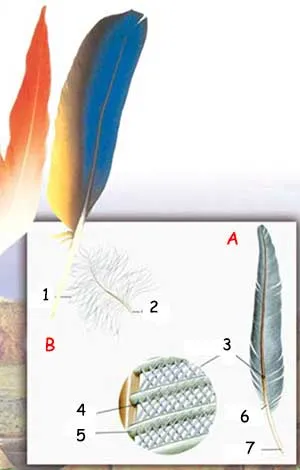
As well as their bones, birds' wings also possess a special design not found in any other living thing. As well as their light bones, their feathers also play an important role in the aerodynamic properties of the wing. Dr. Andy McIntosh, a professor in Combustion Theory at Leeds University, UK and an aerodynamicist, described the superior design in feathers during an interview:
Bird flight in particular is remarkable; consider feathers. If you look at a feather under a microscope, you see the main stem, with barbs coming out to the left and right, and from these you have left-and right-handed barbules. Now the interesting bit is that the left-handed ones have hooks, and the right-handed ones have ridges... The feather is made such that if you bend it, everything bends with it, and yet it's a very light structure. So the hooks catch the ridges and they slide over the ridges—it's a mechanical engineer's dream to have such useful, lightweight engineering. But if you have a sliding joint, you need lubrication. To do this the bird twists its neck around 180o and dips its beak into a tiny oil gland right down at the back of its spine. It then preens itself, wiping this oil all over its feathers, so that they join together nicely, and these sliding joints are oiled. That's a marvellous bit of engineering.6
Dr. McIntosh finds the idea unscientific that feathers with such a superior design have evolved and not been created by an intelligent design:
I have seen a photo in a book, of an aircraft landing at Hong Kong and underneath it is a falcon landing at the same time. Now as you look at birds and planes together, are you going to say that one is designed and the other isn't? I would find that scientifically preposterous.7