Reading time: ~3 min read
The first in the series of documentaries called The Shape of Life, jointly produced by the PBS and the National Geographic Society, was about the origin of animals (metazoans). The scientific deceptions contained in that documentary, which attempted to describe how the first multicellular organisms came into being, are set out below.
At the beginning of the documentary there is an account of how one day, in some way, sponge cells living independently of one another took a decision among themselves to live together. In fact, in line with the familiar evolutionist scenario, the program even said that " Somehow, cells developed a language that allowed them to work together." Yet, the fact is that this imaginary account—the product of the evolutionists' own fantasy world—is a complete violation of the facts.
The origin of the organization in living things is one of the fundamental questions for which the theory of evolution can never offer a logical explanation. There is absolutely no reason for cells that can function independently of one another to begin to act together. Yet, the different cells in all multicellular organisms do work together towards a common purpose in an extremely organized manner. The sponge is one example of this flawless organization among cells.
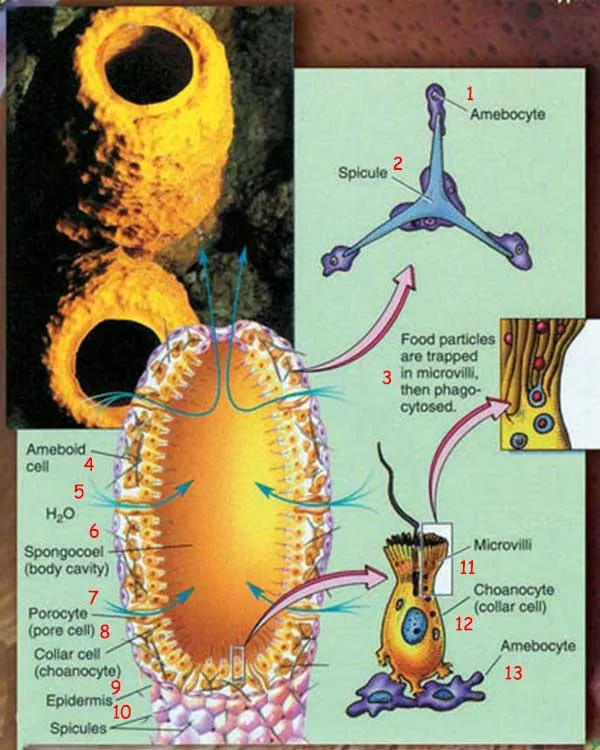
Despite its very simple appearance, the sponge, an animal from the phylum Porifera, actually consists of exceedingly complex cells. These cells, organized in two layers, set up a continuous flow of water inside the sponge. On the one hand, the plankton in the water are filtered and digested; on the other, waste material is deposited into the flow and carried away. In this way, the sponge functions like a funnel in a specially established current.
The cells cannot have adopted the principle of working together by themselves. That is because they come into being already in possession of the special connecting nodules that bind them together. When sponge cells approach one another, these connecting nodules grip one another and an organized, multicellular appearance emerges. In short, sponge cells were designed to work together. When they are all together, they immediately acquire a nature of their own and assume the duties regarding the particular layer they are in. With the enzymes they produce and their chemical digestion methods, sponge cells are actually very complex.
This organization does not come about with their knowledge. Cells have no brain, nervous system, or consciousness. That is why there can be no question of "cells' inventing a language of communication amongst themselves." The statement in the film that "the cells somehow invented a language by which they could work together" is as nonsensical and unrealistic as saying, "the paints somehow found a language between themselves and produced the Mona Lisa." Like all other paintings in the world, the Mona Lisa was created by a conscious artist. Life was created in the same conscious manner.
The sponge cells take their shape, characteristics, and function from the design described in the DNA sequence placed within them. It is impossible for them to invent anything new or to write any information in that DNA to allow them to acquire a new function. Thus, not even the existence of the sponge, described as "the simplest animal organization" by evolutionists, can be accounted for by a process of evolution. Like all living things, sponges are evidence of the fact of creation.