

Reading time: ~2 min read
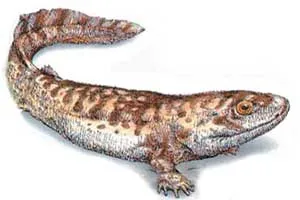
Acanthostega is a sea creature with gills. Its age is estimated at some 360 million years. Jenny Clack, a paleontologist from Cambridge University, maintains that this fossil possesses a hand, and that on this hand there are eight fingers, for which reason it is an intermediate form between fish and tetrapods (four-footed land vertebrates). Taking this fossil as their starting point, evolutionists claim that instead of fish developing feet after moving onto the land, they first developed feet and then made that transition. Yet this claim is inconsistent. First of all, despite being an evolutionist, Clack clearly states that she does not know whether Acanthostega made the transition to the land or not. It is an error to regard a marine-dwelling creature with certain bone-like structures in its fins as a form that brought about the transition from sea to land. The fact that evolutionists are making this error shows how quickly they have forgotten their mistakes over the Coelacanth, which was discovered to be living up until 65 years ago.
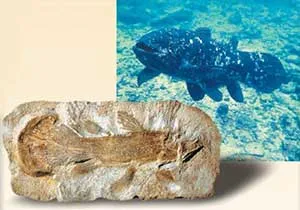
Up until the end of 1930s, evolutionists portrayed the Coelacanth as an intermediate form. It was thought that the bones in the fins of this 200-million-year-old fossil turned into feet, which carried the creature when it moved onto the land. In 1938, however, they learnt to their great surprise that Coelacanth was still living. On close examination, it was revealed that these fish caught by fishermen off the coast of Madagascar had undergone no changes at all in the last 200 million years. Furthermore, the organ which evolutionists had believed to be a primitive lung turned out to be nothing but a fat-filled swimbladder. Moreover, a great many more Coelacanths were caught shortly afterwards, and evolutionists had to abandon forever the claim that the creature represented an intermediate form.
As can be seen from the Coelacanth example, as well as that of Acanthostega, marine creatures with bone-like structures are portrayed as intermediate forms, not because they might have been able to live on land, but because of evolutionists' prejudices.