

Reading time: ~4 min read
Fossils from Georgia Deal a Mortal Blow To The Human Evolution Scenario
July 4 – Skull fossils unearthed during an archaeological excavation in Dmanisi in the Republic of Georgia in 1999 caused a widespread reaction in the scientific world. The age and features of these fossilized bones were of a kind to challenge the evolutionist chronologies. Based on these fossils, a number of eminent paleontologists stressed the invalidity of certain classical evolutionary scenarios at the Seckenberg Conference in Germany.1 The latest skull fossils found at Dmanisi deepen still further the damage done to evolutionary scenarios by the first discoveries. The fossils caused great excitement in the media, and were reported by MSNBC under the headline "Fossil Discovery Upsets Theory on Human Origins."2 Paleontologists seeking the imaginary "missing link" were no longer able to defend their old claims in the face of the picture now emerging with the increasing number of fossils that failed to fit in with the evolutionist chronology. No concrete proof to show that there had been evolution from ape to man had been found anywhere in the fossil record.
The Fossil That Made Them Confess: Sahelanthropus tchadensis
July 7 – The fairy story of evolution that has been recounted for the last 150 years was dealt another blow by a fossil skull found in Chad and named as Sahelanthropus. Daniel Lieberman, an anthropologist from Harvard University, described the seven-million-year-old fossil as the discovery of the century and said, "This [discovery] will have the impact of a small nuclear bomb."3 The fossil definitively overturned the evolutionist myth of a gradation beginning with apes and ending in modern man. It was understood that the idea of the "ape-man" acquiring a gradually more modern appearance, as maintained in newspapers and magazines, was untrue. Moreover, it was also realized that the so-called missing link (between man and ape), widely used as a propaganda tool and which evolutionists claimed would inevitably be discovered one day, was actually missing because it did not exist. The paleontologist Henry Gee, the editor of the famous journal Nature which announced the fossil discovery to the world, described it as "the most important discovery in the search for human origins in living memory" and wrote the following in an article in the Guardian newspaper:
Whatever the outcome, the skull shows, once and for all, that the old idea of a "missing link" is bunk... It should now be quite plain that the very idea of the missing link, always shaky, is now completely untenable.4
Forced Speculation in Time Magazine
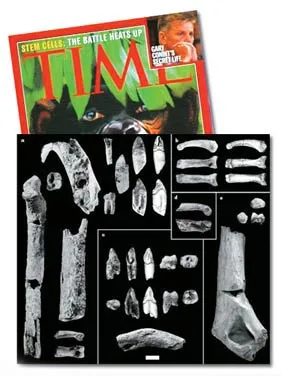

August 27 – Detailed analyses by Joseph Mastropaolo, a world-famous scientist and member of the American Physiological Society, invalidated Time's evolutionist propaganda. Time magazine had announced to the world that the fossils of the species Ardipithecus ramidus kadabba discovered by the University of California at Berkeley anthropologist Yohannes Haile-Selassie in Ethiopia represented the "missing link." In its cover story dated July 23, 2001, and entitled "Meet your newfound ancestor, a chimplike forest creature," Time discussed the fossil in question in terms of a bipedal evolutionary ancestor. Evolutionists who studied the fossil had claimed the creature was 5.5-5.8 million years old and capable of bipedal walking. However, the bone they based all these claims on was just a single toe. Some 95% of the skeleton was missing, yet evolutionists still made the totally unrealistic claim that this toe supposedly showed that this creature was capable of walking on two legs, which showed in turn that man and apes evolved from a common ancestor. The evolutionist magazine Time felt no need to question whether its claims rested on any scientific foundation, and portrayed to the world these evolutionary tales, embellished with pictures of ape-men, as scientific fact.
Mastropaolo, regarded as one of the most respected authorities in the world of paleontology, wanted to be sure of the facts by examining the toe himself. He compared the Kaddaba toe bone to those of man, chimpanzees, and baboons. Comparing the anatomic criteria from a mathematical perspective, Mastropaolo arrived at very different results. The toe did not resemble those of chimpanzees or baboons at all. The resemblance between it and the human toe was also insufficient.
Mastropaolo's findings were unveiled at the San Diego Conference held by the American Physiological Society on August 27, 2002. It was made clear in the concluding part of the paper that the idea of an evolutionary ancestor walking upright was a work of pure imagination:
Accordingly, the objective ancestry analyses for fossil bones assert that the conclusions of Haile-Selassie and Robinson were farfetched speculations.5
References
- Pat Shipman, "Doubting Dmanisi," The American Scientist, November-December 2000, p.491 ↩
- MSNBC.com: "Fossil Discovery Upsets Theories on Human Origins," 4 July 2002 ↩
- D. L. Parsell, "Skull Fossil FromChad Forces Rethinking of Human Origins," National Geographic News, July 10, 2002 ↩
- Henry Gee, "Face of Yesterday," The Guardian, 11 July 2002 ↩
- Eurekalert.com: "Oldest Human Ancestor is (Again) Called into Question," August 27, 2002 ↩