

Reading time: ~3 min read
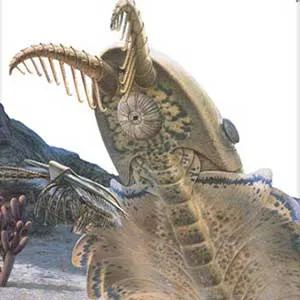
The beginning of the film deals with living things which lived around 500 million years ago. This period, known as the Cambrian Age, was when organisms possessed of complex physical structures suddenly emerged. These are the "phyla," the most fundamental category of living creatures. In a most interesting way, nearly all the phyla that have existed on the earth emerged during the Cambrian period. Only a few phyla have been identified from before this period, whereas it has been estimated from the fossil record that the number of phyla appearing in the Cambrian was close to 100. The enormous jump in the variety of life at this time was so great that it is known in the scientific literature as the "Cambrian Explosion."
Richard Monastersky, a staff writer at ScienceNews magazine , a popular evolutionist publication, provides the following information on the Cambrian Explosion:
A half-billion years ago, . . . the remarkably complex forms of animals that we see today suddenly appeared. This moment, right at the start of the Earth's Cambrian Period, some 550 million years ago, marks the evolutionary explosion that filled the seas with the world's first complex creatures.1
The same article also quotes Jan Bergström, a paleontologist who studies the early Cambrian deposits in Chengjiang, China, as saying, "The Chengyiang fauna demonstrates that the large animal phyla of today were present already in the early Cambrian and that they were as distinct from each other as they are today.2
No organism has ever been found that the evolutionists might possibly put forward as an "ancestor" of the living things that emerged in the Cambrian Explosion. The creatures of the Cambrian period emerged suddenly, and with flawless structures. This naturally demonstrates that creation was at the root of the Cambrian Explosion. The British zoologist Richard Dawkins, one of the most prominent defenders of Darwinism in the world, makes the following admission regarding the living things of the Cambrian:
For example the Cambrian strata of rocks . . . are the oldest ones in which we find most of the major invertebrate groups. And we find many of them already in an advanced state of evolution, the very first time they appear. It is as though they were just planted there, without any evolutionary history.3
Another aspect of the Cambrian period that totally undermines evolution is the fact that the number of phyla existing today is far fewer than the number that emerged during the "explosion." According to the theory of evolution, there should have been an increase over time in the number of categories of living things. Yet from the fossil record the situation is the exact opposite.
One of the world's most prominent critics of Darwinism is University of California Berkeley professor Phillip E. Johnson, who openly states the contradiction with Darwinism revealed by this situation in the following words:
Darwinian theory predicts a "cone of increasing diversity," as the first living organism, or first animal species, gradually and continually diversified to create the higher levels of taxonomic order. The animal fossil record more resembles such a cone turned upside down, with the phyla present at the start and thereafter decreasing.4
Not one word about this is mentioned in the documentary. There can be only one reason why a film that deals with how living things emerged on earth and then spread should ignore this huge explosion in the number of phyla and variety of living things. This explosion in the Cambrian Period definitively reveals that life came about not by chance but all of a sudden and in perfect form—in other words that it was created. The makers of the documentary deliberately avoided touching on the subject.
References
- Richard Monastersky, "Mysteries of the Orient," Discover, April 1993, p. 40. ↩
- Richard Monastersky, "Mysteries of the Orient," Discover, April 1993, p. 40. ↩
- Richard Dawkins, The Blind Watchmaker, London: W.W. Norton, 1986, p. 229. ↩
- Phillip E. Johnson, "Darwin's Rules of Reasoning," Darwinism: Science or Philosophy? by Buell Hearn, Foundation For Thought and Ethics, 1994, p. 12. ↩