

Reading time: ~3 min read
A number of anatomical and cultural features of Neanderthal man are distorted on The Discovery Channel. This distortion can even be seen in the interpretation of the very word Neanderthal. Neanderthal man is spoken of in the documentary as "primitive Stone-Age man." Yet the fact is that Neanderthal means nothing of the sort. The name of this human race comes from the Neander valley near the German city of Dusseldorf (The first discoveries of this man were made by miners working in a cave in the valley in 1856.)
In the documentary, Neanderthal man is described as having a strong body, with a sloping, narrow forehead, following which there is speculation about his artistic levels. We are told that he left behind him no cave drawings in the habitat he lived in, and it is suggested that he thus left "no clues as to his symbolic life." The programme then says that modern man, on the other hand, attaches great importance to art and takes great care over it.
What emerges from this anatomical and artistic comparison of modern and Neanderthal man is not an evolutionary superiority. The fact that Neanderthals had powerful bodies or narrow foreheads is insufficient to demonstrate that they were a primitive species. For instance, we do not conclude that the large inhabitants of Northern Europe are cruder and more primitive than the smaller Chinese or pygmies. That is because bone and skeletal structure is not a criterion for judging behavior and intelligence.
On the other hand, if anatomical features are to be regarded as such criteria, then according to evolutionist logic, Neanderthals must be regarded as more intelligent than modern man, since evolutionists base human intelligence upon brain size. The brain volume of Neanderthal man is some 13% greater than that of his modern counterpart.
The fact that no Neanderthal drawings have come down to the present day is also no indication of primitiveness. There are modern societies which take little interest in art or painting. Looking at their lack of representational art, all one can say about the Neanderthals is that they were "backward in art." Portraying them as a primitive intermediate species solely because they did not make pictures is nothing more than prejudice.
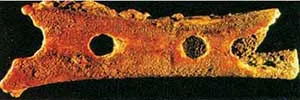
The fact that they did not make pictures is insufficient to show that they had little interest in art. A flute unearthed from a Neanderthal cave in Slovenia demonstrates that these people did have a musical culture. This flute is the oldest known musical instrument. Made from bear bone, it is able to produce notes thanks to four holes specially made in it. There is no doubt that it is only possible to make a flute and produce tunes by means of abstract conception. There is no reason not to assume that these people who interpreted music and produced tunes also entertained themselves by dancing.
Moreover, it has also been demonstrated that the Neanderthals nursed their sick and injured, and buried their dead with flowers. This indicates that they were social beings, possessed of the concepts of love and affection. To maintain that Neanderthals were primitive and on a lower evolutionary level than modern man is nothing than The Discovery Channel's own prejudice.